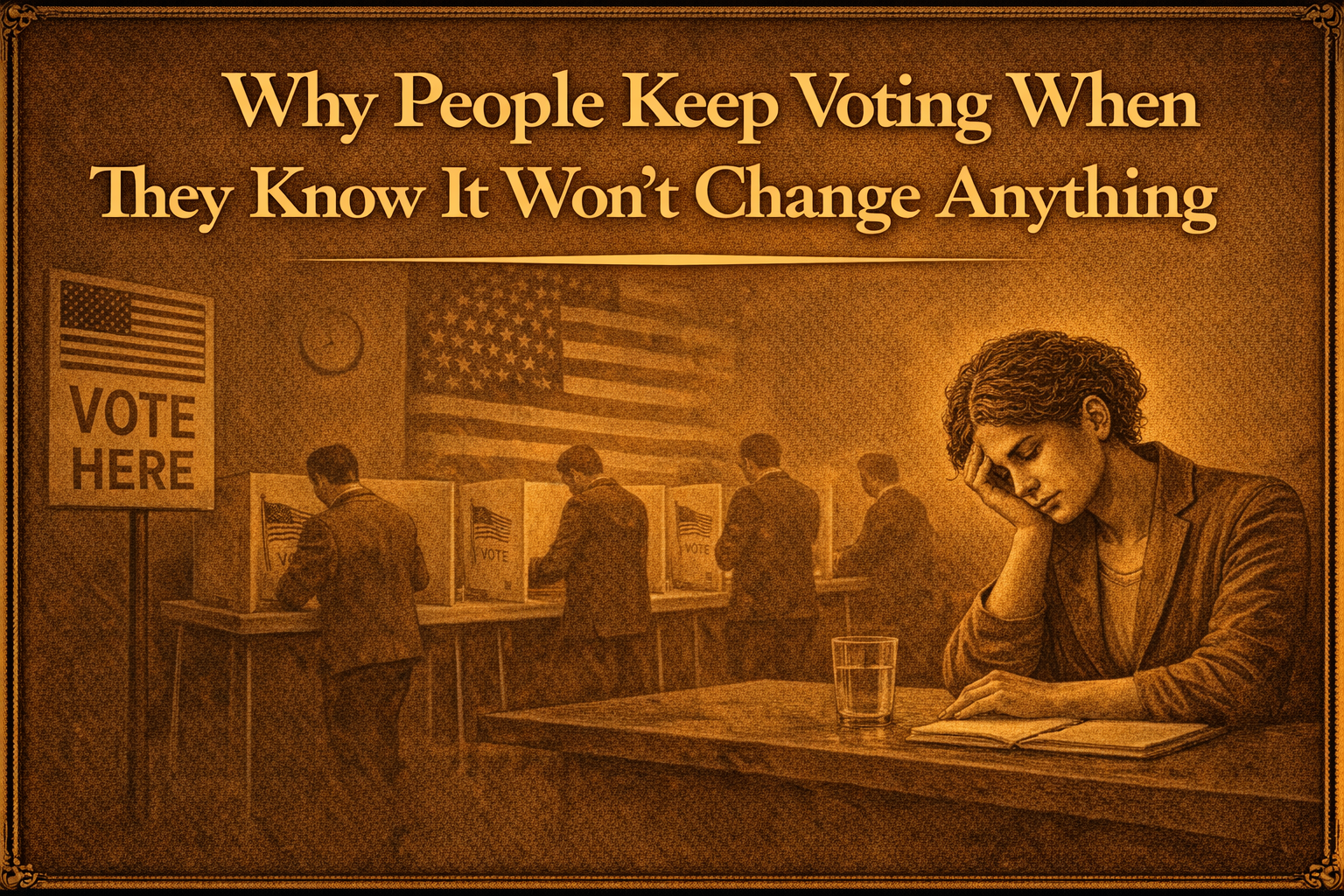
Why People Keep Voting When They Know It Won’t Change Anything
Why People Keep Voting When They Know It Won’t Change Anything
It is easy to assume people vote because they believe their candidate will win.
But that explanation collapses the moment you look closely at how people actually behave.
Millions of voters already know, somewhere beneath the optimism, roughly how the result will end.
Same party.
Same candidate.
Same margin.
And still:
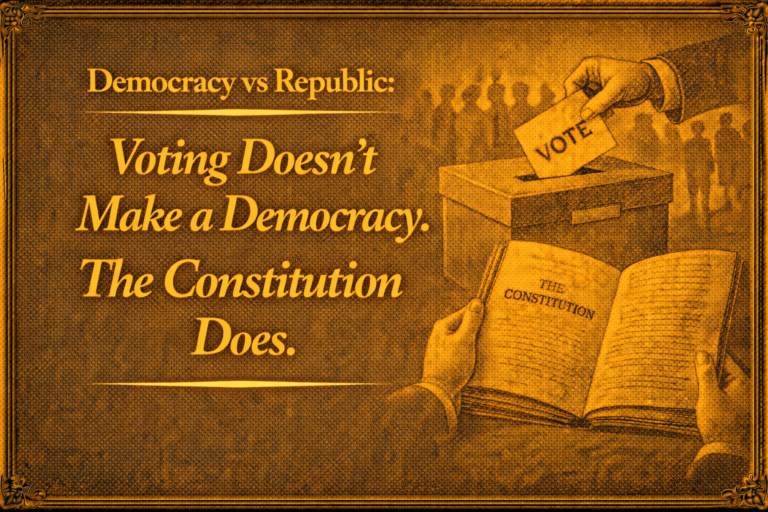
- They wake early
- Stand in line
- Press the button
- Walk home with ink on their finger
Then the results arrive exactly as expected.
And they vote again in the next election.
Not because they misunderstood the odds.
Not because they were fooled.
Something else is happening underneath the act itself.
The Assumption Most People Make
Most commentary treats voting like a transaction:
“If people believe their vote matters, they participate.”
“If they think nothing will change, participation should collapse.”
But the data does not fully support this.
Research on voter participation repeatedly shows that turnout in “safe seat” constituencies remains surprisingly high even when outcomes are highly predictable.
In India, Lokniti-CSDS election data found that constituencies dominated repeatedly by the same party showed only modest turnout declines compared to competitive seats.
That gap matters.
Because it means:
Outcome expectation is not the main thing driving participation.
The Road Near The Nala
A man votes in a constituency where the same candidate has won every election for over a decade.
He already knows the likely result.
But outside his house, near the drainage channel, a section of road collapses every monsoon.
Water collects there.
People step around it carefully.
Scooters skid there every rainy season.
He walks past it daily.
That morning, while standing in line at the polling booth, he is not thinking about coalition arithmetic or television debates.
He is thinking about that patch of road.
That specific thing.
That visible thing.
That local thing.
This is important because it changes the scale of the vote completely.
National outcomes may feel unreachable.
The broken patch near the nala does not.
What Actually Keeps People Voting
Three different mechanisms operate simultaneously inside many voters.
None of them require strong expectation of victory.
1. Expressive Participation
Sometimes voting is not mainly about changing the outcome.
It is about expressing identity.
The vote says:
“This is where I stand.”
Even if the candidate loses.
Even if the margin is enormous.
Political theorists call this expressive voting.
The act becomes symbolic before it becomes strategic.
The person is not calculating:
“Will my single vote change the election?”
They are registering alignment:
“This is my position.”
That is a different kind of rationality entirely.
2. Institutional Legitimacy
Most people never describe it this way.
But many still behave as if they feel responsible for participating in the system itself.
Not voting can feel less like neutrality and more like withdrawal.
The act of voting becomes:
- A contribution to legitimacy
- A ritual of citizenship
- A participation in collective process
This explains why many disillusioned voters still show up.
They may distrust politicians while still believing the electoral system matters.
Those are not contradictory feelings.
3. Residual Local Agency
This is the most overlooked mechanism.
People often vote at the level where they still believe outcomes remain physically tangible.
Not ideology.
Not national transformation.
Specific things:
- The road
- The drainage
- The water connection
- The school teacher who never comes
- The clinic without medicine
At that scale, voting still feels connected to reality.
The voter is not confused about national power.
He is precise about local leverage.
Why This Is Not Blind Hope
The easiest mistake is assuming repeated participation means optimism.
Not necessarily.
Many voters are deeply realistic.
They understand:
- The candidate may not change
- The party may remain dominant
- The system may stay frustrating
And still they vote because the act itself performs functions beyond prediction.
The vote and the result are separate events with separate meanings.
The Threshold Nobody Maps Clearly
This framework also has limits.
Participation does eventually collapse under certain conditions:
- Extreme distrust
- Suppression
- Perceived illegitimacy
- Total absence of representation
But the threshold differs across societies and individuals.
Some people stop voting after repeated disappointment.
Others continue for decades despite expecting little.
That variation is not fully understood yet.
The Ticker At Midnight
The television ticker confirms the result.
Same winner.
Same margin.
Same speeches.
The man watches quietly from a plastic chair.
The road near the nala is still broken.
He already knew it probably would be.
And still:
He stood in line that morning.
Because voting was never only about prediction.
It was also:
- Expression
- Participation
- Residual local agency
Most commentary treats the vote and the outcome as the same thing.
That is the misunderstanding.
For many people, the vote is not proof they believe the system will fully change.
It is proof they still believe they exist inside it.