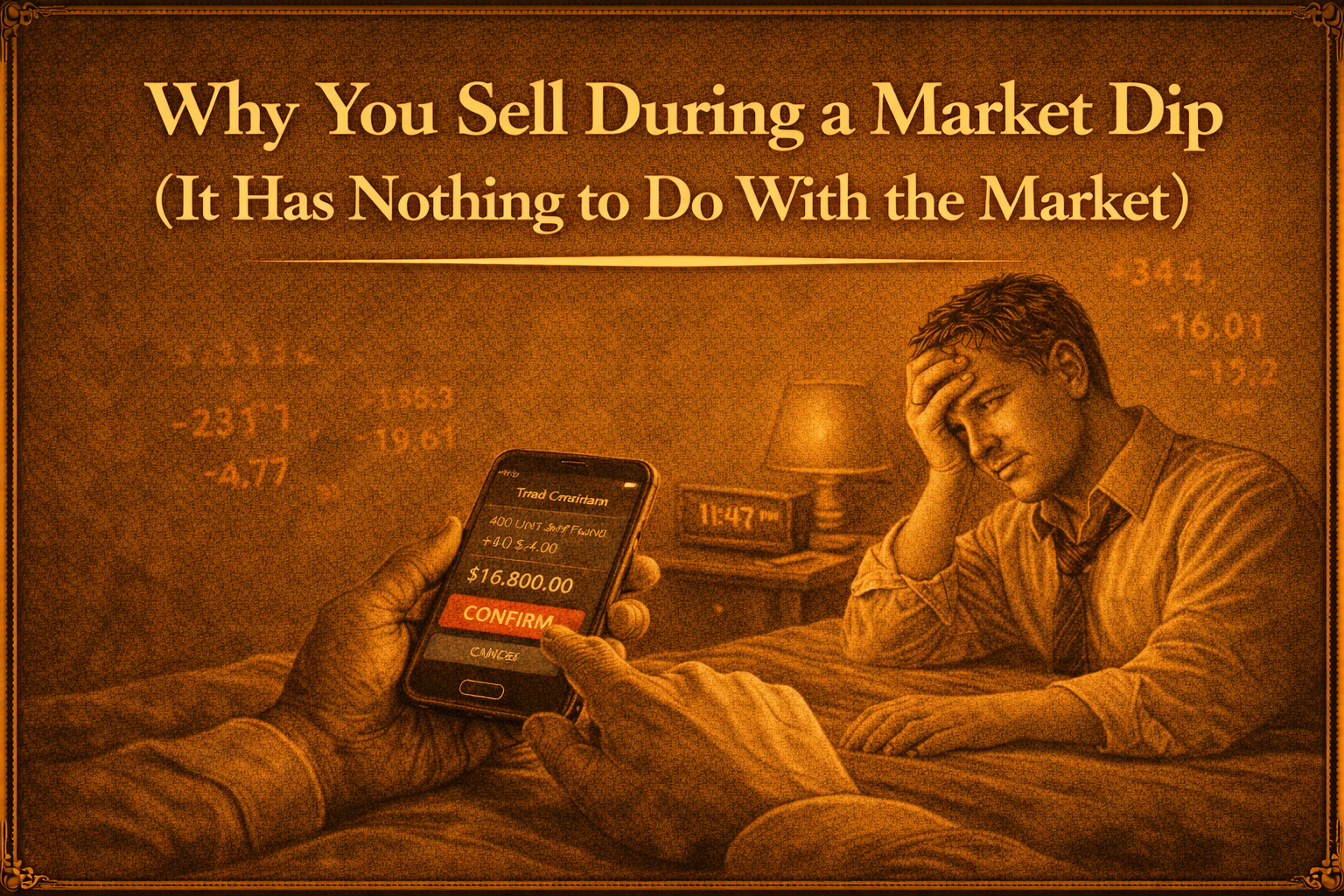
Why You Sell During a Market Dip (It Has Nothing to Do With the Market)
Why You Sell During a Market Dip (It Has Nothing to Do With the Market)
The real trigger is usually not the chart.
It is the hour.
The body.
And three weeks of accumulated pressure finally finding somewhere to go.
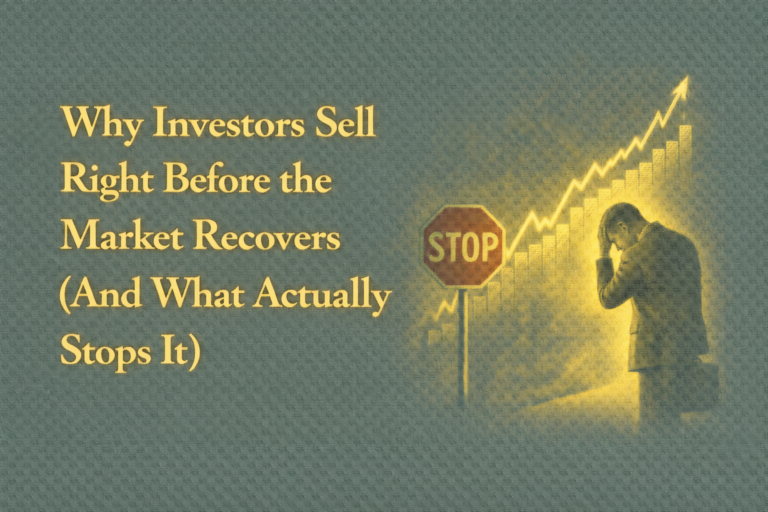
Most retail investors do not panic-sell because a number moved.
They panic-sell because stress crossed a threshold at the exact moment a red screen offered relief.
The Explanation Most People Hear
Every behavioural finance article gives roughly the same answer:
Humans hate losses more than they enjoy gains.
This is called loss aversion.
When portfolios fall:
- stress rises
- fear increases
- the brain narrows toward protection
That explanation is correct.
But it misses something important.
Loss aversion exists at noon and at midnight.
Yet panic-selling decisions cluster under very specific conditions:
- late-night checking
- fatigue
- silence
- isolation
- accumulated stress
The market did not suddenly become more dangerous at 11:47 PM.
The investor became more vulnerable.
What Actually Happens Before The Sell
Nishant had been holding a mutual fund for almost a year.
Not enough money to destroy his life.
Enough money to matter emotionally.
The decline had lasted three weeks.
Not a crash.
Not a disaster.
Just a slow, repetitive erosion that kept returning every morning through notifications, headlines, charts, and small red numbers.
Earlier dips had felt temporary.
This one felt personal.
By 11:47 PM he was checking the app again.
The room was quiet.
The fan was running.
His wife was asleep.
Nothing dramatic was happening externally.
Internally, something had been building for days.
That is the actual setup behind most retail panic-selling.
Not sudden catastrophe.
Accumulated low-level stress finally crossing the body’s tolerance threshold.
Why The Hour Changes Everything
Three things happen late at night that change financial decision-making completely.
1. Fatigue Compresses The Future
A tired brain becomes present-focused.
Immediate discomfort feels heavier than long-term probability.
So two thoughts arrive differently:
- “What if it falls further?” arrives vividly
- “What if it recovers later?” arrives abstractly
The future loses emotional weight under stress.
Relief becomes more persuasive than strategy.
2. Decision Fatigue Removes Friction
Good investing decisions usually contain pauses:
- sleeping on it
- re-reading the thesis
- calling someone
- checking fundamentals
Late at night, those friction points weaken.
The easiest action becomes the dominant action.
And the easiest action on a red screen is usually:
“Exit.”
3. Isolation Removes Perspective
Panic intensifies in solitude.
A second person slows the emotional acceleration.
Not because they necessarily know more.
Because human presence interrupts spiralling thought.
Alone in a dark room, the mind loops internally without resistance.
The market becomes emotionally larger than it objectively is.
The Forty Seconds Before Confirmation
The actual sell decision often happens in less than a minute.
During those seconds, two systems compete:
One says:
“If I sell now, this feeling stops.”
The other says:
“What if recovery comes later?”
The first thought is immediate.
The second requires patience.
Under stress, the nervous system prioritises immediate threat reduction.
That is not stupidity.
It is biology functioning correctly in the wrong environment.
Why Investors Often Sell Near The Bottom
People assume investors sell because the information became catastrophic.
Usually, something else happened:
The investor simply reached exhaustion.
During the 2020 COVID crash:
- many retail investors exited near peak fear
- markets recovered rapidly afterwards
- sellers locked losses permanently
- holders recovered
The pattern repeats every cycle:
- initial patience
- gradual stress accumulation
- late emotional exit
The market did not necessarily worsen enough to justify panic.
The investor became tired enough to need relief.
The Important Question Most People Miss
Not every sell during a dip is wrong.
Sometimes fundamentals genuinely deteriorate:
- business quality changes
- debt explodes
- the original thesis breaks
Those are rational exits.
The important diagnostic question is:
Did the investment change, or did your emotional state change?
If the answer is the second one:
The hour may be driving the decision more than the market itself.
What Actually Helps
Most advice says:
“Be disciplined.”
But discipline weakens under fatigue.
Systems work better than willpower.
1. Set A Hard Checking Cutoff
Stop checking after a fixed hour.
Not because prices change.
Because your ability to process them changes.
2. Define Exit Rules Before Investing
Write down:
- time horizon
- loss threshold
- fundamental conditions for exit
If those conditions are not met:
The sell decision is postponed automatically.
3. Never Make Major Sell Decisions Alone At Night
Call someone.
A friend.
A partner.
An advisor.
Not for prediction.
For interruption.
Presence slows panic.
The Real Variable
The market creates the occasion.
The hour creates the vulnerability.
Most retail investors who panic-sell did not lack intelligence.
Many had perfectly reasonable long-term strategies.
The strategy did not fail first.
The conditions around the decision did.
That is why the most useful investing rule is not financial.
It is physiological:
The version of you at midnight should not decide for the version of you three years from now.