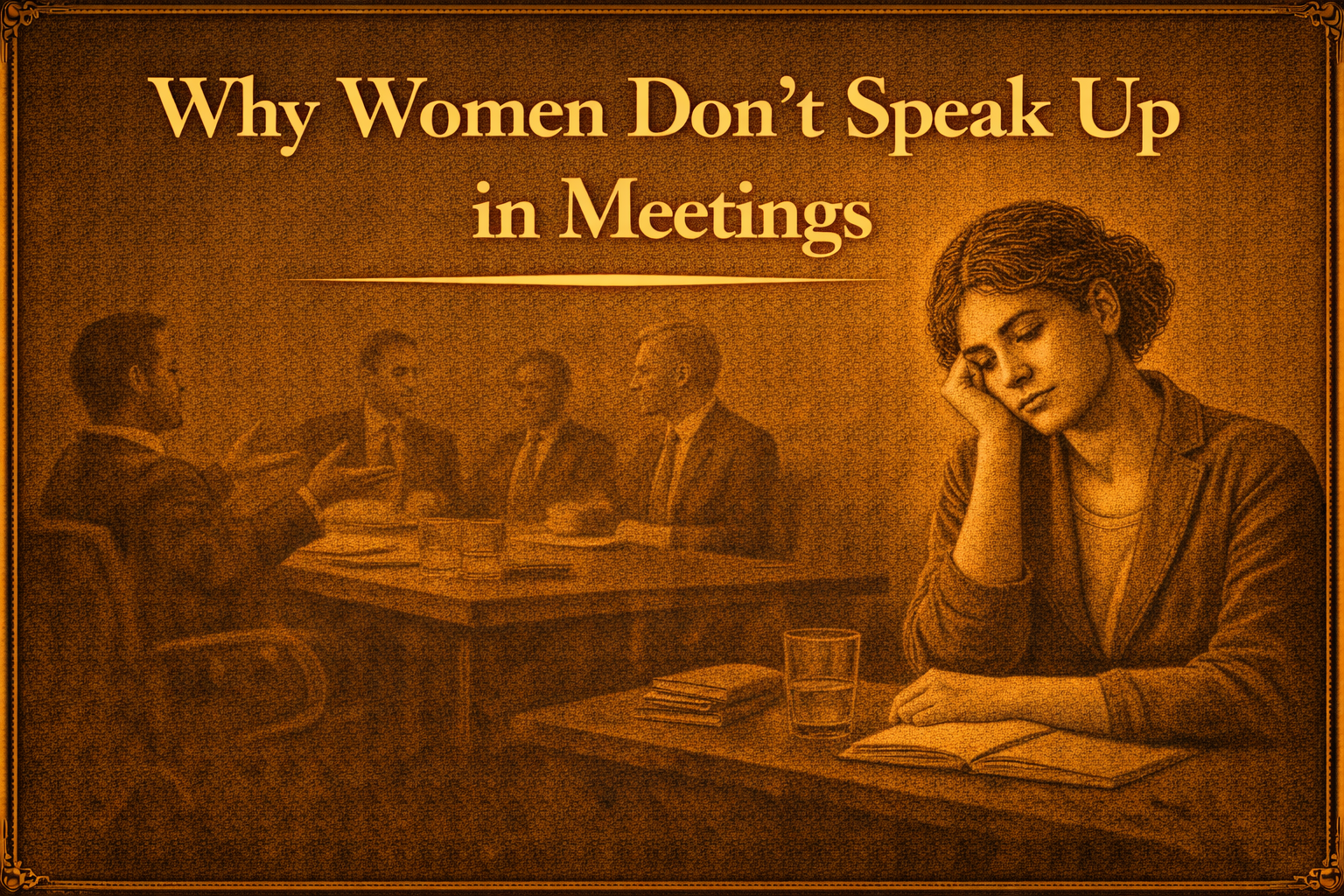
Why Women Don’t Speak Up in Meetings (And Why It Has Nothing to Do With Confidence)
Why Women Don’t Speak Up in Meetings (And Why It Has Nothing To Do With Confidence)
The silence is not hesitation.
It is a calculation.
A fast one.
A private one.
A repeated one.
And most of the time, it finishes before anyone notices it happened.
The Misread Almost Everyone Makes
Women leave meetings having contributed less than they actually knew.
This happens:
- Across industries
- Across seniority levels
- Inside male-dominated teams
- Inside teams where women are the majority
And the explanation people reach for immediately is confidence.
“She needs to be more confident.”
“She should speak up more.”
“She has good ideas but doesn’t project herself.”
But the mechanism underneath the silence is usually not self-doubt.
It is assessment.
A rapid evaluation of:
- How the room handles interruption
- Who gets ignored
- Who gets punished for assertiveness
- Whether this point is worth spending social capital on right now
That is not a confidence problem.
That is environmental pattern recognition.
What The Silence Actually Is
The calculation often takes only a few seconds.
Sometimes less.
Before speaking, the brain processes:
- Who already controls the conversation
- Whether disagreement is welcomed or merely tolerated
- Whether interruption will be penalised
- Whether the room pauses for women the same way it pauses for men
Then comes the harder variable:
Does this room currently see me as someone allowed to take space?
That variable matters more than expertise.
A woman can:
- Be senior
- Be technically correct
- Know more than everyone else in the room
and still carry a higher conversational penalty for speaking directly.
If the answer feels uncertain, the calculation tips toward silence.
Not dramatically.
Not consciously.
The point simply stays internal.
The meeting moves forward.
As if nothing happened.
Why Confidence Is The Wrong Explanation
The confidence explanation breaks at one important point:
Many women who stay quiet already know their point is strong.
The hesitation is not:
“I don’t know if this is right.”
It is:
“I don’t know if this room will process this fairly.”
That distinction changes everything.
Because now the silence is not insecurity.
It is cost management.
The Patterns That Train The Calculation
1. Interruption Patterns
Women are interrupted more frequently in professional discussions.
Not occasionally.
Repeatedly.
And interruption changes future participation.
The brain learns:
“Speaking here requires fighting for conversational space.”
Not everyone wants to spend energy doing that ten times a day.
2. Credit Diffusion
A woman introduces an idea.
Minutes later, someone else repeats it more forcefully and becomes associated with it.
This happens often enough that many women anticipate it before speaking.
Eventually the calculation becomes:
“Will I actually retain ownership of this contribution?”
If the answer feels uncertain, participation decreases.
3. The Likability Penalty
Assertiveness is not evaluated symmetrically.
The same behaviour produces different emotional readings depending on who performs it.
| Behaviour | Man | Woman |
|---|---|---|
| Direct disagreement | Confident | Aggressive |
| Firm interruption | Leadership | Rude |
| Strong positioning | Decisive | Difficult |
Not always.
Not everywhere.
But often enough that the pattern becomes predictable.
The calculation adapts accordingly.
Why Experience Often Makes The Silence Faster
People assume confidence grows automatically with experience.
Sometimes it does.
But repeated environmental feedback can produce the opposite effect.
The calculation becomes more efficient.
- First interruption → noticed
- First credit loss → remembered
- Repeated pattern → internalised
Over time:
- The scan gets faster
- The risk estimate sharpens
- The silence becomes automatic
Eventually it no longer feels like a choice.
It feels natural.
That is what makes the pattern durable.
What Organisations Usually Get Wrong
Most organisations treat the outcome as the problem.
“Women should participate more.”
But participation is downstream.
The environment is upstream.
If the room keeps:
- Rewarding interruption
- Ignoring attribution
- Penalising assertiveness asymmetrically
then the calculation remains rational.
And rational calculations repeat.
What Actually Changes The Pattern
Not motivational workshops.
Not “confidence training” alone.
The conditions themselves have to change.
Structured Turn-Taking
Meetings where everyone has protected speaking space reduce interruption asymmetry dramatically.
Explicit Attribution
When managers deliberately connect ideas to their original contributor, participation changes over time.
People speak more when ownership survives the meeting.
Interruptions Being Managed Publicly
Rooms change quickly when interruptions stop being invisible.
A simple:
“Let her finish.”
changes conversational norms more than most diversity presentations.
Evaluation Systems That Separate Competence From Style Expectations
Many workplaces still reward masculine-coded communication styles while pretending evaluation is neutral.
Until that changes, the calculation remains structurally accurate.
The Part That Never Appears In Meeting Notes
Meeting minutes record decisions.
They do not record:
- The point someone decided not to make
- The correction swallowed halfway through
- The interruption anticipated before it happened
- The expertise that stayed internal because the room felt expensive
That absence accumulates quietly.
Across teams.
Across careers.
Across years.
And because silence leaves no visible trace, organisations underestimate its cost completely.
The Structural Reality
The woman speaking less in meetings is not necessarily less confident.
Often she is more experienced at reading the room.
The silence is not empty.
It is full of:
- Pattern recognition
- Social risk assessment
- Past outcomes
- Learned efficiency
The calculation will continue running exactly as it does now until the environment changes enough to produce a different answer.
Not before.