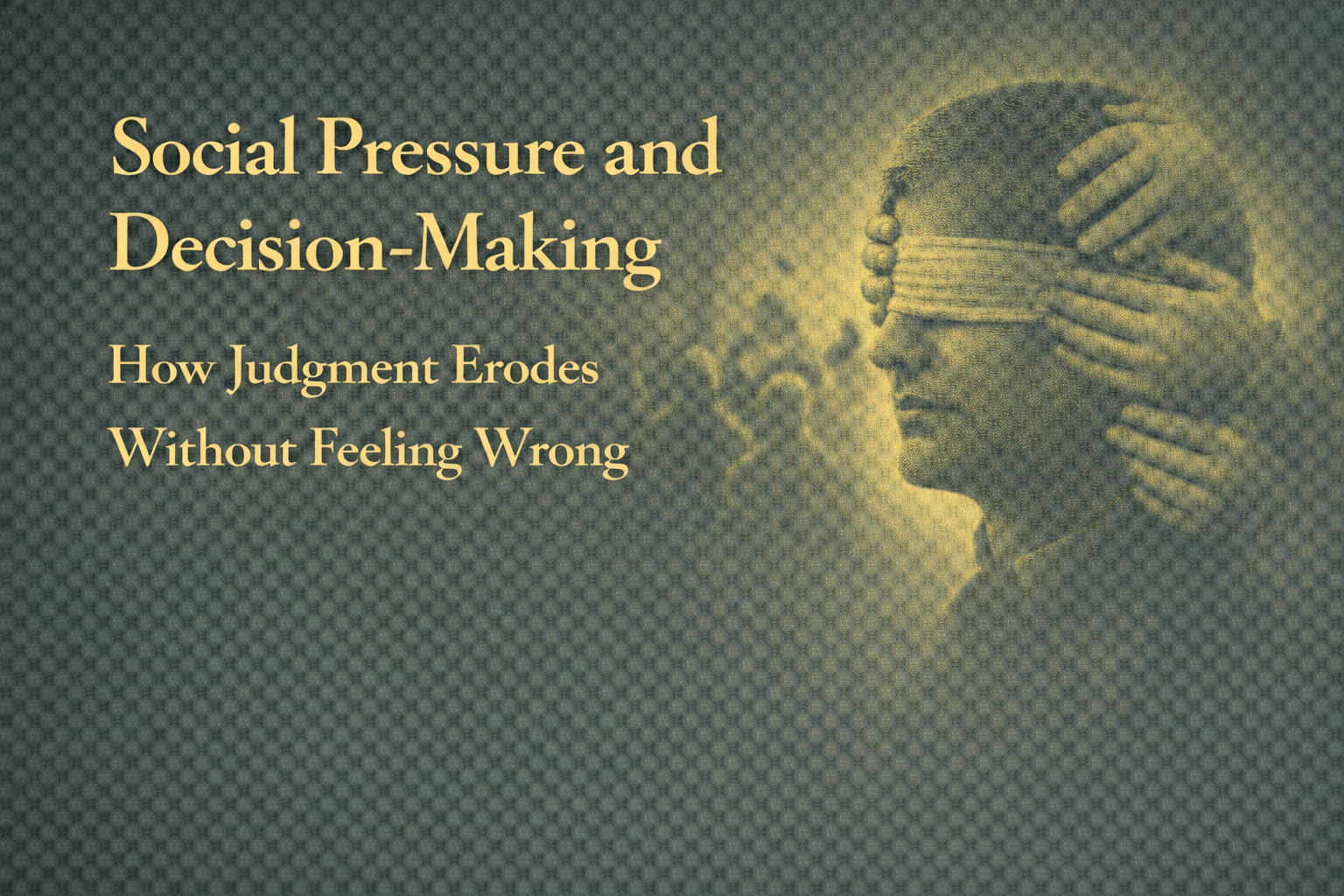
Social Pressure and Decision-Making: How Judgment Erodes Without Feeling Wrong
Social Pressure in Decision-Making: How Judgment Disappears Without Anyone Noticing
Social pressure in decision-making does not rely on force, authority, or coercion.
It works by normalising agreement, reducing friction, and rewarding decisions that feel reasonable in the moment.
Nothing feels wrong while it is happening.
That is why it works so effectively.
Under social pressure, decisions become smoother. Disagreement fades. Confidence arrives earlier than it should.
Judgment does not collapse dramatically.
It thins quietly.
Most people never notice the erosion because the process looks mature, efficient, aligned, and responsible.
Social pressure reshapes decision-making before analysis even begins. Before options are weighed. Before anyone realizes the range of acceptable judgment has already narrowed.
What Social Pressure Actually Does to Decisions
Social pressure is not persuasion.
It is not someone directly telling you what to do.
It is the quiet pull toward decisions that preserve agreement and social stability.
The Mechanism in Plain Language
A decision feels easier when other people expect it.
It feels safer when it aligns with the group.
It feels reasonable when nobody objects.
That is social pressure.
It narrows judgment by making certain options feel unnecessary, awkward, impractical, or disruptive before they are seriously evaluated.
No one blocks alternatives explicitly.
People simply stop feeling the need to consider them.
Why Social Pressure Exists
Social pressure is not inherently harmful.
It serves real coordination functions inside groups and systems.
- It speeds up decisions
- It reduces conflict
- It strengthens belonging
- It helps groups move together
These functions matter.
The problem begins when social pressure keeps operating after judgment becomes necessary.
What Social Pressure Is Not
Social pressure is frequently confused with other forces.
The distinction matters.
It Is Not Persuasion
Persuasion changes what you believe.
Social pressure changes what feels acceptable to express or explore.
It Is Not Authority
Authority operates through hierarchy and visible power.
Social pressure works sideways through expectations, tone, norms, and silence.
It Is Not Manipulation
Manipulation is intentional.
Social pressure usually is not.
Most people applying it believe they are being practical, supportive, or efficient.
How Social Pressure Replaces Judgment
Social pressure rarely changes decisions directly.
Instead, it changes what gets treated as a legitimate decision in the first place.
The Core Substitutions
Social pressure replaces difficult judgment with something cheaper and easier.
Judgment → Acceptance
Judgment requires uncertainty, friction, and evaluation.
Acceptance simply follows what already feels socially settled.
Thinking → Alignment
Thinking creates divergence.
Alignment compresses divergence.
Alignment feels productive because it creates movement without conflict.
But movement is not the same thing as direction.
Risk → Social Safety
People stop asking:
“Is this correct?”
And begin asking:
“Will this create friction or isolate me socially?”
That substitution happens quietly.
Once it does, the system begins running on social momentum instead of judgment.
How Disagreement Gets Filtered Out
Disagreement is usually the first casualty.
Healthy judgment produces friction:
- Questions
- Delays
- Alternative interpretations
- Awkward discussions
Social pressure reduces the visibility of all of them.
Not through censorship.
Through self-editing.
People learn quickly which objections feel “safe” and which ones disrupt momentum.
Over time, only socially acceptable objections survive long enough to reach the room.
That is not harmony.
It is selection pressure.
Why Speed Becomes Dangerous
Fast agreement often gets mistaken for competence.
But speed serves another function:
It reduces the time available for competing interpretations to survive.
The faster groups converge:
- The fewer alternatives emerge
- The less uncertainty survives
- The less dissent develops language
Speed does not eliminate bad ideas.
It often prevents better ones from fully forming.
How Status Protection Shapes Decisions
Social systems teach people which risks feel socially tolerable.
Disagreement carries asymmetric cost.
Agreeing rarely damages status.
Objecting sometimes does.
That imbalance quietly trains behavior.
People learn:
- Which questions slow momentum
- Which objections create tension
- Which positions make them appear difficult
As a result, people narrow judgment voluntarily because the environment makes it rational.
When Responsibility Becomes Impossible to Locate
Social pressure spreads ownership thinly across groups.
When everyone agrees, nobody feels singularly responsible.
Outcomes become collective.
Responsibility becomes procedural.
Over time, accountability weakens:
- Questions arrive later
- Doubt feels unnecessary
- Risk feels diluted
That is where judgment erodes fastest.
Why Social Pressure Looks Like Progress
From the inside, socially pressured systems often feel highly functional.
- Meetings end quickly
- Conflict disappears
- Decisions move smoothly
- Processes feel mature
That smoothness is exactly what makes erosion difficult to detect.
The range of acceptable judgment shrinks while the appearance of efficiency improves.
This is why intelligent groups often fail faster than naive ones.
They recognize efficiency quickly.
And then they protect it.
The Time Lag Problem
Social pressure rarely creates immediate failure.
Outcomes usually arrive later:
- After praise
- After promotions
- After public commitment
- After systems harden
By the time consequences appear, responsibility is diffused and the process feels untouchable.
Recognition trails damage.
Where Social Pressure Shows Up in Real Life
Inside Organizations
The first signal often appears inside meetings.
Everyone agrees quickly.
Action items are clear.
Nothing feels wrong.
That smoothness is often the warning.
When organizations reward speed and harmony:
- Questions get softer
- Alternatives disappear
- Dissent arrives later
Promotions begin rewarding alignment instead of judgment.
Dependability becomes confused with predictability.
Inside Markets and Investing
Markets amplify social pressure rapidly.
Consensus starts feeling like validation.
If everyone sees the same opportunity, disagreement starts looking irrational.
People stay exposed longer because exiting early feels socially wrong.
Risk does not disappear inside consensus.
It concentrates.
When reversals finally arrive, they feel sudden only because recognition was delayed.
Inside Personal Decisions
Social pressure becomes most persuasive when it sounds caring.
Phrases like:
- “Be realistic”
- “This is safer”
- “Everyone does it this way”
Do not remove alternatives directly.
They make alternatives feel irresponsible.
People still feel free while their optionality quietly narrows.
When Social Pressure Stops Helping
When Decisions Cannot Be Reversed
Social pressure becomes dangerous when choices are irreversible.
Early agreement hardens assumptions before reality fully stabilizes.
Once commitment forms:
- Doubt arrives late
- Course correction feels reckless
- Staying committed feels responsible
That is the trap.
When Risk Is Unevenly Distributed
Social pressure weakens judgment fastest when one person absorbs consequences while many people shape the decision.
Groups experience risk abstractly.
Individuals experience it concretely.
That asymmetry changes incentives.
Cohesion becomes more valuable than accuracy.
When Clarity Arrives Too Early
Early certainty feels emotionally comforting.
But clarity that appears before uncertainty has been explored is usually borrowed, not earned.
Social pressure accelerates convergence before understanding stabilizes.
Once certainty gets socially declared:
- Dissent feels disruptive
- Questions feel inefficient
- Judgment slows down too late
Observable Signals Before Breakdown
Social pressure rarely announces itself through chaos.
It announces itself through efficiency.
Signals Worth Noticing
- Agreement forms unusually fast
- Debate narrows quickly
- Confidence arrives early
- Resistance disappears completely
- Complexity collapses into clean narratives
These signals do not guarantee failure.
They signal that the system may have stopped testing itself properly.
How Social Pressure Differs From Related Forces
Social Pressure vs Peer Influence
Peer influence changes beliefs.
Social pressure changes what feels acceptable to express.
A person can privately disagree while still complying socially.
Social Pressure vs Authority
Authority is explicit.
Social pressure is ambient.
Authority says:
“This is the decision.”
Social pressure says:
“This already feels settled.”
Social Pressure vs Groupthink
Groupthink is visible collapse.
Social pressure is earlier-stage erosion.
Groupthink is the crash.
Social pressure is the narrowing road that quietly made the crash possible.
Three Misreads That Hide the Problem
“This Feels Efficient”
Efficiency often disguises judgment erosion.
Fast movement gets mistaken for strong evaluation.
In reality, speed frequently removes alternatives before they fully develop.
“Everyone Agrees”
Consensus gets mistaken for validation.
But agreement often reflects social alignment more than genuine examination.
People comply for different reasons:
- Conviction
- Momentum
- Status protection
- Avoidance of friction
Consensus collapses those differences into apparent certainty.
“There Was No Resistance”
Lack of resistance does not automatically mean safety.
Friction is how systems stress-test themselves.
When resistance disappears completely, weak assumptions stop surfacing.
Silence becomes informational.
How to Interpret Situations Differently
This is not about rejecting social pressure completely.
It is about recognizing when it begins doing more work than evidence itself.
Patterns Worth Distrusting
- Sudden clarity in complex situations
- Clean narratives that explain everything early
- Immediate emotional relief after major decisions
- Early certainty without visible friction
Real understanding usually develops more slowly.
It leaves residue:
- Tension
- Trade-offs
- Unresolved uncertainty
- Conditional confidence
What Quietly Changes
Nothing dramatic happens externally.
The shifts are subtle:
- Confidence arrives later
- Alternatives survive longer
- Weak signals remain visible
- Optionality stays alive
That does not guarantee perfect decisions.
It reduces fragility.
Common Questions About Social Pressure
What is social pressure in decision-making?
Social pressure is the force that narrows choices by shaping what feels acceptable before evaluation begins.
It influences behavior without requiring direct coercion or explicit authority.
How does social pressure affect judgment?
It reduces the range of options that survive long enough to be seriously examined.
Judgment weakens because disagreement, friction, and uncertainty disappear too early.
Why does social pressure not feel dangerous?
Because it provides emotional relief:
- Less uncertainty
- Less tension
- Less isolation
- More belonging
The human brain often mistakes reduced friction for progress.
Is social pressure always harmful?
No.
It helps groups coordinate efficiently under low-risk, reversible conditions.
It becomes dangerous when stakes are high, consequences are delayed, and reversibility disappears.
Can intelligent people resist social pressure?
Intelligence does not reliably protect against it.
In many environments, intelligent people adapt to social incentives faster than others.
Social pressure selects for adaptability, not ignorance.
Final Perspective
Social pressure in decision-making reshapes judgment by narrowing what feels acceptable before evaluation begins.
It does not rely on force.
It operates through comfort, coordination, and relief.
Most socially pressured decisions are not obviously wrong when they are made.
They are incomplete.
They trade optionality for smoothness and uncertainty for emotional stability.
That is why the damage arrives late.
By the time fragility becomes visible:
- The process feels mature
- Responsibility is diffused
- Alternatives no longer feel thinkable
Nothing appears broken externally.
Something essential has already thinned internally.
Most people do not lose judgment through obvious mistakes.
They lose it by repeatedly doing what feels reasonable inside systems that quietly reward agreement over examination.