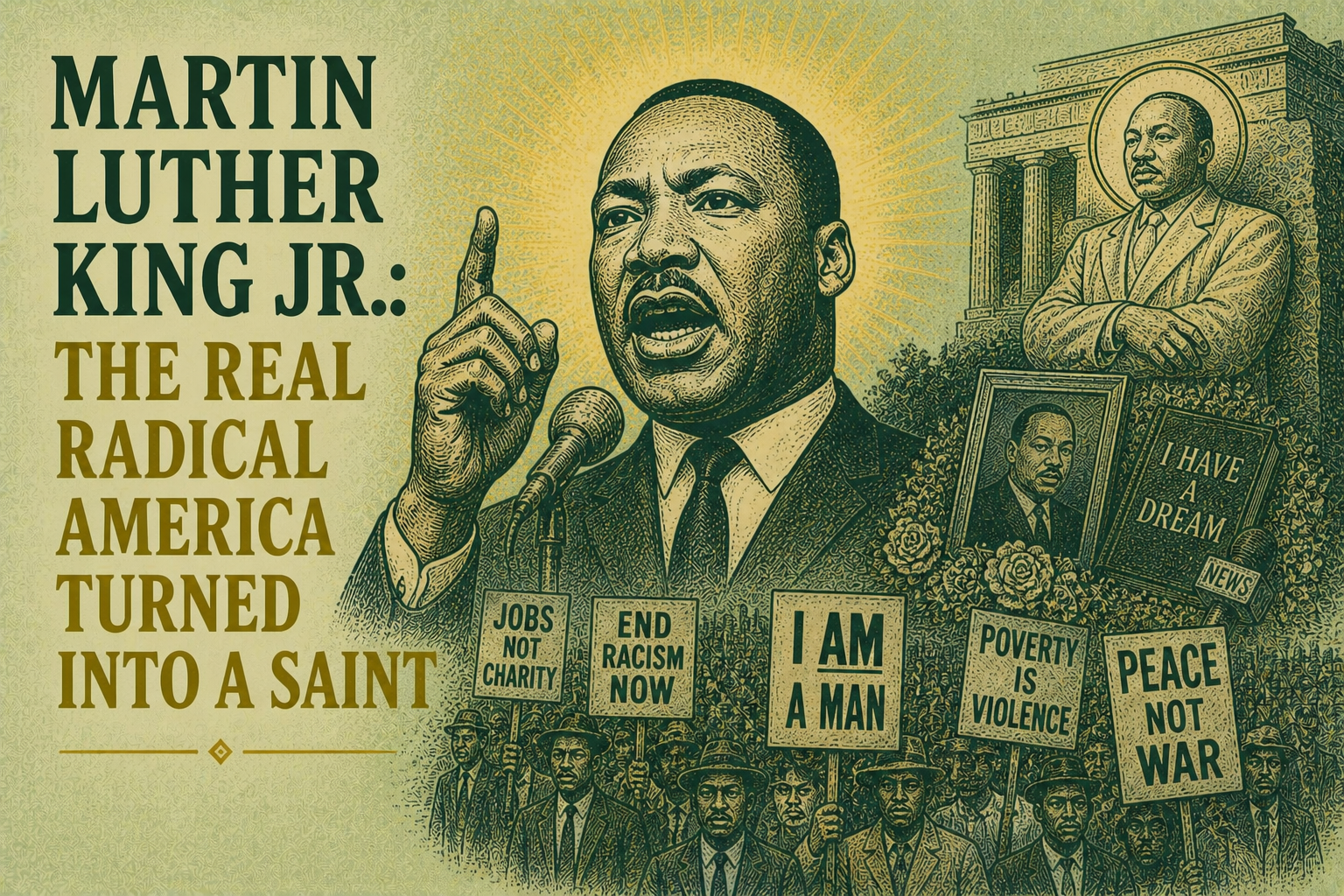
Martin Luther King Jr.: The Real Radical America Turned Into a Saint
The Version of MLK History That Survived Was Not the Whole One
When people do not know what someone actually believed, they inherit the edited version.
That is what happened to Martin Luther King Jr..
The image that survived was carefully narrowed:
the dreamer,
the reconciler,
the national holiday,
the moral symbol safe enough for textbooks and commemorations.
The parts that made him politically dangerous were gradually removed from public memory.
This article examines:
- What King actually argued beyond civil rights
- Why the FBI considered him one of the most dangerous men in America
- How his economic positions disappeared from mainstream narratives
- What the sanitisation process looked like
- Why the safe version survived while the disruptive one faded
What Martin Luther King Jr. Usually Means in Public Memory
Most people inherit the same simplified timeline:
- 1963
- The March on Washington
- The “I Have a Dream” speech
- His assassination in Memphis in 1968
The standard version presents King as:
- A peaceful reformer
- A moral leader
- A national symbol of racial harmony
That version is not false.
It is incomplete in ways that fundamentally change what he represented.
King was a Baptist minister and civil rights leader who became the central figure of the American civil rights movement from the mid-1950s until his assassination in April 1968.
He played a major role in dismantling legal segregation and advancing voting rights through nonviolent protest.
What the simplified version often excludes:
- He argued that racial equality without economic redistribution was hollow
- He openly criticised capitalism as structurally exploitative
- He opposed the Vietnam War publicly and aggressively
- He attempted to organise a multiracial economic movement demanding guaranteed income and structural reform
Those positions rarely appear in official commemorations.
King Never Separated Race From Economics
One of the largest distortions in public memory is the idea that King focused only on civil rights in the narrow legal sense.
He did not.
For King, racial injustice and economic injustice were connected systems.
In Why We Can’t Wait, he called for what he described as a:
“Bill of Rights for the Disadvantaged.”
By 1967, his argument had expanded further.
In Where Do We Go from Here: Chaos or Community?, he advocated:
- Guaranteed annual income
- Economic redistribution
- Direct intervention against poverty
His reasoning was straightforward:
Civil rights without economic transformation leaves the underlying system intact.
Formal equality meant little if millions remained trapped inside structures producing permanent poverty.
The Vietnam War Position Changed Everything
Many Americans supported King when his demands remained focused on segregation.
Support weakened sharply when he linked race, war, and economics together.
In 1967, at Riverside Church in New York, King delivered:
Beyond Vietnam: A Time to Break Silence.
In the speech, he described the United States as:
“the greatest purveyor of violence in the world today.”
The reaction from the American establishment was immediate and severe.
- The Washington Post called the speech “a grave injury”
- Time described it as “demagogic slander”
- The NAACP distanced itself
- President Lyndon B. Johnson cut off communication with him
King did not lose support because he defended civil rights.
He lost support because he connected militarism, poverty, and racial inequality into one structure.
Why the FBI Considered Him Dangerous
Under FBI director J. Edgar Hoover, King was monitored for years.
An internal FBI memo reportedly described him as:
“the most dangerous Negro in America.”
The Bureau:
- Wiretapped his phones
- Bugged hotel rooms
- Conducted extensive surveillance
- Sent anonymous letters attempting psychological intimidation
These operations formed part of COINTELPRO, the FBI’s broader domestic counterintelligence program.
The threat was not simply rhetorical idealism.
The deeper concern was his ability to organise people across:
- Race
- Class
- Regional identity
A multiracial poor coalition carried implications far beyond civil rights legislation.
Where the Sanitisation Happened
The Photograph Replaced the Argument
After King’s assassination in 1968, public memory became selective.
Some elements survived prominently:
- The Dream speech
- The Nobel Peace Prize
- The language of reconciliation
Other elements gradually faded:
- Economic redistribution
- Structural criticism of capitalism
- Anti-war arguments
- Demands for systemic change
The least disruptive version became the official one.
The Campaign That Nearly Vanished From Public Memory
Before his death, King was organising the Poor People’s Campaign.
Its goals included:
- Occupying Washington
- Building a large protest encampment
- Demanding economic legislation
- Applying sustained pressure on the federal government
This was not designed as symbolic protest.
It was intended to disrupt political normalcy.
Today, it receives far less attention than the Dream speech.
The Federal Holiday
The federal Martin Luther King Jr. holiday was signed into law by President Ronald Reagan in 1983.
By that stage, the safer version of King had largely replaced the radical one in mainstream culture.
What Gets Quoted Versus What Gets Ignored
Popularly circulated quotes often focus on morality and unity:
- “Darkness cannot drive out darkness…”
- “The arc of the moral universe is long…”
Less circulated are statements such as:
“There must be a better distribution of wealth.”
The historical reality also complicates the modern image of universal admiration.
In 1966:
- Approximately 63% of Americans viewed King unfavourably
Decades later:
- He became one of the most admired figures in American public memory
Acceptance rose as the more disruptive elements disappeared from mainstream teaching.
Where the Sanitised Narrative Breaks Down
Moral Language Without Structural Change
King repeatedly argued that the American system surrendered only what cost little.
It resisted demands requiring:
- Economic sacrifice
- Redistribution
- Structural transformation
Nonviolence Was Not Passive
Modern retellings often portray nonviolence as calm restraint detached from confrontation.
King used nonviolence differently.
It was designed to expose the violence already embedded inside institutions and public order.
His Letter from Birmingham Jail did not primarily target extremists.
It targeted:
White moderates who preferred order over justice.
The Gap Between the Symbol and the Historical Figure
Today, King is quoted across the political spectrum.
Many people who celebrate him now would likely have opposed his positions in 1967.
That contradiction is not always conscious hypocrisy.
Often, it reflects inherited incompleteness.
Common Misreadings of King
1. “He Would Oppose Modern Protest Movements”
Reality:
- He was repeatedly jailed
- He disrupted public order
- He embraced confrontation as political strategy
2. “His Dream Was Pure Colour-Blindness”
Reality:
King supported race-conscious economic repair and structural intervention.
3. “He Was Universally Loved”
Reality:
He was deeply unpopular with large parts of the American public before his death.
How to Read King More Accurately
When encountering a King quotation:
- Check the year
- Check the surrounding argument
- Check what was removed
If only the Dream speech appears, you are usually seeing the least disruptive version of his politics.
Frequently Asked Questions
What did King believe about capitalism?
He criticised capitalism for producing structural inequality and argued for redistribution and guaranteed income measures.
Why did the FBI target him?
Because federal authorities believed he could organise poor Americans across racial lines into a powerful political coalition.
What was the Poor People’s Campaign?
A planned economic protest movement demanding structural reform and federal anti-poverty action.
Was King popular when he died?
No.
Public approval was far lower during his lifetime than it became afterward.
What does the Birmingham Jail letter argue?
That moderates who prioritise social order over justice often become the greatest obstacle to meaningful reform.
What Remains After the Sanitisation Is Removed
King was simultaneously:
- A civil rights leader
- An economic radical
- An anti-war critic
- A mass organiser
The Dream speech was not the conclusion of his politics.
It was the beginning of a broader argument.
Most misunderstandings are not malicious.
They emerge because many people inherited a version that had already been edited before it reached them.
Conclusion
Selective memory solved a political problem:
How do societies honour figures whose demands they once resisted?
You preserve the inspiration.
You soften the confrontation.
You remove the structural demands.
Then the symbol becomes easier to celebrate than the argument itself.
King warned repeatedly that progress is not automatic, linear, or guaranteed.
The historical record became safer when those warnings faded from public memory.