Why Your “Monthly” Mobile Plan Is Actually 28 Days — And What That Costs You
Why India’s “Monthly” Mobile Plans Actually Charge You 13 Times a Year
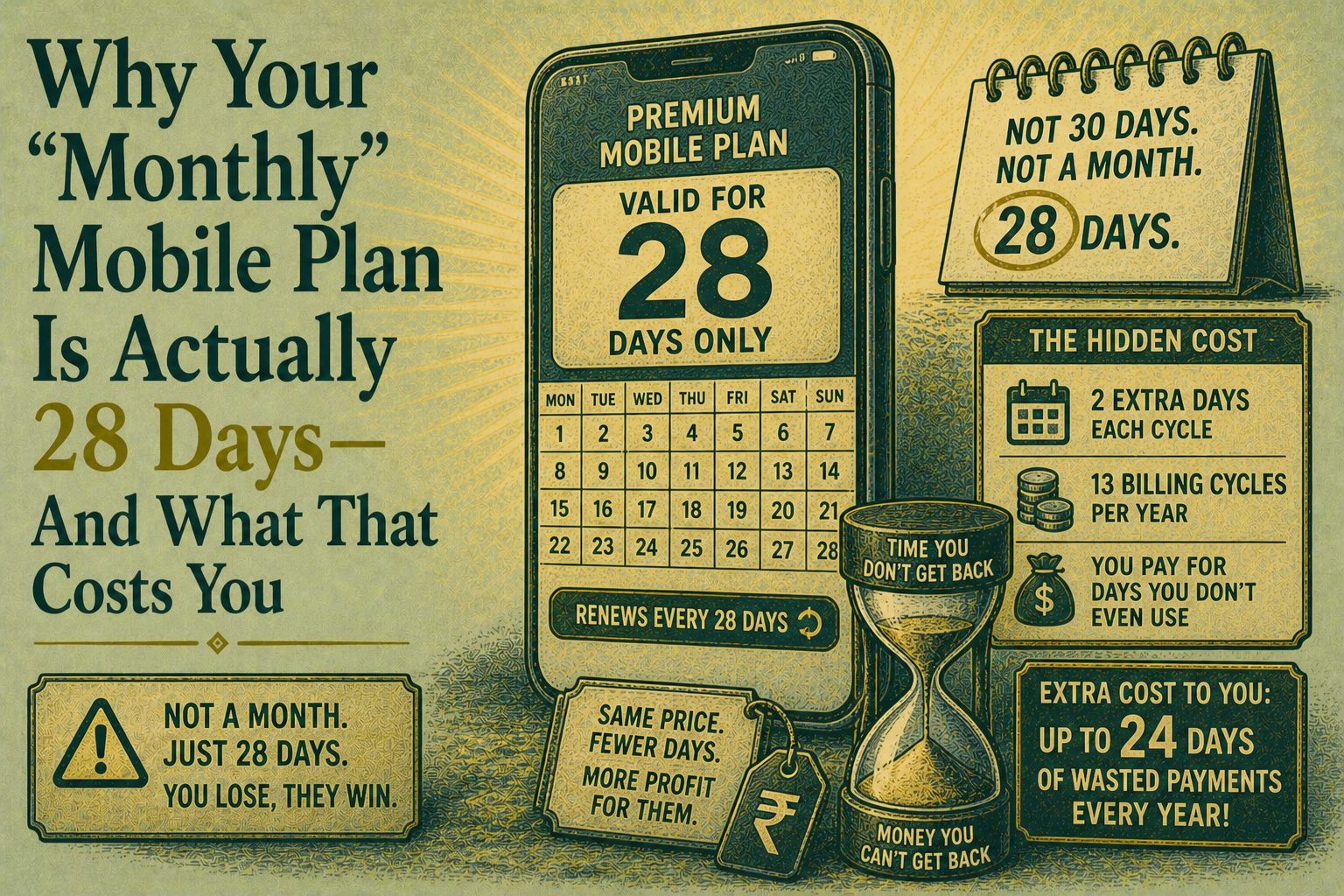
The plan marketed as monthly isn’t.
It runs 28 days.
That two-day gap is the entire mechanism behind India’s hidden 13th recharge cycle.
And when the plan expires, the consequences now extend far beyond missed calls.
The Recharge Date Keeps Moving Earlier
Most Indians notice the pattern long before they calculate it.
The recharge date drifts earlier every month.
A recharge done on the 10th slowly becomes the 8th, then the 6th, then the 4th.
The annual math never quite feels like 12 payments.
That instinct is correct.
The “monthly” prepaid mobile plan most Indians use is not monthly in calendar terms.
It runs 28 days.
Not 30.
Not the calendar month the word “monthly” implies.
That specific number is where the financial structure changes.
A two-day gap, multiplied across more than a billion subscribers, becomes an additional national billing cycle.
What the 28-Day Cycle Actually Does
A 28-day validity plan is not a billing error.
It is a deliberate pricing structure with a precise outcome.
A calendar year contains 365 days.
365 ÷ 28 = 13.03 billing cycles
365 ÷ 30 = 12.17 billing cycles
Seven months in a year contain 31 days.
That creates 21 additional days against a 28-day recharge cycle.
Four more months contain 30 days.
That adds another 8 days.
Together, the gap becomes 29 days annually.
Enough to require a full additional recharge.
For a subscriber on a ₹299 plan:
- 12 cycles = ₹3,588 annually
- 13 cycles = ₹3,887 annually
Difference:
₹299 every year.
The arithmetic is transparent.
The label is what creates confusion.
How the Structure Became Industry Standard
The 28-day cycle did not emerge accidentally.
It became standard across:
- Reliance Jio
- Bharti Airtel
- Vodafone Idea
Earlier telecom plans commonly used 30-day validity.
The shift toward 28-day cycles aligned with the consolidation of the telecom industry during the 4G era.
The outcome is structurally simple:
A shorter cycle increases billing frequency without increasing the visible price of each recharge.
India has roughly 1.15 billion wireless subscribers.
Nearly 90% use prepaid plans.
At that scale, a two-day reduction becomes a large revenue mechanism.
Why TRAI Intervened
The Telecom Regulatory Authority of India acknowledged complaints that 28-day plans marketed as monthly effectively require 13 recharges annually.
In January 2022, TRAI directed operators to offer:
- At least one 30-day tariff voucher
- One special tariff voucher
- One combo voucher
Operators complied.
Technically.
The plans exist.
But they are rarely promoted prominently inside recharge flows, apps, or retail recommendations.
The 28-day plan remains the default option most consumers encounter first.
The structure therefore survived largely unchanged.
Why Expiry Matters More Today
A mobile number in India is no longer just a communication tool.
It functions as digital identity infrastructure.
The same number is now linked to:
- UPI transactions
- Bank OTPs
- Aadhaar verification
- DigiLocker access
- Insurance services
- Government portals
- Employment verification systems
When a recharge expires:
- Outgoing calls stop immediately
- Incoming calls may stop after a limited grace period
- OTP delivery can fail soon after
The consequence is no longer inconvenience alone.
It can become temporary exclusion from banking, payments, and identity systems.
What Happens When a SIM Remains Inactive
The failure sequence follows a predictable structure.
- Outgoing services stop
- Incoming services gradually stop
- The SIM becomes inactive after prolonged non-recharge
- The number enters the recycling process
If reassigned to another user:
- Bank alerts may reach the new holder
- Verification messages may continue temporarily
- Account recovery becomes difficult for the original user
The number itself becomes the risk surface.
This is why expiry now carries consequences beyond telecom access.
The Industry’s Defence
Telecom operators have consistently argued that changing billing structures would:
- Disrupt existing billing systems
- Confuse consumers used to current cycles
- Affect weekly budgeting habits
One claim appears repeatedly:
The 28-day cycle helps lower-income users manage money more easily.
The arithmetic does not support that argument.
A shorter cycle requires more frequent recharges.
More frequent payments generally make budgeting harder, not easier.
Three Practical Alternatives
1. Use 30-Day Plans
TRAI-required plans already exist.
Examples include:
- Jio: ₹259, ₹296
- Airtel: ₹128, ₹131
- Vodafone Idea: ₹137, ₹141
Availability varies by circle and app visibility.
2. Use Annual Plans
Annual plans usually range between ₹1,999 and ₹2,999.
These cover the full 365-day cycle directly.
The 13th recharge disappears entirely.
3. Use Long-Validity SIMs for OTP Numbers
For low-usage secondary numbers:
- BSNL offers longer inactivity windows
- Suitable for banking OTP retention
- Useful where continuous calling/data use is unnecessary
What Most People Miss
- The 13th recharge is not a hidden fee added later. It is embedded inside the cycle itself.
- The additional cost only becomes visible when calculated annually.
- Recharge expiry now affects identity verification systems, not only communication access.
- Number reassignment creates real security and fraud exposure.
- The regulatory response created alternatives without changing the default structure.
Frequently Asked Questions
Why are telecom plans 28 days instead of 30?
Because a 28-day cycle creates 13 billing cycles annually instead of 12.
The structure increases recharge frequency.
How much extra does this cost?
One additional recharge annually.
Examples:
- ₹299 plan → roughly ₹299 extra annually
- ₹399 plan → roughly ₹399 extra annually
Are 30-day plans available?
Yes.
TRAI requires operators to provide them.
They exist but are usually less visible than standard 28-day plans.
What happens when a plan expires?
Outgoing services stop first.
Incoming services and OTP delivery may stop afterward.
Extended inactivity can lead to permanent SIM deactivation and number reassignment.
Why do incoming calls stop too?
This is primarily a billing-policy decision rather than a technical limitation.
What is the best option for OTP-only usage?
Annual plans or long-validity SIMs reduce the risk of number expiry and reassignment.The Mechanism in One Line
A 28-day cycle creates 13 payments.
A 30-day cycle creates 12.
The label says monthly.
The billing structure says otherwise.
TRAI required alternatives.
Operators complied formally.
The default structure remained intact.
And once mobile numbers became the backbone of India’s digital identity system, the cost of a missed recharge stopped being minor inconvenience and became temporary exclusion from the system itself.