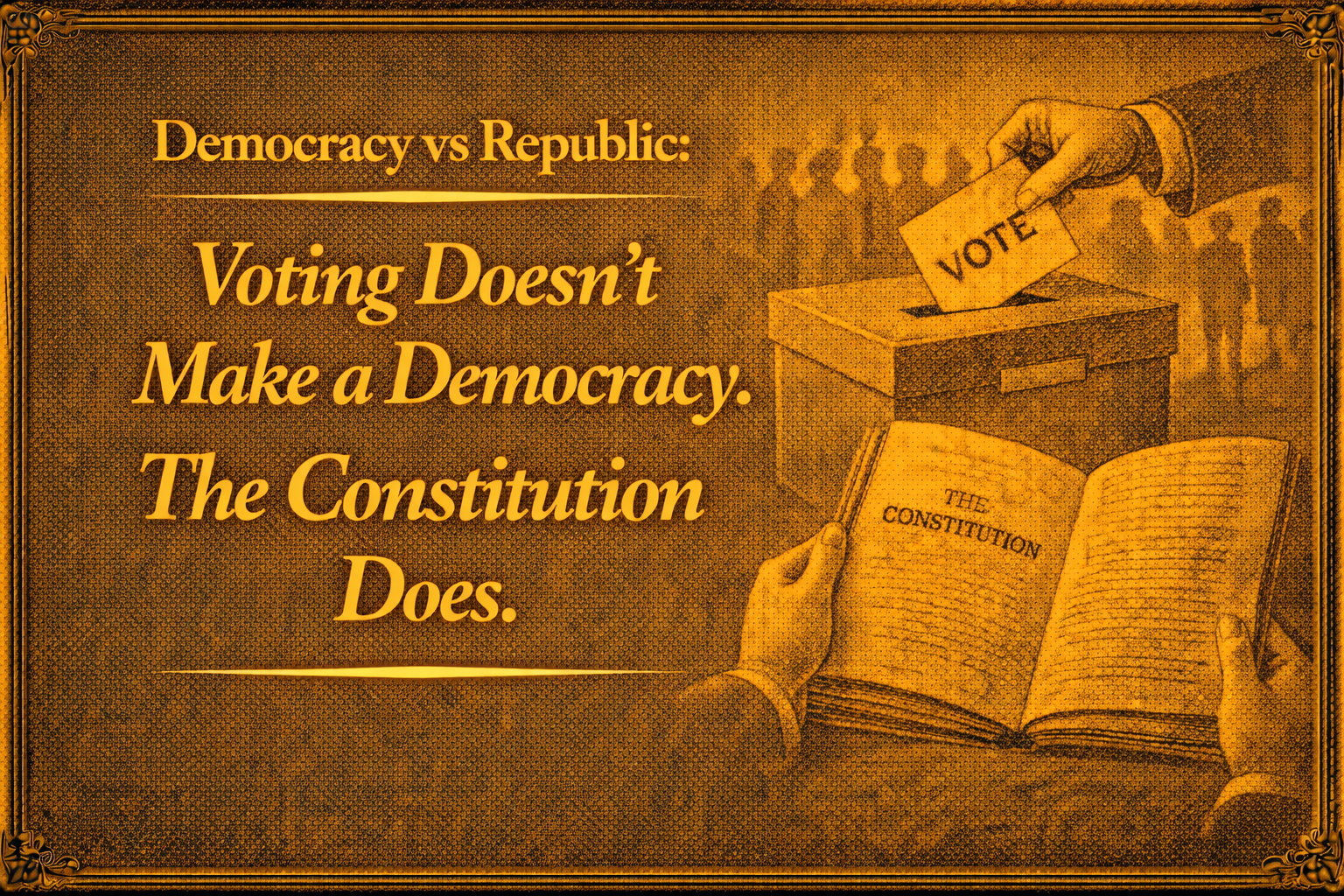
Voting Doesn’t Make a Democracy. The Constitution Does.
Democracy vs Republic: The Difference Most People Never Learn
One system is ruled by people.
The other is ruled by law.
Most people use the words democracy and republic as if they mean the same thing.
They do not.
The difference usually stays invisible until institutions weaken and power starts testing limits.
This article explains:
- What democracy actually means
- What a republic actually means
- Why the two systems are different
- Why stable countries often require both together
By the end, the distinction becomes simple:
Democracy asks what the majority wants.
A republic asks what the Constitution allows.
Start With a Simple Classroom Example
Imagine a classroom with 40 students.
A vote happens on lunch rules.
Thirty-five students vote:
“No one should bring non-vegetarian food.”
The majority wins.
The rule passes.
Now imagine the school already has a written rule:
“Students cannot be forced to change their food choices because of majority preference.”
Suddenly, the vote no longer matters.
The written protection overrides the majority.
That difference explains the core distinction between democracy and republic.
- Democracy focuses on majority decision
- Republic focuses on constitutional limits
What Is a Democracy?
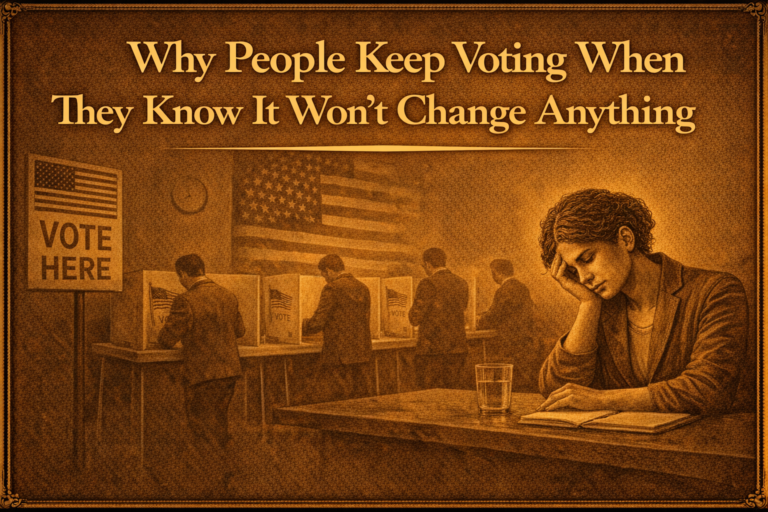
Democracy is a system where people make decisions through voting.
The majority wins.
The word comes from Greek:
- demos = people
- kratos = rule
So democracy literally means:
“Rule by the people.”
In a democracy:
- Citizens vote
- Governments are chosen by elections
- Policies can change based on public opinion
Democracy gives political power legitimacy through public participation.
What Is a Republic?
The word republic comes from the Latin phrase:
res publica
Meaning:
“Public matter.”
A republic is a system where a written constitution protects rights that even the majority cannot remove.
In a republic:
- The Constitution stands above the government
- The law limits political power
- Rights are protected even during unpopular moments
This creates a critical principle:
The majority is powerful, but not unlimited.
How Democracy Actually Works
In a pure democracy:
- People vote
- The side with more votes wins
This system works well when the majority acts fairly.
But democracies contain a built-in danger:
Tyranny of the Majority
This happens when the majority uses voting power to harm a smaller group.
For example:
Suppose 60% of citizens vote to ban a minority religion’s places of worship.
In a pure democracy:
- The majority wins
- The restriction passes
- No higher protection necessarily exists
Voting alone does not automatically create justice.
How a Republic Works
A republic adds another layer above voting:
The Constitution.
The Constitution establishes rights that cannot simply disappear because public opinion changes.
It says:
“These protections remain valid even when the majority disagrees.”
That means:
- Courts can block unconstitutional laws
- Governments cannot legally remove basic rights at will
- Minorities receive legal protection against majority pressure
Even if 90% vote against a right, the Constitution can still say:
“No.”
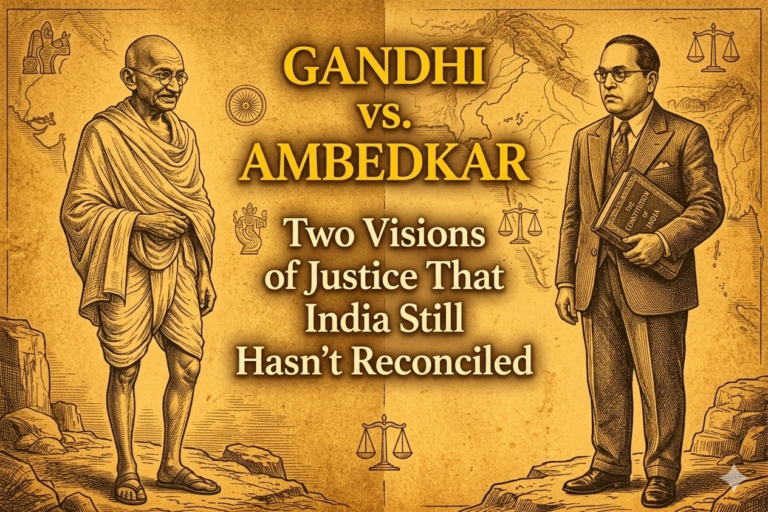
India Is Both a Democracy and a Republic
India is officially a:
Democratic Republic
That means both systems operate together.
- People vote and elect governments → democracy
- The Constitution protects rights → republic
The Constitution of India, adopted in 1950, guarantees Fundamental Rights that cannot simply be removed through ordinary political voting.
Real-World Examples
Example 1: Fundamental Rights in India
India’s Constitution protects rights such as:
- Equality before law
- Freedom of speech
- Protection from discrimination
- Religious freedom
If Parliament passes a law violating these protections:
The Supreme Court can strike it down.
One of the most important cases was:
Kesavananda Bharati v. State of Kerala (1973)
The Supreme Court ruled that Parliament cannot destroy the Constitution’s:
“Basic structure.”
This strengthened the republican side of India’s system.
Example 2: The United States Bill of Rights
The US Constitution was written in 1787.
The Bill of Rights was added in 1791.
These amendments protect:
- Freedom of speech
- Freedom of religion
- Fair trial rights
- Protection from state abuse
Even large majorities cannot legally remove these rights through ordinary voting alone.
Example 3: When Democracy Exists Without Strong Constitutional Protection
Germany in 1933 provides a warning.
Adolf Hitler rose to power through elections.
After gaining authority:
- Rights were suspended
- Political opposition was crushed
- Minorities were persecuted
Germany had democratic processes.
It lacked strong enough constitutional barriers to stop authoritarian consolidation.
After World War II, Germany adopted a new constitution:
The Basic Law
It placed strong constitutional protections around human dignity and democratic order.
Democracy vs Republic: Side-by-Side Comparison
| Feature | Democracy | Republic |
|---|---|---|
| Primary source of power | The majority of voters | The Constitution and law |
| Decision-making method | Voting | Voting limited by legal protections |
| Minority protection | Can be weak | Stronger constitutional safeguards |
| Rights | Can shift with opinion | Protected by written law |
| Main risk | Majority tyranny | Slow institutional change |
Common Mistakes Students Make
Mistake 1: “If People Vote, the System Is Automatically Fair”
Not necessarily.
Majorities can still support unjust policies.
Voting alone does not guarantee liberty or equality.
Mistake 2: “Republic Just Means No King”
That definition is incomplete.
A republic requires:
- Constitutional limitation of power
- Legal protection of rights
Mistake 3: “India Is Either a Democracy or a Republic”
India is both simultaneously.
- Democracy provides representation
- Republic provides constitutional protection
The Simplest Way to Remember the Difference
- Democracy = rule by majority
- Republic = rule by Constitution
The majority can still be wrong.
A republic exists to place legal limits on what majorities can do.
Why Most People Never Notice the Difference
When institutions function normally:
- Elections happen
- Rights appear stable
- No visible conflict emerges
The distinction feels abstract.
But when power begins stretching limits:
- Courts may weaken
- Rights may come under pressure
- Media independence may decline
Then the deeper question appears:
Does the Constitution still restrain power?
Final Insight
Voting alone does not fully protect freedom.
Constitutional protection matters because public opinion can change quickly.
But constitutions only work when:
- Institutions enforce them
- Courts defend them
- Citizens respect them
A republic without democratic participation becomes rigid.
A democracy without constitutional limits becomes unstable.
Conclusion
Democracy gives citizens a voice.
A republic ensures that voice does not become unlimited power.
Stable systems usually require both working together:
- Public participation
- Constitutional restraint
Remove either one, and the balance begins to weaken.