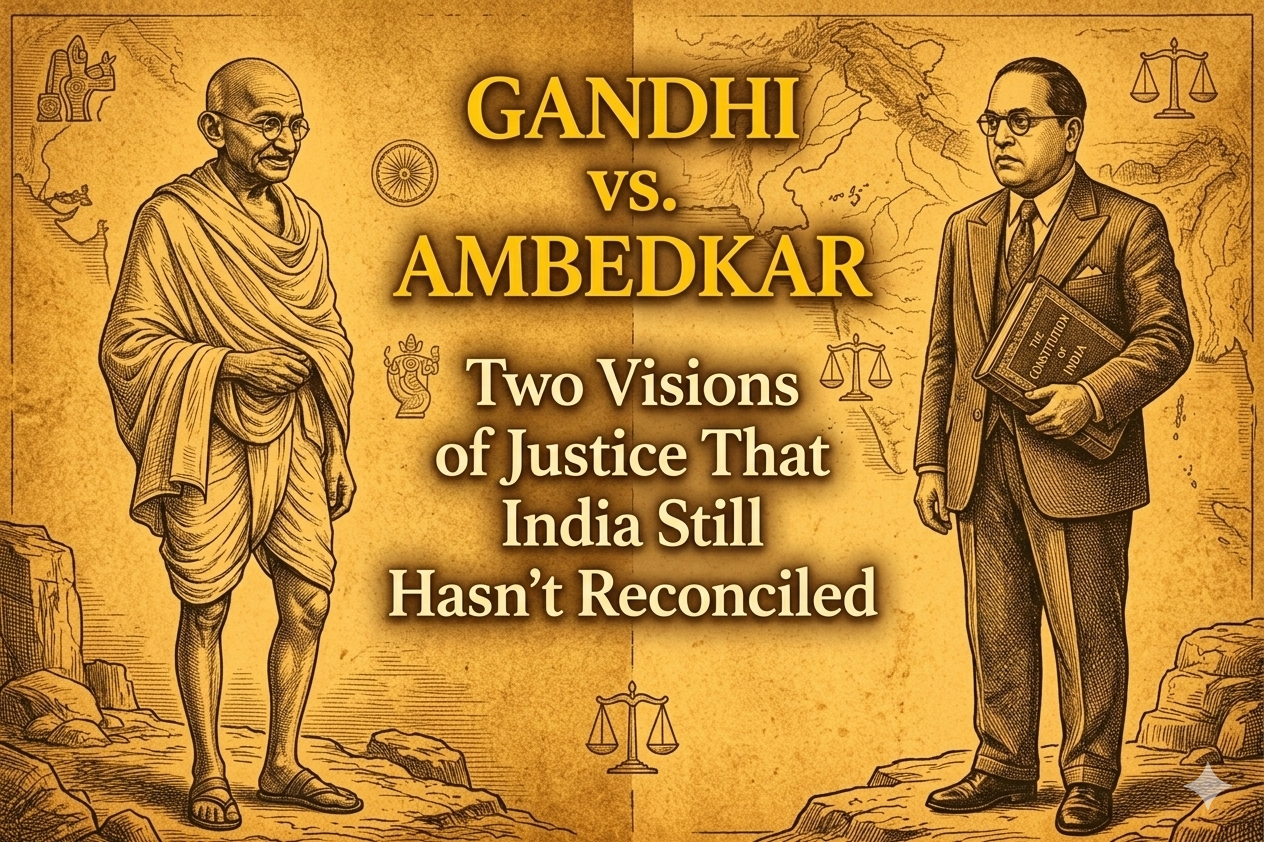
Gandhi vs. Ambedkar: Two Visions of Justice That India Still Hasn’t Reconciled
Why Did Two Architects of Modern India Reach Conclusions That Cannot Be Reconciled?
They both wanted a free India.
They disagreed, with precision and fury, about what freedom actually meant—and for whom.
When two serious thinkers disagree, the disagreement often reveals something the agreement conceals.
Mahatma Gandhi and B.R. Ambedkar agreed on ending British colonial rule.
On nearly everything else—caste, religion, village life, economic structure, and the meaning of justice—they reached conclusions so opposed that reconciling them requires distorting at least one of them.
India has largely chosen distortion.
Official memory places both men together:
- on currency notes
- inside school textbooks
- through public statues and memorials
The historical record shows something harder to simplify:
Two men who understood each other clearly, debated directly, and arrived at fundamentally incompatible visions of India.
This article examines:
- what Gandhi and Ambedkar each believed
- where their arguments directly collided
- what the Poona Pact actually settled
- whose framework better explains contemporary India
- why the official reconciliation remains historically misleading
The Two Men Before the Conflict
Gandhi
Mohandas Karamchand Gandhi was born in 1869 in Porbandar, Gujarat, into a Vaishya family within the Hindu varna system.
He studied law in London and spent twenty-one years in South Africa developing his philosophy of nonviolent resistance.
By the 1920s, Gandhi had become the dominant moral and political figure inside the Indian independence movement.
He could mobilise millions.
His influence within the Indian National Congress was unmatched.
Ambedkar
Bhimrao Ramji Ambedkar was born in 1891 in Maharashtra into a Mahar family classified as untouchable—outside the varna system entirely.
Untouchables were excluded from:
- temples
- public wells
- schools
- shared public spaces
Ambedkar earned doctorates from:
- Columbia University
- The London School of Economics
He qualified as a barrister in London and emerged by the 1930s as the most prominent political voice for untouchables in India.
The structural difference between Gandhi and Ambedkar is not background detail.
It shaped every conclusion they reached.
Gandhi experienced caste from within the system.
Ambedkar experienced caste from beneath it.
What Gandhi Actually Believed
Reform from Within Hinduism
Gandhi believed untouchability was a corruption of Hinduism—not its foundation.
His position evolved over time, but one element remained consistent:
He believed Hinduism contained the moral resources required to reform itself.
His core arguments included:
- untouchability violated true Hindu principles
- upper-caste Hindus needed moral reform
- varna and caste were different systems
- village India represented moral civilisation
Gandhi argued varna was originally a non-hierarchical division of labour.
The problem, in his view, was hereditary rigidity and social contempt—not the framework itself.
Village India and Swaraj
Gandhi believed India’s future should rest on:
- self-sufficient villages
- small-scale production
- cottage industries
- moral self-discipline
He opposed large-scale industrialisation.
For Gandhi, political freedom without moral renewal was incomplete.
Swaraj meant more than independence from Britain.
It meant civilisational self-rule.
What Ambedkar Actually Believed
Structural Abolition, Not Moral Reform
Ambedkar rejected Gandhi’s framework almost entirely.
His central argument:
Caste was not a distortion of Hinduism.
It was one of its structural foundations.
Ambedkar argued Hindu sacred texts explicitly sanctioned hierarchy.
As long as those texts remained authoritative, caste would survive.
His conclusions were direct:
- moral persuasion was insufficient
- caste required structural dismantling
- varna and caste could not be separated historically
- political equality without economic equality was hollow
The Village as a Site of Oppression
Where Gandhi saw moral civilisation, Ambedkar saw localised caste enforcement.
Village structures controlled:
- water access
- housing
- employment
- social movement
Ambedkar believed industrialisation and urbanisation weakened caste by disrupting hereditary occupational structures.
Factory wages did not ask for caste identity in the same way village labour systems did.
Where the Arguments Directly Collided
Collision 1: The Source of Untouchability
Gandhi:
Untouchability is a corruption of Hinduism.
Ambedkar:
Untouchability is produced by Hinduism’s structure itself.
This disagreement was not symbolic.
It determined the proposed solution.
Gandhi wanted reform within the tradition.
Ambedkar argued the structure itself required confrontation.
Collision 2: Separate Electorates
At the Round Table Conferences, Ambedkar demanded separate electorates for untouchables.
This would allow untouchables to elect their own representatives independently.
Gandhi opposed the proposal.
He believed it would permanently divide Hindu society.
The British accepted Ambedkar’s demand in the Communal Award of 1932.
Gandhi responded with a fast unto death.
The pressure became immense.
Ambedkar eventually signed the Poona Pact.
Separate electorates were abandoned.
Reserved seats inside joint electorates replaced them.
Ambedkar later described the event as coercion through moral authority.
Collision 3: The Village Question
For Gandhi:
The village represented India’s moral centre.
For Ambedkar:
The village represented caste hierarchy in its most complete form.
Ambedkar argued that romanticising villages erased the lived reality of those forced to survive at the bottom of village social systems.
Collision 4: Hindu Scriptures
In Annihilation of Caste, Ambedkar argued caste could not disappear without confronting the authority of Hindu scriptures directly.
He wrote:
“You must destroy the authority of the Shastras and Smritis.”
Gandhi responded by arguing the scriptures had been misinterpreted and that true Hinduism supported equality.
Ambedkar rejected that defense.
His response was methodological:
A tradition should be judged by its historical outcomes, not its ideal interpretation.
The Poona Pact: What It Settled and What It Didn’t
The Poona Pact settled one question:
Separate electorates for untouchables would not exist.
It did not settle the deeper argument:
Was Ambedkar correct about structural caste power?
Subsequent political research suggests many of Ambedkar’s concerns proved accurate.
Reserved seats inside joint electorates often produced representatives accountable to dominant caste voting structures rather than exclusively to Scheduled Caste communities.
Ambedkar later described the pact as a defeat rather than a compromise.
Whose Framework Better Explains Contemporary India?
This is not a question about moral intention.
It is a question about predictive accuracy.
On Caste Persistence
Ambedkar predicted legal equality without structural change would leave caste largely intact.
Contemporary evidence supports this:
- marriage patterns remain caste-based
- employment networks still reflect caste structures
- residential segregation persists
On Rural Hierarchy
Ambedkar argued rural caste hierarchies would remain durable.
Most documented caste atrocities still occur in rural areas.
On Industrialisation
Ambedkar believed urbanisation would weaken caste occupational rigidity.
Urban labour markets show weaker caste–occupation links than rural ones.
On caste specifically, Ambedkar’s structural analysis has proven more empirically accurate.
That does not diminish Gandhi’s role in anti-colonial mobilisation.
But the predictive record on caste favours Ambedkar’s framework.
Why India Never Fully Resolved the Disagreement
Official memory reconciles Gandhi and Ambedkar because the alternative is politically uncomfortable.
To fully endorse Ambedkar’s analysis would require acknowledging that Gandhi’s understanding of caste was fundamentally limited.
To fully endorse Gandhi’s gradual moral reform model would require explaining why structural caste inequality remains deeply persistent decades later.
So the disagreement is managed rather than confronted.
Both men remain national icons.
The actual debate between them is rarely taught in full.
Common Misreadings
Misreading 1: They Were Ultimately on the Same Side
Both opposed colonialism.
That does not mean they shared the same vision of India.
Ambedkar repeatedly argued the Congress movement did not adequately represent untouchable interests.
Misreading 2: Gandhi’s Fast Was Purely Moral Protest
Gandhi used fasting throughout his political life.
But the 1932 fast was directed against a specific political mechanism:
independent representation for untouchables.
Ambedkar interpreted it as moral pressure used for political leverage.
Misreading 3: Ambedkar Was Being Excessively Radical
Ambedkar’s arguments followed from historical evidence.
If caste hierarchy was structurally linked to sacred authority, dismantling caste required confronting that authority.
His position was radical because it addressed the root of the problem directly.
Final Understanding
Gandhi and Ambedkar were not two leaders offering slightly different solutions to the same problem.
They diagnosed the problem differently from the beginning.
Gandhi believed caste could be corrected through moral reform within Hinduism.
Ambedkar believed caste required structural transformation and theological challenge.
Independent India adopted Ambedkar’s constitutional framework.
But public discourse often still relies on Gandhi’s gradual reform model.
The tension between those two visions continues to shape debates around:
- reservations
- land reform
- social justice
- caste violence
The disagreement between Gandhi and Ambedkar is not a historical footnote.
It remains one of the central unresolved arguments inside modern India itself.
About the Author
Nishant Chandravanshi writes on sovereign risk, strategic leverage, institutional systems, and geopolitical miscalculation.
Author of multiple nonfiction works examining power, decision-making, and structural conflict.