Frederick Douglass: From Enslavement to the Conscience of a Nation
Frederick Douglass: From Enslavement to the Conscience of a Nation
Frederick Douglass transformed lived experience into a political argument America could not permanently ignore.
He began life as property inside a system built to deny literacy, autonomy, and personhood.
He ended as one of the most powerful constitutional thinkers and abolitionist voices in American history.
The distance between those two realities explains both the scale of his achievement and the structure he fought against.
The System He Was Born Into
Frederick Douglass was born Frederick Augustus Washington Bailey in Talbot County, Maryland, around 1818.
The exact date remains uncertain.
Enslaved people were not reliably granted recorded birthdays.
Even identity itself was unstable inside the system.
His mother, Harriet Bailey, was separated from him during infancy.
His father was unknown.
That uncertainty was not incidental.
It was structural.
Douglass did not rise despite adversity.
He rose against a system designed to prevent his rise entirely.
American slavery was not a peripheral institution.
It was simultaneously:
- Economic
- Legal
- Constitutional
The same republic that declared equality also embedded bondage into its political and economic foundations.
Slavery was not treated as a temporary contradiction.
It was negotiated into the structure of the nation itself.
Douglass grew up inside that contradiction.
What Learning to Read Actually Cost
Around the age of twelve, Sophia Auld began teaching Douglass the alphabet.
Her husband intervened and stopped the lessons.
He reportedly warned:
“If you give a slave an inch, he will take an ell… learning will spoil him.”
Douglass understood the meaning immediately.
Literacy and slavery could not comfortably coexist.
That insight became strategic.
He:
- Traded bread for reading lessons
- Studied The Columbian Orator
- Learned argument alongside language
One dialogue in the book described an enslaved man defeating his enslaver through logic and persuasion.
Douglass absorbed the structure of that argument carefully.
He was not simply learning to read.
He was learning how to challenge the system using its own intellectual framework.
The Escape and What It Did Not Solve
In 1838, Douglass escaped slavery disguised as a sailor.
He reached New York and later settled in New Bedford, Massachusetts.
There, he adopted the surname:
Douglass.
Legally, he was no longer enslaved.
But freedom remained unstable.
He was:
- Economically vulnerable
- Legally exposed
- Constantly at risk of capture
The Fugitive Slave Act meant that freedom in the North remained conditional and fragile.
This shaped his political thinking deeply.
Escape alone was not enough.
The system itself had to be dismantled.
The Narrative and the Risk It Carried
In 1845, Douglass published:
Narrative of the Life of Frederick Douglass, an American Slave.
The book did something unusually dangerous.
It named:
- People
- Places
- Events
He made the account verifiable.
That increased credibility.
It also increased personal risk.
After publication, he traveled to Britain.
There, he:
- Spoke extensively
- Built international pressure against American slavery
- Secured legal freedom through supporters who purchased his emancipation
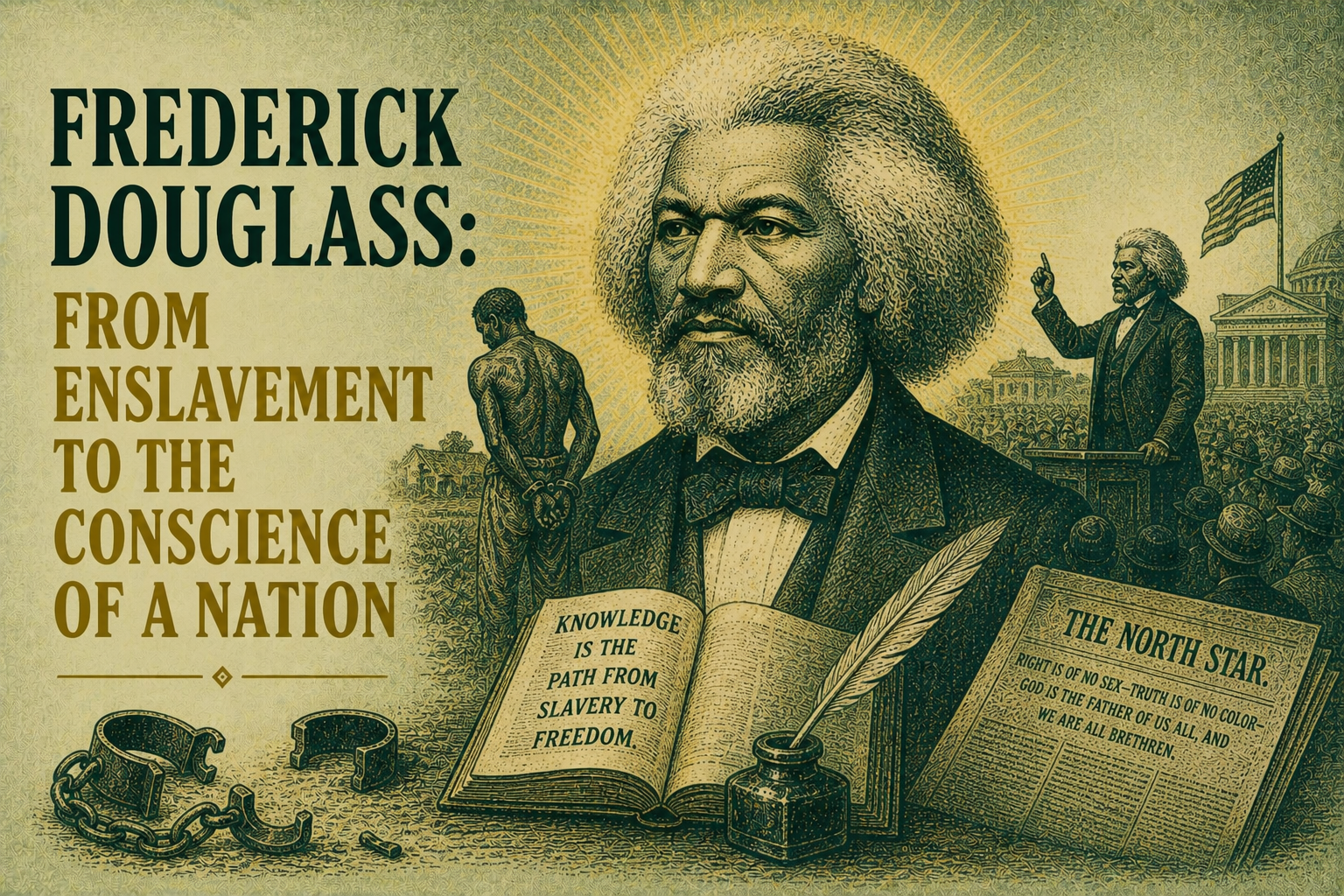
Upon returning to the United States, he founded the abolitionist newspaper:
The North Star.
Its masthead declared:
“Right is of no Sex — Truth is of no Color — God is the Father of us all…”
What Independence Day Meant to Douglass
In 1852, Douglass delivered one of the most important speeches in American history:
What to the Slave Is the Fourth of July?
The structure of the speech mattered.
He began with praise for the ideals of the American founding.
Then he pivoted sharply.
“This Fourth of July is yours, not mine.”
Douglass argued:
- Freedom in America was selective
- Law actively supported slavery
- Religion frequently justified injustice
The hypocrisy was not accidental.
It was institutional.
He was not requesting sympathy.
He was demanding consistency between American ideals and American reality.
The Break With William Lloyd Garrison
Douglass initially worked closely with abolitionist William Lloyd Garrison.
Garrison believed:
- The Constitution was fundamentally pro-slavery
- The system could not be redeemed from within
Douglass eventually disagreed.
He argued that the Constitution could instead be interpreted as a tool against slavery.
This marked a major strategic shift.
The movement moved:
- From moral witness toward political engagement
- From exposing injustice toward forcing institutional change
History ultimately validated much of Douglass’s approach.
The Civil War and Abraham Lincoln
Douglass engaged directly with President Abraham Lincoln during the Civil War.
He pushed consistently for:
- Emancipation
- Black military enlistment
- Equal pay for Black soldiers
He helped recruit troops, including for the famous 54th Massachusetts Regiment.
Lincoln moved cautiously and incrementally.
Douglass applied pressure continuously.
He recognised growth in Lincoln without romanticising him.
Later, Douglass observed:
Lincoln was “the white man’s president” first.
The statement was not bitterness.
It was analytical precision.
Reconstruction and Its Collapse
After the Civil War, major constitutional changes followed:
- The 13th Amendment abolished slavery
- The 14th Amendment established citizenship protections
- The 15th Amendment expanded voting rights
Douglass participated actively in the Reconstruction era.
Then came the Compromise of 1877.
Federal troops withdrew from the South.
What followed included:
- Poll taxes
- Literacy tests
- Lynching
- Convict leasing systems
The structure adapted and returned under new forms.
Douglass recognised the pattern clearly.
The Limit of One Voice
Douglass helped transform:
- Public argument
- Constitutional interpretation
- National political language
Yet he also understood the limitation of legal victory alone.
Law changed faster than enforcement.
The system repeatedly adjusted to preserve hierarchy under altered rules.
Winning the argument is not the same as winning reality.
What His Legacy Actually Requires
Douglass died in 1895.
His final public appearance was at a women’s rights meeting.
That detail reflected a larger principle he held consistently:
Equality is indivisible.
He supported:
- Abolition
- Women’s suffrage
- Universal civil rights
The same moral logic, in his view, challenged all forms of hierarchy.
What Frederick Douglass Actually Built
Douglass did not simply leave behind symbolism.
He built a method.
- Name the contradiction clearly
- Support the argument with evidence
- Use the system’s own logic against itself
- Refuse comfort when truth demands confrontation
His power came not from abstraction, but from combining lived experience with disciplined argument.
Conclusion
Frederick Douglass began life as property inside a constitutional system that denied his humanity.
He ended as:
- A national voice
- A constitutional thinker
- A moral force in American political life
The distance between those two realities measures one extraordinary life.
The distance between Douglass’s argument and present reality measures something larger:
How much remains unresolved.
America never fully answered Douglass.
It postponed the answer.