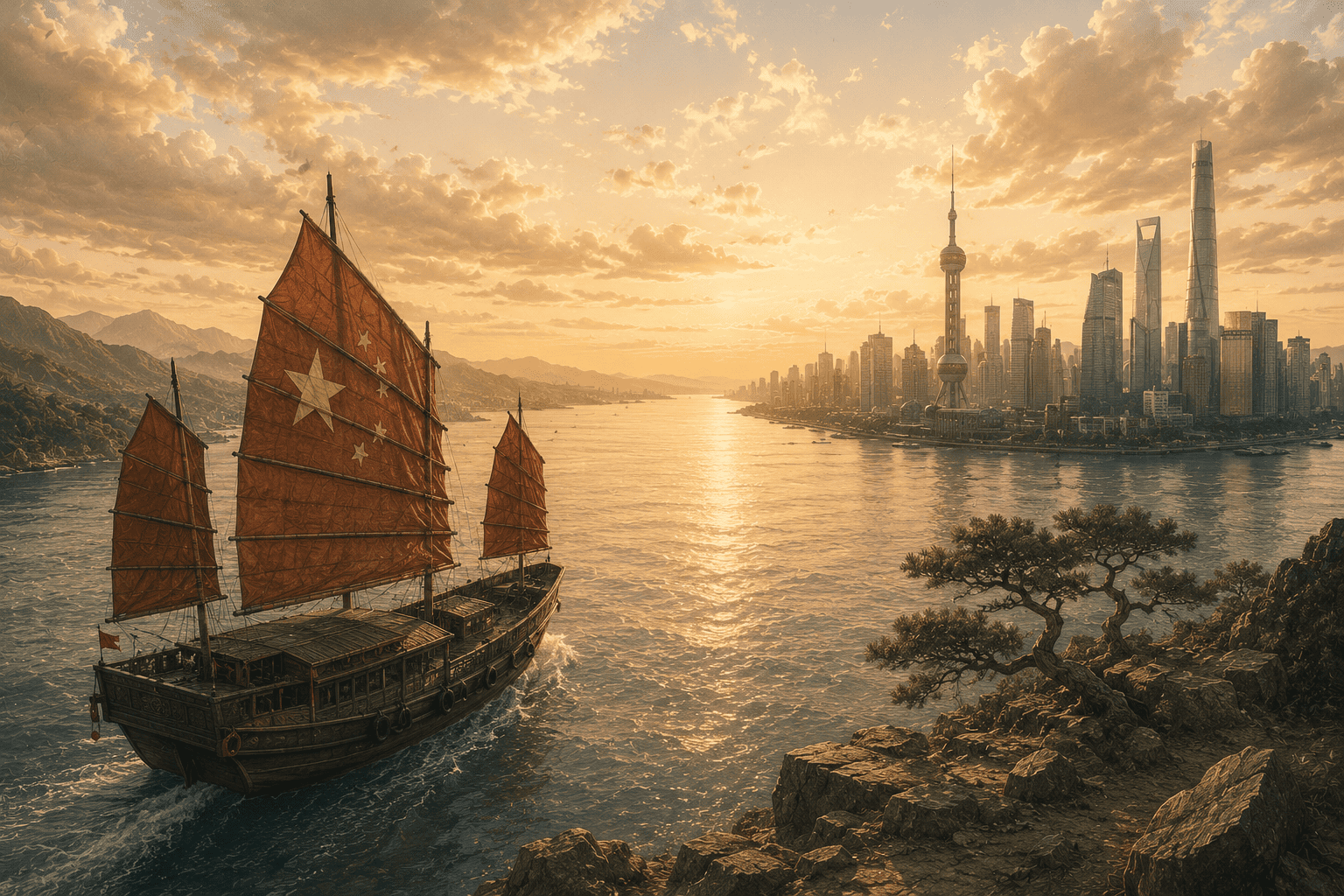
China Crossed the River. Nobody Knew How Wide It Was
A fishing village became a technological superpower within one human lifetime. The economic story is famous. The human disorientation inside it is less understood.
Somewhere in Guangdong, a grandmother remembers the color of a ration ticket.
Not as history. As the texture of Tuesday. A specific shade of paper for cooking oil. A different one for cloth. You kept them in a small drawer. You checked before you left the house.
Her granddaughter is on her phone.
They are sitting at the same dinner table, in the same city, separated by forty years and three completely different economies. The grandmother’s hands remember scarcity. The granddaughter’s thumbs navigate abundance. Neither can fully explain to the other what they actually lived through.
This is what China’s Reform and Opening Up produced at the human level — before the GDP charts, before the Shenzhen skyline photographs, before the policy papers. It produced that dinner table. That silence between two people who share blood and share almost nothing else about the world they inhabit.
The economic transformation is documented. The human rupture underneath it mostly isn’t.
In 1979, Shenzhen was where people fished. Today it is where the future gets manufactured and shipped everywhere else. That sentence takes four seconds to read. The living of it took one generation.
Near a construction site in Shenzhen, a plaque sits slightly tilted, weathered at the edges. It reads: 1979: small fishing village. Behind it, sixty floors of glass catch the afternoon light. Cranes move overhead. The coordinates on the plaque and the coordinates on a phone map are identical. Everything else is a different planet.
A GDP chart shows a line going up. The line is accurate. The line does not show what it costs a person to watch everything they knew become unrecognizable before they are old.
Hundreds of millions of people left villages, moved to cities, sent money home, learned to operate machines they had never seen, lived in dormitories, and raised children over video calls before video calls were common. Each of those is a life. A complete human life, rearranged around an economic opening the person living it did not design and could not slow down.
The factory worker’s story got told in the aggregate. The aggregate drains it of what actually happened.
Deng Xiaoping described it as crossing a river by feeling the stones.
Watch the clip, read the phrase carefully, and notice what it contains: the admission that nobody knew where the bottom was. This was not a plan delivered from certainty. It was a bet placed by a system that had come close enough to collapse to understand that doing nothing was also a choice — and not a safe one.
The Cultural Revolution had ended. The country was exhausted. Reform and Opening Up were not an ideological conversion. It was an adaptation of wearing the clothes of policy.
The assumption carried quietly for decades went like this: open the economy, and the rest follows. Trade builds a middle class. The middle class wants a vote. The market is a Trojan horse for liberalism, and everyone is just waiting for the reveal. It didn’t happen. The economy opened. The party tightened. The whole thing worked — on its own terms, by the measures the party chose to count.
What’s worth naming honestly: through the 1980s, there was a genuine argument within the leadership about political liberalization. Zhao Ziyang was not a footnote. He was a serious alternative path. That argument didn’t fade on its own. It was closed, forcibly, in 1989. What looked from outside like a coherent authoritarian project was, for a moment, actually contested.
The outcome was chosen. It was not predetermined. That distinction matters for understanding what came after — and what is still running now.
The grey tunics gave way to color. Color gave way to neon. Neon gave way to livestream shopping at two in the morning — a person in a ring-lit room selling skincare to three hundred thousand viewers in real time.
Scroll through the photographs in sequence, and it looks like watching a country wake up. Except waking up is too gentle. It was more like a controlled explosion. Carefully directed, deliberately constrained, but an explosion regardless.
The special economic zones were laboratories with walls. Shenzhen could experiment. The experiment would not automatically spread everywhere. Flexibility within a frame. Pragmatism inside ideology.
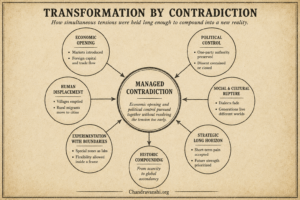
Economic opening, political control, human displacement, and technological ascent unfolded simultaneously inside the same historical transition.
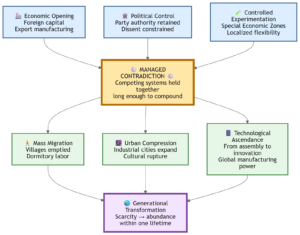
Economic opening, political control, experimentation, and human displacement compounded together instead of replacing one another.
Holding two contradictions at once, and holding them long enough to make them produce something — that was the operational innovation. Not the zones, not the tariffs, not the foreign investment rules. The capacity to be both things simultaneously and not resolve the tension too early.
“Made in China” appeared on everything in the world’s homes. Then, slowly, “Designed in China” started appearing. That gap — between executing someone else’s idea and generating your own — is not a small shift. The assembly line was the entry point. It was never meant to be the destination.
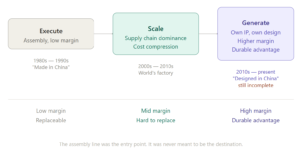
The gap between executing someone else’s idea and generating your own is not a small shift. It is the difference between renting a place in the global economy and owning one.
Something was lost.
This sits uncomfortably inside a story about growth, but it is true and should not be folded out of the account.
Villages emptied. Dialects started disappearing because children grew up in cities where Mandarin was the common tongue. Air quality in manufacturing regions became a public health reality still being reckoned with. The property sector, which financed much of the physical construction of modern China, is unwinding in ways that were not in the original model.
The people who made the trade-offs at the top knew displacement and inequality were coming. They chose the trade-off. That is different from not seeing it. But choosing a trade-off at the level of national policy and living it at the level of a specific family in a specific village are two entirely different experiences of the same decision.
The grief in this is real. It sits in the gap between what was gained at the national level and what was quietly surrendered at the human one.
The people who designed the reform calculated the macro trajectory. What nobody modeled — what the calculation did not require — was what it would cost specific people in specific places to absorb thirty years of compression in a single lifetime. That calculation was not run. Not because it was impossible. Because it was not the calculation that mattered for the policy to proceed.
If Reform and Opening Up was an experiment — and Deng’s own framing invited that word — then the question of who got to be the laboratory and who got to write the results does not have a comfortable answer.
The people who absorbed the transformation most directly were not setting the terms. The factory workers, the rural migrants, the communities that became industrial zones overnight, the families whose dialects thinned and whose villages emptied — they were the medium through which the experiment ran. The results were written in policy papers, economic models, and party congress reports.
The lab was human. The write-up was institutional.
This is not unique to China. It is how large-scale economic transformation operates almost everywhere. But the speed here compressed something that usually takes generations into a single working lifetime. The distance between the people who decided and the people who lived it was never abstract. It was the distance between a grandmother and a granddaughter at a dinner table, in the same city, on different planets.
The window opened in 1978. The wind is still moving.
The property sector debt is still unwinding. The demographic curve is running in the wrong direction. The manufacturing cost advantage is compressing. What was built in one generation will be stress-tested in the next.
None of this negates what happened. Hundreds of millions of people moved out of material poverty. Cities were built. Infrastructure was laid. A country that had spent decades in managed scarcity demonstrated that the scarcity was a policy, not a fate.
But the version of this story that only counts the line going up on the chart is not an honest account. It leaves out the grandmother. It leaves out the dialects. It leaves out the fact that the people who absorbed the change most directly were never asked whether the pace was survivable.
Deng said: Cross the river by feeling the stones. He was right about the river. What nobody standing on the bank in 1978 could fully see was how wide it was — and how many people would have to carry each other across it before anything on the other side became visible.
The grandmother remembers the color of the ration ticket. The granddaughter cannot quite imagine it.
Between those two facts sits the full weight of what Reform and Opening Up actually was — not a policy triumph or a human cost, but both, held simultaneously, unresolved, at the same dinner table.
The window opened. Forty-six years later, the wind is still moving.
Nobody standing on the other side now can fully see where the current ends.