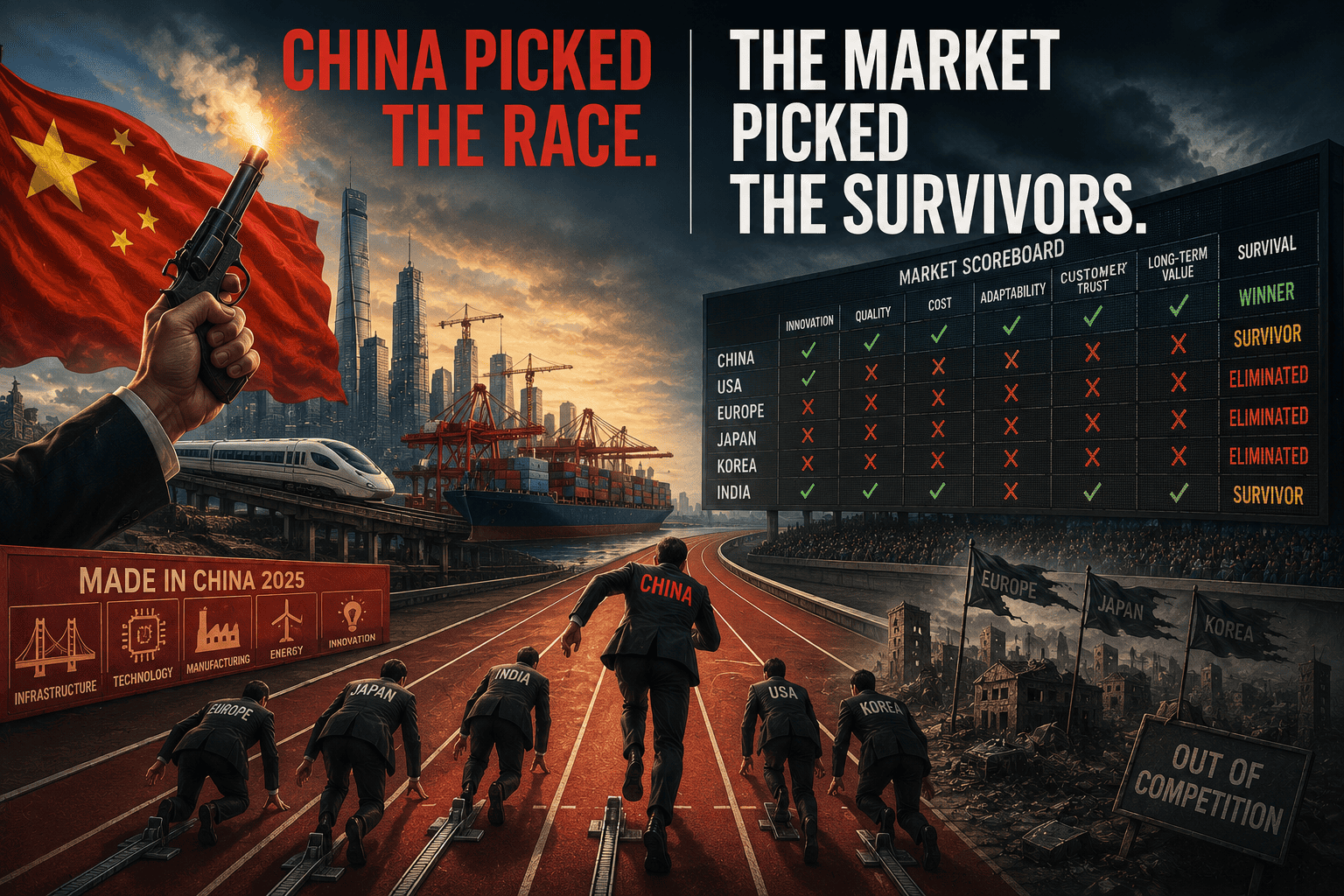
China Picked the Race. The Market Picked the Survivors.
China Picked the Race. The Market Picked the Survivors.
China’s industrial system combines state direction, strategic subsidies, and hypercompetitive private-sector competition in ways that older economic categories no longer fully explain.
Ten miles separate two buildings in Hebei province that shouldn’t exist in the same economy.
The first is a state-owned steel plant. Old industrial machinery. Smoke is pushing into the sky. Production levels are exceeding what the market actually needs. From a narrow efficiency reading, it should have closed a decade ago. But closure means unemployment. Social instability. Political risk, the center doesn’t want to absorb right now.
So the plant survives.
Ten miles away, a private battery startup operates inside sterile cleanrooms under bright white lighting. Government grants fund hiring. Engineers work on next-generation storage technology.
The same state helping sustain an unprofitable steel plant is also financing the industry designed to replace parts of it.
One economy. Two time periods. The smoke and the cleanroom exist side by side like overlapping versions of a future that hasn’t fully decided which one wins yet.
That contrast is not a contradiction; the system is waiting to resolve. It is the system operating exactly as intended.
What BYD Actually Shows
The standard explanation for BYD’s rise: government support. Subsidies mattered. Cheap financing mattered. Protection from foreign competition mattered.
All of that is true. None of it is the complete story.
Inside China’s EV sector, companies are simultaneously tearing each other apart through competition so intense it borders on biological. Prices collapse. Margins shrink. Firms die constantly. New brands appear almost monthly.
The state did not pick a winner and hand it dominance.
It picked the race. Built the track. Then let companies run hard enough that many collapsed before reaching the finish line.
BYD began making phone batteries. Then, electric cars. Then became one of the most consequential EV manufacturers in the world, eventually outselling Tesla in several categories. That outcome required surviving not just the market but policy shifts, local politics, industrial overcapacity, subsidy changes, and relentless domestic competition — simultaneously, across two decades.
The selection pressure that produces a company capable of surviving all of that is different from the selection pressure a purely market system generates.
Support was real. So was the brutality of what happened inside the support.
The Conversation That Stayed
A German auto executive said something revealing over dinner in Berlin. “We can’t compete with Chinese state subsidies.”
A few glasses later, he admitted his own company survived partly because of state support after 2008.
How temporary was fifteen years of cheap financing and industrial protection, really?
He laughed. Changed the subject to wine.
The deeper divide in the global economy may no longer be between free markets and state intervention. It may be between systems willing to openly coordinate markets and systems still performing the pretense that they don’t.
Every major economy now intervenes heavily during strategic moments. The CHIPS Act. The Inflation Reduction Act. Export controls. Energy transition funding. The tools increasingly resemble each other across Washington, Brussels, and Beijing. The rhetoric does not.
What the System Is Actually Optimizing For
A Western efficiency analysis of the Hebei steel plant produces a clear verdict: close it.
The system’s verdict is different: not yet.
Closure generates unemployment. Unemployment generates instability. Instability is the thing the system is most consistently designed to prevent. So the plant stays open — absorbing losses on one ledger while the system gains something on another.
The workers in that steel plant are not a line item in a transition plan. They are people whose livelihoods are held inside a calculation they didn’t design and can’t slow down.
The people running this system are not failing to see the inefficiency. They are running a different calculation — one where social stability outweighs narrow market efficiency, and where the losses on the steel ledger are a deliberate subsidy to the political ledger.
The calculation is coherent. It just doesn’t appear in any single spreadsheet.
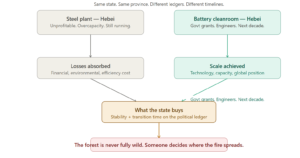
The smoke from the plant is the cost of buying transition time. The chemicals in the cleanroom are the bet that the time is being used correctly. The state is not trying to extinguish every inefficient fire. It is managing a controlled burn.
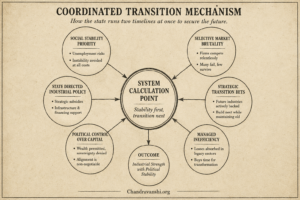
State stability priorities and market selection pressures operate simultaneously inside the same industrial system.
The Psychology of Leased Authority
Western capitalism carries an assumption so embedded it rarely gets named: economic power eventually converts into independent political influence. Build enough wealth, and you build enough autonomy.
In China, the capital behaves more like a leased authority. Productive as long as alignment continues. Fragile the moment it doesn’t.
Jack Ma understood this — or understood it insufficiently. After his November 2020 speech criticizing regulators, Ant Group’s IPO was pulled hours before listing. The company, approaching a $37 billion IPO, the largest in history at that point, was restructured under regulatory oversight.
The message underneath the system is consistent even when nobody says it directly: you may accumulate wealth. You may not accumulate sovereignty.
Private firms can grow rapidly — but there are sectors where political authority outranks shareholder logic immediately. Everyone inside the system understands which sectors those are, even when the list is not written down anywhere.
What is strange, watching this from outside, is that people still build. Entrepreneurs know the rules can shift. Investors know political campaigns can reorder entire industries overnight.
They continue anyway. Not despite the conditionality. Inside it.
The Uncomfortable Possibility
What if China is not the historical exception?
What if most advanced economies are drifting toward versions of state capitalism themselves — just with a different language attached?
The state never really disappeared from capitalism anywhere. China built a version where state involvement stayed visible instead of hiding quietly in the background. The visibility is what generates the accusation of unfair competition — not the intervention itself, which is everywhere.
The debt problems are real. Demographic pressure is serious. Misallocation happens constantly. Entire apartment blocks appear before enough people exist to fill them.
But the system has survived longer, scaled larger, and produced more industrial capacity than most critics expected — and in doing so has made the question of what “free market” means in a world of strategic industrial competition genuinely harder to answer than it was thirty years ago.
The steel plant and the cleanroom are ten miles apart in Hebei.
Both are products of the same system. Both are needed by the same system, for different reasons, on different timelines.
The market inside that system is real. Competition is real. Failure is real.
But the forest is never fully wild. Someone is still deciding where the fire spreads.
Whether that someone can keep deciding it — as demographics shift, as debt resolves, as the next technology cycle demands the kind of distributed experimentation that centralized control tends to compress — is the only question about this system that the next twenty years will actually answer.
What This Changes
The categories capitalism and socialism are not wrong descriptions of China’s system — they are descriptions built for systems that choose between the two. This system didn’t choose. The refusal to choose is the design.
The BYD story is incomplete without the companies that didn’t survive the same selection pressure. Government support was real. So was the brutality of domestic competition inside that support. The combination is what produced the outcome.
The Hebei steel plant is not an inefficiency that the system failed to clean up. It is the system operating as designed — absorbing losses on one ledger to purchase stability and transition time on another.
“Aligning with national strategy” is not a startup’s marketing language. It is the operating condition under which private enterprise functions. Understanding the lease terms is a prerequisite to understanding any specific business outcome.
The divide between free markets and state capitalism is less a divide between two different economic philosophies and more a divide between systems that openly coordinate markets and systems that do the same thing while maintaining the rhetoric of not doing it.
FAQ
What is state capitalism, and how does China’s version differ from Western models?
State capitalism refers broadly to economic systems where the state plays a significant role in directing, owning, or shaping market activity. In most Western economies, state intervention happens episodically — during crises, in strategic sectors — while market logic is presented as the default. In China, state coordination is a continuous and acknowledged feature of how the economy operates. The party does not stand outside the market correcting failures. It sits inside the market shaping direction. That integration is the structural difference, and it produces different behavior from private actors who understand that economic authority is conditional on political alignment.
How did BYD become competitive globally without simply being handed market dominance?
BYD received substantial government support — subsidies, infrastructure investment, protection from foreign competition, and cheap financing across multiple decades. What the support-only explanation misses is the intensity of domestic competition inside China’s EV sector. Prices collapsed. Margins compressed. Dozens of companies failed. The global competitiveness emerged from that specific combination — not from support alone.
What does “capital as leased authority” mean in practice for businesses operating in China?
It means that private wealth accumulation is permitted and encouraged within boundaries that remain politically reversible. A company can scale to enormous size — Alibaba, Tencent, BYD, Huawei all demonstrate this — but only within sectors the party judges compatible with its political priorities. When a company grows large enough that its independence starts to resemble political sovereignty, the system recalibrates. The Ant Group IPO cancellation in November 2020 is the clearest recent example.
Is Western industrial policy becoming more similar to Chinese state capitalism?
The tools are converging. The CHIPS and Science Act of 2022 allocated approximately $52 billion in semiconductor subsidies. The Inflation Reduction Act directed hundreds of billions toward energy transition manufacturing. These interventions function as industrial policy regardless of what they are called. The meaningful difference that remains is the degree of continuous coordination — Western governments intervene strategically during defined moments, while China’s system coordinates continuously.
What are the genuine vulnerabilities in China’s state capitalism model?
Three are structurally significant. First, debt accumulated during the high-growth phase — particularly in local government financing vehicles and the property sector — represents a liability still being resolved. Second, demographic decline is compressing the labor force that made manufacturing-led growth viable. Third, political centralization tends to compress the decentralized experimentation that technology innovation requires. The system has demonstrated it can manage each of these pressures sequentially. Whether it can manage all three simultaneously is the test currently running.
The steel plant and the cleanroom are ten miles apart in Hebei.
Both are products of the same system. Both are needed by the same system, for different reasons, on different timelines.
The smoke from the plant is the cost of buying transition time. The chemicals in the cleanroom are the bet that the time is being used correctly.
The state is not trying to extinguish every inefficient fire.
It is managing a controlled burn — keeping old industries alive long enough for new ones to harden beside them, letting some sectors overheat so others achieve scale first, absorbing losses in one place to gain a strategic position somewhere else.
The market inside that system is real. Competition is real. Failure is real.
But the forest is never fully wild.
Someone is still deciding where the fire spreads.
Whether that someone can keep deciding it — as the demographics shift, as the debt resolves, as the technology cycle demands the kind of distributed experimentation that centralized control tends to compress — is the only question about this system that the next twenty years will actually answer.