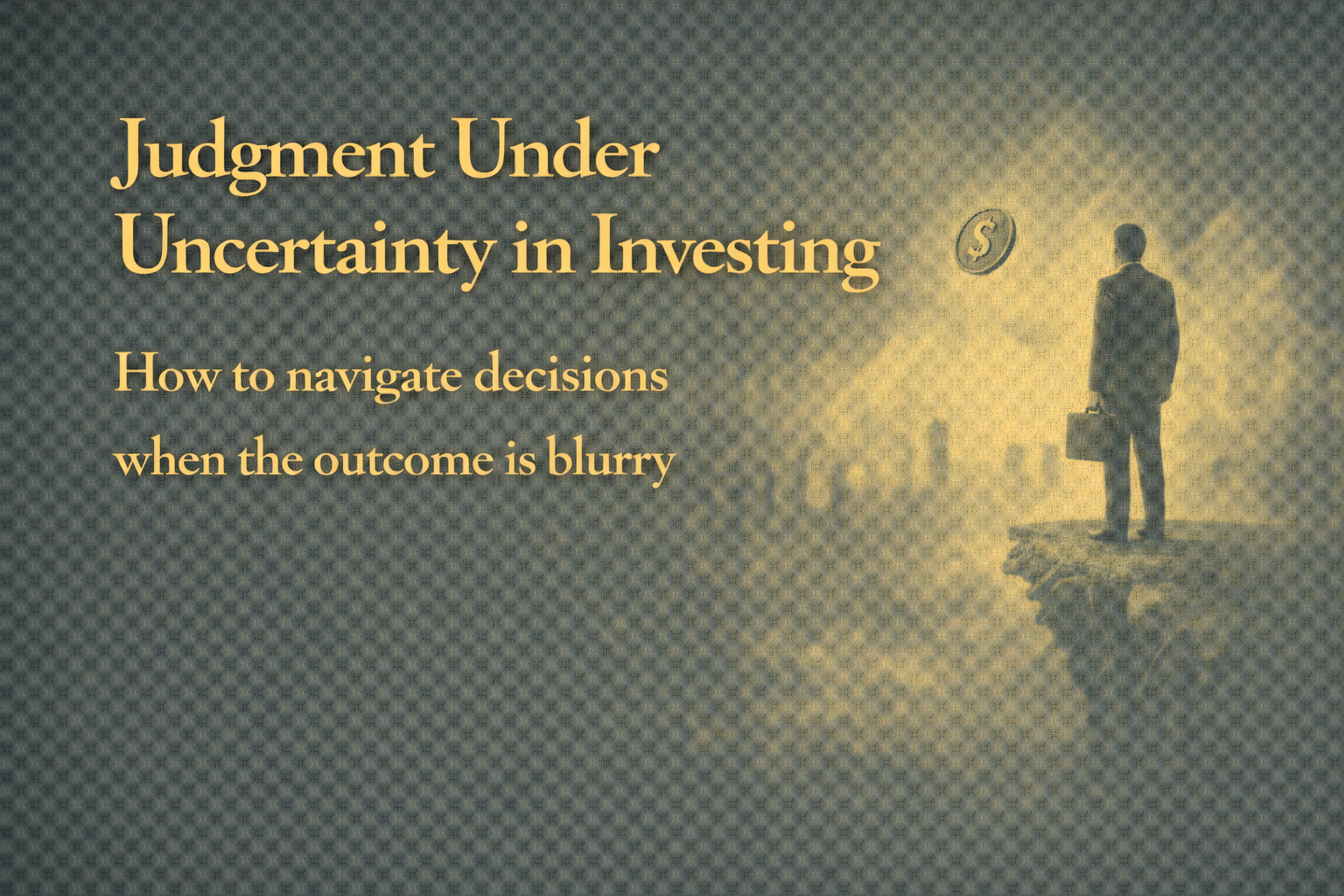
Judgment Under Uncertainty in Investing: How Risk, Timing, and Confidence Destroy Capital
Judgment Under Uncertainty in Investing: Why Capital Erodes Quietly Before Losses Become Visible
When markets feel uncertain, most people assume losses come from bad picks or bad timing.
That explanation is incomplete.
Capital destruction usually happens through a quieter mechanism:
- decisions that looked rational at the time
- analysis that appeared thorough
- logic that felt disciplined and responsible
Judgment under uncertainty in investing means making capital decisions when:
- outcomes cannot be fully known
- probabilities are incomplete
- feedback arrives late, sometimes years later
You are not choosing between obvious right and wrong.
You are choosing without confirmation.
That is why capital can erode without visible mistakes.
By the time results appear, the conditions that mattered may already have changed.
What failed was not necessarily intelligence or discipline.
It was judgment operating inside uncertainty that never allowed complete verification.
This article explains:
- what judgment under uncertainty actually means in investing
- how risk becomes abstract until loss magnitude disappears
- why timing distorts learning faster than selection errors
- how confidence scales exposure before accuracy improves
- where standard investing frameworks break down
- what changes once you recognise the pattern clearly
By the end, you will understand why many major investment losses come from decisions that originally looked correct, and why certainty is often the most expensive signal in markets.
What Judgment Under Uncertainty Actually Means
Most investing mistakes do not feel reckless.
They feel reasonable.
Often professional.
That is the trap.
Deciding Before Truth Exists
Judgment under uncertainty means making decisions before truth becomes available.
Not estimated.
Not clarified later.
Unavailable at the moment capital is committed.
In investing:
- prices move later
- information becomes clearer later
- consequences arrive last
Judgment operates first.
Why Investing Is Structurally Vulnerable
Most fields punish mistakes quickly.
Investing often does not.
Delayed feedback breaks learning.
A decision made today may:
- look brilliant before failing
- look foolish before succeeding
By the time outcomes appear, memory has usually rewritten the original decision.
There is also no counterfactual visibility.
You never see the world where:
- you did not buy
- you exited earlier
- you sized differently
Only one path resolves.
The alternatives disappear.
Then randomness complicates everything further.
Short-term success rewards confidence before understanding.
Luck often wears the appearance of skill.
Markets reinforce behaviour long before they verify reasoning.
Key Distinctions That Matter
Risk vs Uncertainty
Risk involves measurable probabilities.
Uncertainty does not.
Most investment losses happen when uncertainty is treated as measurable risk.
Timing Risk
Being right too early or too late can overwhelm being fundamentally correct.
Correct analysis can still lose money if timing fails.
Confidence Error
Confidence increases exposure faster than accuracy improves.
Conviction changes position size.
It does not change reality.
Outcome Bias
Investors constantly judge decisions by results rather than by information available at the time.
Markets encourage this mistake relentlessly.
The Mechanism That Quietly Erodes Capital
Capital is rarely destroyed in one dramatic move.
It usually erodes through systems that feel controlled while they operate.
When Risk Becomes Abstract
Most investors believe they are measuring risk.
Often, they are measuring movement.
Volatility becomes a proxy for danger.
Drawdowns become “temporary noise.”
The framing quietly shifts:
Risk stops meaning ruin.
It starts meaning fluctuation.
Once that shift happens, investors begin asking:
“How often does this happen?”
instead of:
“What happens if it does?”
That substitution is dangerous under uncertainty.
Low-probability events with extreme consequences dominate long-term outcomes.
But abstraction mentally shrinks those consequences until they stop feeling real.
How Timing Distorts Learning
Timing errors rarely announce themselves immediately.
Early success often reinforces the wrong lesson.
An investment entered too early that rises anyway rewards:
- speed
- confidence
- premature certainty
The opposite distortion happens later.
Late entries feel safer because:
- prices already moved
- social proof increased
- confirmation feels visible
Yet risk may already be higher.
Timing does not simply affect returns.
It reshapes belief.
Correct ideas entered poorly lose money.
Weak ideas entered during favourable momentum create confidence.
Confidence as Hidden Leverage
Confidence is not psychologically neutral.
It acts like invisible leverage.
As conviction rises:
- position sizes expand
- execution speeds increase
- contingencies disappear
Accuracy rarely improves proportionally.
Scenarios collapse into narratives.
Doubt feels unnecessary.
Nothing appears reckless.
The investor simply feels decisive.
That is where fragility forms.
Exposure grows because discomfort falls, not because uncertainty disappeared.
Why Markets Corrupt Learning
Markets are poor teachers.
Good decisions are often punished temporarily.
Bad decisions are often rewarded temporarily.
This reverses the learning signal.
Investors begin updating beliefs from outcomes instead of process quality.
Over time:
- confidence compounds
- calibration weakens
- narratives replace evaluation
Experience accumulates.
Accuracy does not necessarily compound with it.
Where This Appears in Real Markets
Long-Term Investing
Long-term investors often assume time itself provides protection.
Sometimes it does.
Sometimes it hides risk.
As narratives survive longer:
- familiarity grows
- confidence hardens
- structural risks become “temporary noise”
Valuation discipline weakens during momentum.
Rising prices feel like confirmation.
Exposure expands precisely when the margin for error narrows.
When conditions change:
- competition
- interest rates
- regulation
- liquidity
the loss appears sudden.
But the fragility formed much earlier.
Trading and Short-Term Markets
Short-term environments intensify the same mechanisms.
Traders develop timing precision illusions.
Early wins reinforce speed.
Leverage magnifies confidence errors, not insight.
Small timing mistakes become large losses because exposure expanded faster than adaptability.
The market rewards responsiveness until the environment changes.
Then accumulated exposure becomes visible all at once.
Portfolio Construction
Diversification often hides concentration instead of eliminating it.
Assets appear different.
Their underlying drivers remain connected.
Correlations seem stable during calm conditions.
During stress, they converge rapidly.
Portfolios that looked balanced reveal hidden dependence:
- liquidity dependence
- macro dependence
- rate sensitivity
- crowded positioning
The failure is rarely obvious beforehand.
That is why diversification sometimes collapses exactly when it is needed most.
Where Standard Models Break Down
Regime Changes
Most investing frameworks rely on historical relationships.
The problem is simple:
History changes.
Markets evolve:
- participants rotate
- incentives shift
- technology changes
- policy environments move
Models trained on old conditions become obsolete quietly.
The longer a pattern worked historically, the more convincing it feels.
That familiarity becomes dangerous during transition periods.
Asymmetric Risks
Some risks cannot be averaged away statistically.
Rare but catastrophic outcomes dominate long-term investing history.
Standard models underestimate them because:
- they occur infrequently
- they sit outside normal distributions
- they appear manageable until they suddenly are not
Investors can appear consistently correct for years before one event overwhelms the entire record.
Liquidity Stress
Sometimes analysis is correct and capital is still lost.
Liquidity changes everything.
In stable markets:
- exits feel available
- prices feel continuous
- execution appears easy
Under stress:
- buyers disappear
- spreads widen
- exits compete with each other
The issue is no longer prediction.
It becomes survivability.
Three Persistent Errors Investors Repeatedly Make
“Experience Reduces Uncertainty”
Experience reduces discomfort.
It does not eliminate uncertainty.
Familiarity speeds decisions.
Confidence scales faster than calibration.
Experienced investors often stop asking:
“What is different this time?”
That question is where protection usually lives.
“High Conviction Improves Outcomes”
Conviction changes exposure.
It does not change truth.
High conviction:
- increases size
- reduces flexibility
- collapses alternative scenarios
The market does not reward confidence consistently.
It rewards conditions aligning temporarily with exposure.
“Risk Can Be Fully Modelled”
Models are useful.
They are not complete.
The greatest dangers often sit outside measurable frameworks entirely.
Models reduce discomfort by converting ambiguity into numbers.
That conversion can create dangerous overconfidence in environments where uncertainty remains fundamentally unknowable.
What Changes Once You See This Clearly
This framework is not about predicting markes perfectly.
It changes interpretation.
Signals Worth Watching
Pay attention when:
- confidence rises faster than information quality
- decisions become faster without better evidence
- clarity appears unusually early
- alternatives stop being discussed
These are not guarantees of failure.
They are signals that uncertainty may have been mentally compressed too quickly.
What to Distrust
Distrust:
- perfectly clean narratives
- smooth backtests
- certainty during transition periods
- confidence unsupported by optionality
Markets are uneven.
Excessive smoothness often hides hidden exposure.
The Most Important Shift
The central question changes from:
“Is this investment right?”
to:
“How much does this assumption rely on uncertainty resolving favourably?”
That shift matters more than prediction itself.
Final Perspective
Judgment under uncertainty in investing means allocating capital before outcomes can be known with certainty.
That condition never disappears completely.
What changes is how investors interpret confidence, risk, and exposure while uncertainty still exists.
Most capital is not destroyed by obviously irrational decisions.
It is destroyed when:
- confidence rises faster than information
- exposure expands faster than adaptability
- certainty appears before uncertainty actually leaves
Markets tolerate incorrect beliefs for surprisingly long periods.
What they eventually punish is accumulated exposure built on unresolved assumptions.
The most dangerous signal in investing is often not fear.
It is the moment uncertainty starts feeling settled before reality has actually confirmed anything.
About the Author
Mr Chandravanshi writes about judgment under uncertainty, capital allocation, market structure, and human decision errors.