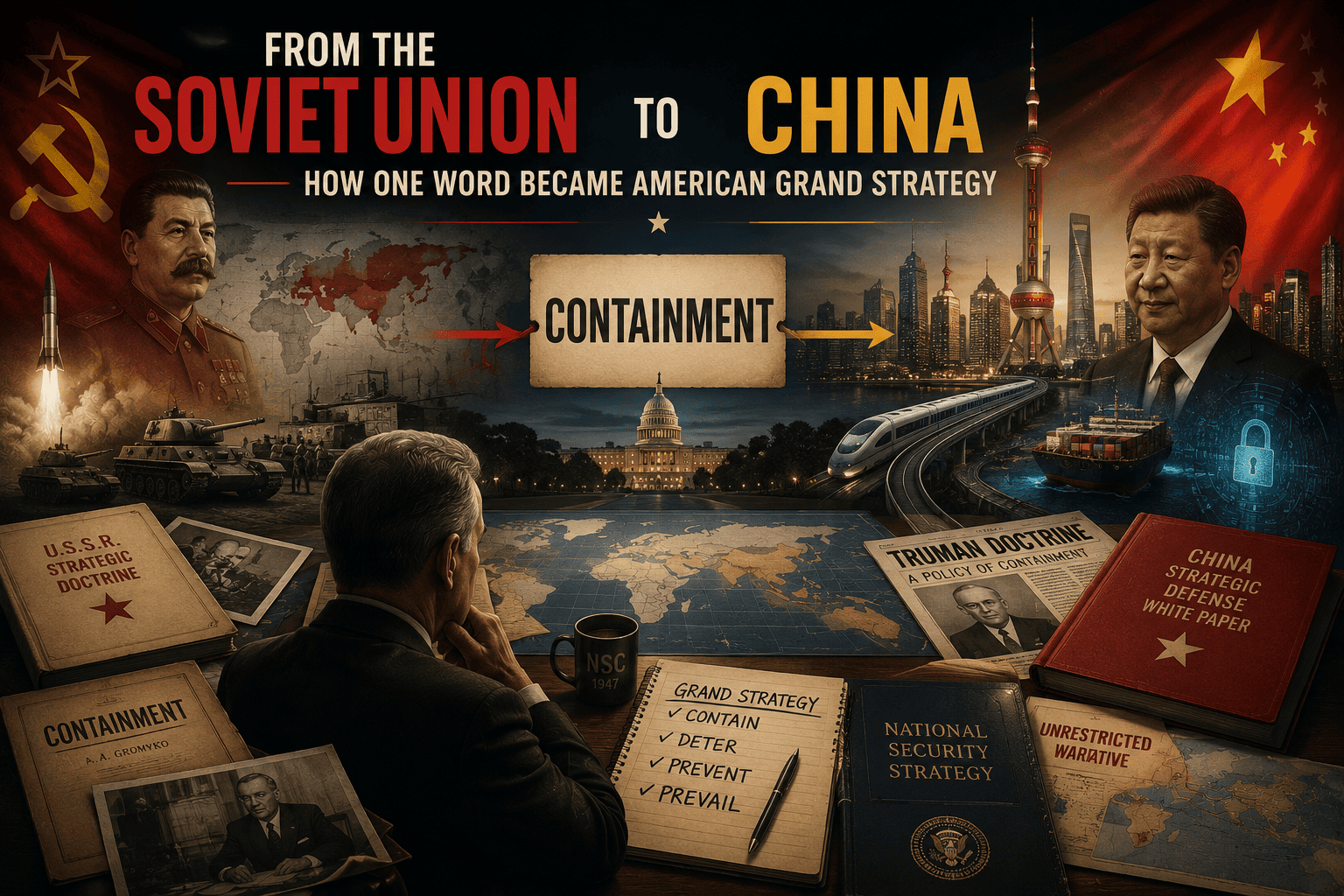
From the Soviet Union to China: How One Word Became American Grand Strategy
George Kennan wrote a nuanced diagnosis of Soviet behavior in 1946. Washington turned it into a permanent doctrine that still shapes how America confronts rival powers today.
George Kennan wrote 5,000 words so that no one could misunderstand him.
It didn’t work.
The year was 1946. He was sitting in a Moscow hotel room in winter, a diplomat who had spent years watching the Soviet government behave, argue, threaten, and retreat. He had watched it closely enough to understand something most of Washington hadn’t yet grasped: the Soviet leadership wasn’t driven by Marxist conviction so much as by old Russian fear.
A country that had been invaded from every direction across centuries. A government that needed enemies outside to justify control inside. Calculating, not reckless. Willing to probe, willing to pull back.
He wrote all of this down. Every qualification. Every caveat. Five thousand words of careful, conditional, honest observation. Then he sent it.
Washington read it, pulled out one word, and ran with it for forty years.
The word was containment.
The Long Telegram is not what you expect when someone tells you it changed the world.
You expect a battle plan. A list of targets. Instead, you get something closer to a psychiatrist’s notes on a difficult patient. Kennan described what the Soviet system feared, where the fear came from, and how it expressed itself in behavior. He was doing a diagnosis.
He was explicit that the Soviet leadership was not suicidal, not irrational, not looking for war. They would expand where they found no resistance. They would stop where they did. The correct response, in his reading, was patient political and economic competition. Let the system collapse under its own weight. Don’t panic.
He was right about the Soviet Union. It collapsed under its own weight in 1991, more or less on the schedule a careful reader of his analysis would have predicted. He was ignored about nearly everything else.
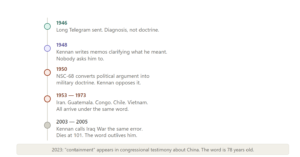
By 1948, two years after the Telegram, Kennan was already writing internal memos trying to clarify what he had meant. By the Korean War, he opposed the direction American policy had taken. In Vietnam, he was testifying before Congress that the entire enterprise was a catastrophe built on a misreading of his own document.
He lived until 2005. He watched the Iraq War begin and said publicly it was the same error, the same logic, the same word pulled across another set of wrong facts. The word had outlived its author by about fifty years, and he was still alive.
Here is the part that takes a moment to absorb.
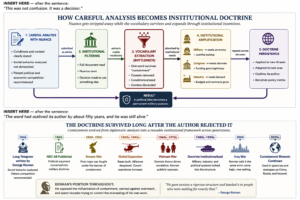
NSC-68, the 1950 policy document that converted containment from a political idea into a military doctrine, was not written by people who had misunderstood Kennan. Paul Nitze and the people around him had read the Long Telegram in full. They knew what the qualifications said. They chose something different.
This was not confusion. It was a decision.
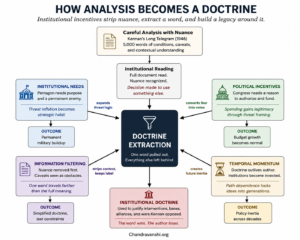
Nuance gets stripped away while the vocabulary survives and expands through institutional incentives.
The word “containment” was an empty container. The military planners, the defense contractors, the career anticommunists — each poured in whatever they needed. Every new intervention became defensive. Every new base became necessary. Every new government that needed overthrowing was Soviet-backed, until it wasn’t, at which point the money had already been spent and the relationships already established.
Iran, 1953. Guatemala, 1954. Congo, 1960. Chile, 1973. A war in Korea that never formally ended. A war in Vietnam built on a domino theory, which Kennan called a fantasy, killed three million people. Dictators from Marcos to Pinochet were armed and supported because they were anti-communist, which meant they were useful.
None of this is what the Telegram called for. But all of it arrived under the same word.
Five thousand words of nuance. One word of policy. The word won.
Look at a map of American military installations in 1946. Then look at one from 1970. Then look at one today — bases in roughly 140 countries, a defense budget that functions as a permanent political constituency, meaning it cannot go down regardless of what the actual threat level is.
That is not the footprint of a country responding to danger. That is the footprint of an institution that found, in one diplomat’s careful prose, the vocabulary it had been waiting for.
This is the part Kennan eventually understood and couldn’t stop talking about, to less and less effect. He had written into an institution that was already looking for a story. The State Department needed a doctrine. The Pentagon needed an enemy. Congress needed a reason to vote yes.
He gave anxiety a rigorous structure and handed it to people who were waiting for exactly that: a serious-sounding name for what they had already decided to do.
The misreading wasn’t a failure of comprehension. It was comprehension followed by deliberate replacement.
The Long Telegram didn’t create American militarism. It arrived at an institution that had already begun building the apparatus — the bases, the budgets, the career structures, the political alliances — that needed a doctrine to justify itself. Kennan’s language fit perfectly. Not because it said what the institution wanted, but because it was serious enough, careful enough, credentialed enough to be borrowed.
The words were stripped. The scaffolding was kept.
What’s uncomfortable, reading the Telegram carefully today, is something else entirely. Kennan was writing about Soviet paranoia — a leadership that required external enemies to justify internal control, a country that had to keep moving to feel safe, an anxiety architecture dressed up as strategy.
The description fits the responding country just as cleanly once the machine got running.
A defense budget that cannot shrink regardless of threat level. A foreign policy apparatus that generates enemies faster than it resolves them. Leadership that finds, in each new crisis, the justification for the last decade of spending. An institution so large that its continuation became the goal, separate from any outcome it was supposed to produce.
Kennan was diagnosing the Soviets. He was also, without intending to, drawing a portrait of what the response would become.
Kennan went to Princeton. He wrote history books. He gave interviews. He sent letters.
He watched his most famous document travel farther and farther from what he had written, attached now to interventions he opposed, wars he testified against, a doctrine that had grown into an industry. The institution had no more use for him. He was too qualified, too conditional, kept insisting on caveats that the machine had long since discarded.
There is something specific about that position — to be alive, lucid, and professionally irrelevant to the thing you created. The document had escaped. The word was running. The author was an inconvenience.
This is how bureaucracies digest careful thinking. Not by refuting it. By absorbing the vocabulary and releasing the reasoning. The caveats disappear first. Then the conditions. Then the historical context. What remains is a clean label that can be attached to the next decision that has already been made.
The 5,000 words didn’t survive the translation into one. What was lost in that compression — the conditions, the limits, the honest acknowledgment of what the analysis could and couldn’t support — is precisely what would have constrained the application. That’s why it was removed. Not accidentally. Because constraint was not what the institution needed from the document.
The harder question is whether a more faithful reading would have changed anything.
Kennan himself seemed to believe it would have, which is why he spent decades trying to correct the record. But the evidence points somewhere more uncomfortable. The institution was not waiting for the right interpretation. It was waiting for the right vocabulary.
If Kennan hadn’t provided it, someone else would have. NSC-68 would have found another serious-sounding framework. The bases would have been built. The budget would have grown. The territory had already been decided. Kennan drew the map.
This is the version of the story that doesn’t have a corrective ending. The lesson is not: write more carefully, qualify more precisely, explain more thoroughly. Kennan did all of those things. The lesson is that a document enters an institution, and the institution uses it, and what the document intended is a separate question from what the institution needed.
Every analyst who has ever written a careful, conditional assessment and then watched it get converted into a headline knows this feeling. The qualification is the first thing that goes. The nuance is the second. What survives is whatever fits the decision already in progress.
Kennan spent sixty years learning that the map and the territory are not the same thing.
The word “containment” is still in use. It appeared in congressional testimony about China in 2023. It appeared in assessments of Russian behavior after 2022. The word is 78 years old. Kennan is 22 years dead.
The vocabulary he chose that winter in Moscow is still running, still generating budgets and alliances and rationales, still being borrowed for decisions he never imagined and would not have endorsed.
Five thousand words of nuance. One word of policy.
The word won. It always does.
What This Changes
A doctrine is not a translation of an analysis. It is what the institution that receives the analysis decides to make of it, independent of what the analysis said.
The Long Telegram’s qualifications were not lost in translation. They were removed deliberately by people who had read them.
Containment as military doctrine was not Kennan’s prescription. NSC-68, drafted four years later, converted his political argument into a defense posture he spent the rest of his life opposing.
The gap between what a careful thinker writes and what an institution does with it is not a failure of communication. It is the normal operation of institutions.
FAQ
What was the Long Telegram, and why does it matter?
The Long Telegram was an 8,000-word cable sent by George Kennan from Moscow in February 1946. It described Soviet foreign policy behavior, its historical roots in Russian anxiety, and argued that the USSR would expand opportunistically but retreat where it found firm resistance. It matters because it is the clearest example in modern diplomatic history of a careful analysis being stripped of its conditions and converted into something its author spent decades opposing.
Did Kennan support the Cold War policies carried out in his name?
No. Kennan opposed the militarization of containment from an early stage. He argued against NSC-68, opposed American involvement in Korea, testified before Congress against Vietnam, and publicly criticized the Iraq War in 2003. The policies associated with his doctrine were, in his own view, a misapplication of his analysis.
What is NSC-68, and how does it relate to the Long Telegram?
NSC-68 was a classified policy document produced in 1950, primarily drafted by Paul Nitze. It converted Kennan’s political argument for patient competition into a rationale for massive military buildup. Where Kennan had argued the Soviet system would eventually fail on its own, NSC-68 argued for urgent, large-scale rearmament. Kennan opposed it. NSC-68 became American policy regardless.
Why couldn’t Kennan correct the misreading once it had happened?
By the time Kennan began pushing back — which he did as early as 1948 — the doctrine had already acquired institutional momentum. Careers, budgets, alliances, and political constituencies had organized around it. An author disputing the application of their own work has no institutional leverage against that kind of accumulated interest. Kennan was sidelined, moved to Princeton, and watched from outside as the machine he had inadvertently supplied with vocabulary ran in directions he opposed.
Does this pattern appear elsewhere in policy history?
Consistently. The gap between what an analyst intended and what a policy institution does with the analysis is not a Cold War-specific phenomenon. It describes how most careful assessments travel through bureaucracies: the conditions get removed, the vocabulary gets retained, and the original reasoning becomes available for attachment to decisions already in progress. The analyst becomes irrelevant the moment the institution finds the phrase it needed.