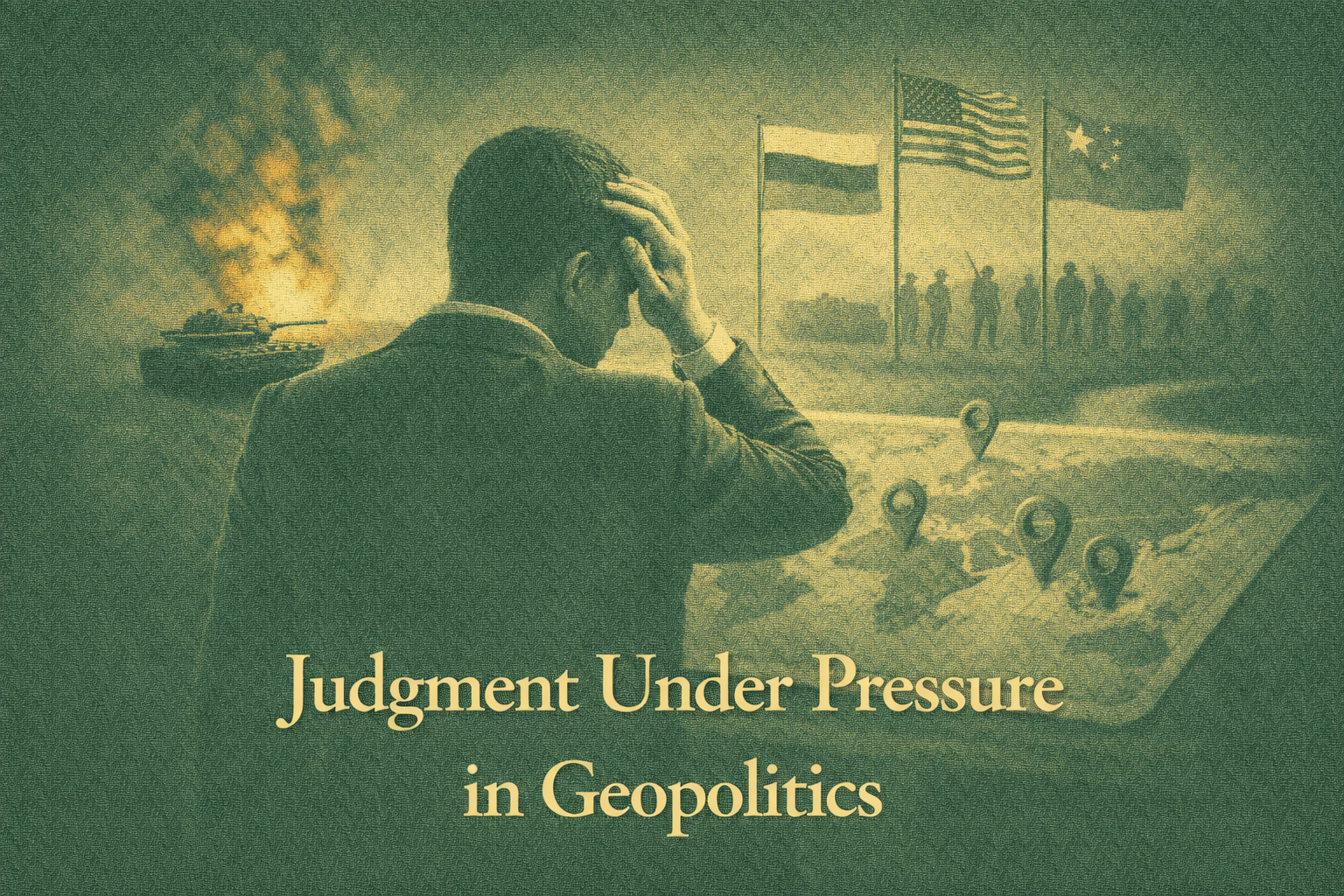
Judgment Under Pressure in Geopolitics: Causes, Effects, and Misreads
Geopolitical Judgment: How Strategic Thinking Collapses Under Pressure
Geopolitical judgment is the ability to assess power dynamics, predict state behaviour, and understand how nations act under strategic constraints.
It matters because errors in geopolitical judgment lead to miscalculated wars, failed alliances, and long-term strategic erosion.
This guide covers:
- What geopolitical judgment actually is
- How pressure distorts decision-making in foreign policy
- Where judgment breaks under crisis conditions
- Common misreads that lead to strategic failure
- When restraint outperforms action
By the end, you will understand how geopolitical judgment degrades under pressure and why most strategic errors are not caused by bad information, but by compressed thinking.
Understanding Geopolitical Judgment
Geopolitical judgment is the capacity to evaluate state actions, predict responses, and understand how constraints shape behaviour across nations and regions.
States operate under pressures fundamentally different from individuals or corporations.
Geographic position, resource access, historical grievances, demographic realities, and alliance structures all create incentives that remain invisible if analysis focuses only on speeches or policy statements.
When people discuss geopolitics, they often merge it with international relations theory or foreign policy commentary.
Geopolitical judgment is narrower and more structural.
It focuses on what states can realistically do under material and geographic constraints, not merely what leaders claim they want.
How Geopolitical Judgment Differs From Military Strategy
Military strategy focuses on:
- Force deployment
- Tactical operations
- Battlefield positioning
- Operational logistics
Geopolitical judgment operates on a longer time horizon.
It examines:
- Resource dependency
- Strategic chokepoints
- Alliance durability
- Economic vulnerability
- Regional balance shifts
Military decisions occur inside geopolitical constraints.
Confusing the two creates distorted analysis because tactical victories can still produce long-term strategic decline.
How Pressure Distorts Geopolitical Judgment
Judgment under pressure compresses in predictable ways.
Speed Replaces Deliberation
When crises escalate, decision-makers face shrinking time windows.
Assessments that would normally take weeks become compressed into hours.
Complex strategic trade-offs get reduced into binary choices.
This is not usually incompetence.
Fast decision-making structurally favours immediate threats over long-term positioning.
A leader managing a missile crisis prioritises avoiding catastrophe today, even if the chosen solution creates strategic weakness over the next decade.
The trade-off is subtle:
- Short-term stability improves
- Long-term leverage erodes
States often stabilise crises by accepting arrangements they would reject under calmer conditions.
Consensus Suppresses Dissent
Under geopolitical stress, disagreement begins feeling dangerous.
Leaders prioritise unity because uncertainty appears indistinguishable from weakness.
This creates an internal filtering process:
- Contradictory intelligence gets downweighted
- Alternative scenarios appear unrealistic
- Uncertainty becomes politically costly
The narrowing happens gradually.
Early dissent frequently identifies structural vulnerabilities that consensus ignores.
By the time those vulnerabilities become undeniable, response options have already narrowed.
Historical Analogies Replace Analysis
Under pressure, leaders often reach for familiar historical parallels:
“This is another Munich.”
“This is another 1914.”
Analogies simplify complexity.
They compress a multi-variable geopolitical situation into pattern recognition.
That creates emotional clarity.
But the clarity is often false.
Two crises may share surface similarities while operating under completely different:
- Alliance structures
- Technological conditions
- Economic dependencies
- Nuclear constraints
- Domestic political pressures
Decision-makers believe they are learning from history when they may actually be filtering out the information that makes the current situation unique.
Alliance Commitments Override Strategic Logic
As pressure rises, alliance cohesion frequently becomes more important than strategic optimisation.
States may support allies even when doing so damages their own long-term interests because abandoning the ally signals unreliability to other partners.
This changes the core decision framework.
The question stops being:
“Does this action serve our long-term interests?”
And becomes:
“What does refusal signal about our commitments?”
Alliance systems formed under one historical condition often persist long after those conditions change.
The reputational cost of leaving becomes higher than the immediate strategic cost of staying.
Where Geopolitical Judgment Breaks Under Stress
When Clarity Hardens Too Early
Leaders under pressure demand certainty.
Intelligence systems respond by compressing probability ranges into definitive assessments.
Uncertainty becomes politically inconvenient.
This creates a false sense of control.
Decision-makers feel informed when they may simply be operating inside narrowed assumptions.
Once clarity hardens:
- Contradictory intelligence gets dismissed
- Alternative interpretations disappear
- New evidence becomes “noise”
The danger is not uncertainty itself.
The danger is pretending uncertainty has disappeared.
When Time Horizons Collapse
Geopolitical systems evolve over decades.
Crises compress planning horizons into days or months.
Actions that stabilise immediate conditions often create long-term vulnerabilities that remain invisible inside the compressed timeframe.
A ceasefire may stop violence temporarily while locking in territorial conditions that guarantee future instability.
The feedback loop becomes distorted.
By the time long-term consequences emerge:
- The original decision-makers are gone
- The causal chain is obscured
- The earlier trade-off feels invisible
When Escalation Becomes Automatic
States develop escalation ladders to prevent paralysis during crises.
These systems create structure under uncertainty.
But they also create momentum.
Each escalation step begins justifying the next one.
Decision-makers gradually stop asking:
“Does escalation still serve strategic goals?”
And begin asking:
“Can we afford to appear weak?”
Strategic judgment quietly gets replaced by positional logic.
When Domestic Politics Override Strategy
Leaders do not operate only against foreign adversaries.
They also operate under domestic political pressure.
During crises, public audiences demand visible action.
Restraint frequently appears weak even when restraint is strategically correct.
This creates a structural conflict:
- The politically safe choice is visible escalation
- The strategically optimal choice may be delay or restraint
The pressure is systemic, not personal.
Even leaders who understand the strategic risks of escalation may still escalate because the political cost of caution arrives immediately while the strategic cost of escalation appears later.
Common Misreads in Geopolitical Judgment
Mistaking Capability for Intent
States often assess threats based on what adversaries can do rather than what they are incentivised to do.
Capability is measurable.
Intent is uncertain.
That makes capability-focused analysis emotionally comforting because it feels objective.
But capability without strategic incentive creates false urgency.
A weaker state with strong motivation may become more dangerous than a stronger state lacking incentive to act.
Strategic behaviour emerges from incentives, not raw capacity alone.
Assuming Rational Actor Models
Many geopolitical frameworks assume states behave rationally:
- Maximising utility
- Avoiding unnecessary costs
- Updating beliefs efficiently
This simplifies analysis.
But states are run by human systems.
Domestic politics, historical grievances, institutional inertia, ideology, and leadership psychology all distort supposedly rational behaviour.
Actions that appear irrational externally may make perfect sense internally.
Treating Deterrence as Permanent
Deterrence depends on psychological credibility.
It is not mechanically stable.
A deterrent threat only works when:
- The threat is believed
- The costs remain intolerable
Both conditions can erode gradually without obvious warning signs.
States adapt psychologically to previously unacceptable costs.
Boundary testing slowly weakens credibility.
When deterrence fails, the failure feels sudden.
The erosion was usually gradual.
Confusing Influence With Control
Economic leverage, sanctions, military presence, and diplomatic pressure create influence.
They do not create control.
The influenced state still retains agency.
It can:
- Absorb costs
- Shift alliances
- Develop alternatives
- Delay responses strategically
Influence creates friction.
It does not guarantee compliance.
Interpreting Geopolitical Signals
Geopolitical systems reveal themselves more clearly through changes than static conditions.
If Military Spending Increases
The immediate interpretation is usually rising aggression.
Reality is more complicated.
Increased military spending may reflect:
- Regional insecurity
- Domestic industrial lobbying
- Resource windfalls
- Institutional inertia
Context matters more than the raw spending number itself.
Flat spending during heightened regional tension can actually signal strategic confidence or internal constraint more clearly than rising budgets.
If Alliances Begin Weakening
Alliance decline usually appears gradually before formal collapse.
Watch for:
- Reduced intelligence sharing
- Declining military exercises
- Softer diplomatic language
- Increasing policy divergence
Public declarations of unity often become strongest precisely when underlying cohesion weakens.
The alliance remains politically useful while strategically hollowing out internally.
If Economic Integration Reverses
Economic decoupling usually signals declining trust and preparation for strategic competition.
Trade relationships create mutual vulnerability.
States reduce dependence when they anticipate future conflict or coercion risk.
By the time visible decoupling appears:
- The strategic shift has already begun
- Political assumptions have already changed
- Institutional preparation is usually underway
Practical Interpretation Guidance
When to Distrust Consensus
Geopolitical systems are multi-variable and inherently uncertain.
When all major institutions suddenly converge on identical conclusions, it often signals compressed thinking rather than improved understanding.
Be cautious when:
- All intelligence agencies produce nearly identical assessments
- Media narratives rely on the same historical comparisons
- No major institution publicly questions assumptions
Consensus is not proof of accuracy.
Sometimes it reflects narrowed interpretive range.
What to Watch When Speed Increases
As timelines compress, watch for:
- Binary framing
- Dismissal of uncertainty
- Escalating emotional language
- Historical analogies replacing direct analysis
These conditions do not automatically produce wrong decisions.
They indicate that judgment is operating under compressed conditions where error probability increases.
When Strategic Drift Becomes Visible
Strategic drift occurs when incremental decisions accumulate into positions that were never deliberately chosen.
Watch for patterns where:
- Each step feels justified independently
- No single choice appears decisive
- Long-term positioning quietly changes anyway
This signals reactive adaptation replacing deliberate strategy.
Frequently Asked Questions
What is geopolitical judgment?
Geopolitical judgment is the ability to assess how geography, resources, alliances, and strategic pressures shape state behaviour under constraint.
How does pressure distort geopolitical decisions?
Pressure compresses time horizons, suppresses dissent, encourages simplistic analogies, and shifts focus from long-term positioning toward immediate stability.
When does deterrence fail?
Deterrence fails when credibility erodes, when costs become psychologically tolerable, or when states misjudge each other’s willingness to escalate.
Why do states repeat similar geopolitical mistakes?
Because structural pressures repeat.
Domestic politics, alliance commitments, institutional incentives, and crisis timelines create recurring patterns that override historical learning.
Can geopolitical judgment improve?
It can improve through:
- Longer time horizons
- Maintaining dissent inside decision systems
- Tracking predictive accuracy honestly
- Recognising when pressure is compressing thought
But structural pressures never disappear entirely.
What are the warning signs of strategic drift?
Incremental escalation, alliance dependence despite diverging interests, binary framing, and cumulative positioning shifts that no one consciously intended.
Related Areas for Deeper Exploration
- Strategic patience under crisis conditions
- Alliance dynamics and commitment traps
- Economic interdependence as strategic constraint
- Deterrence erosion and escalation psychology
- Resource geography and regional power competition
Final Perspective
Geopolitical judgment is the ability to interpret state behaviour through structural constraints rather than stated intentions alone.
Most strategic failures do not emerge from complete ignorance.
They emerge from compressed thinking sustained for too long.
Pressure rarely announces itself as distortion.
It arrives disguised as:
- Urgency
- Consensus
- Clarity
- Moral certainty
Those conditions feel like understanding.
That is precisely why they become dangerous.
Geopolitical systems rarely collapse from a single catastrophic decision.
More often, they drift through a series of individually reasonable choices that accumulate into positions no one originally intended to create.
By the time the strategic cost becomes visible, optionality has already narrowed.
That is why geopolitical judgment matters most before pressure peaks, not after.