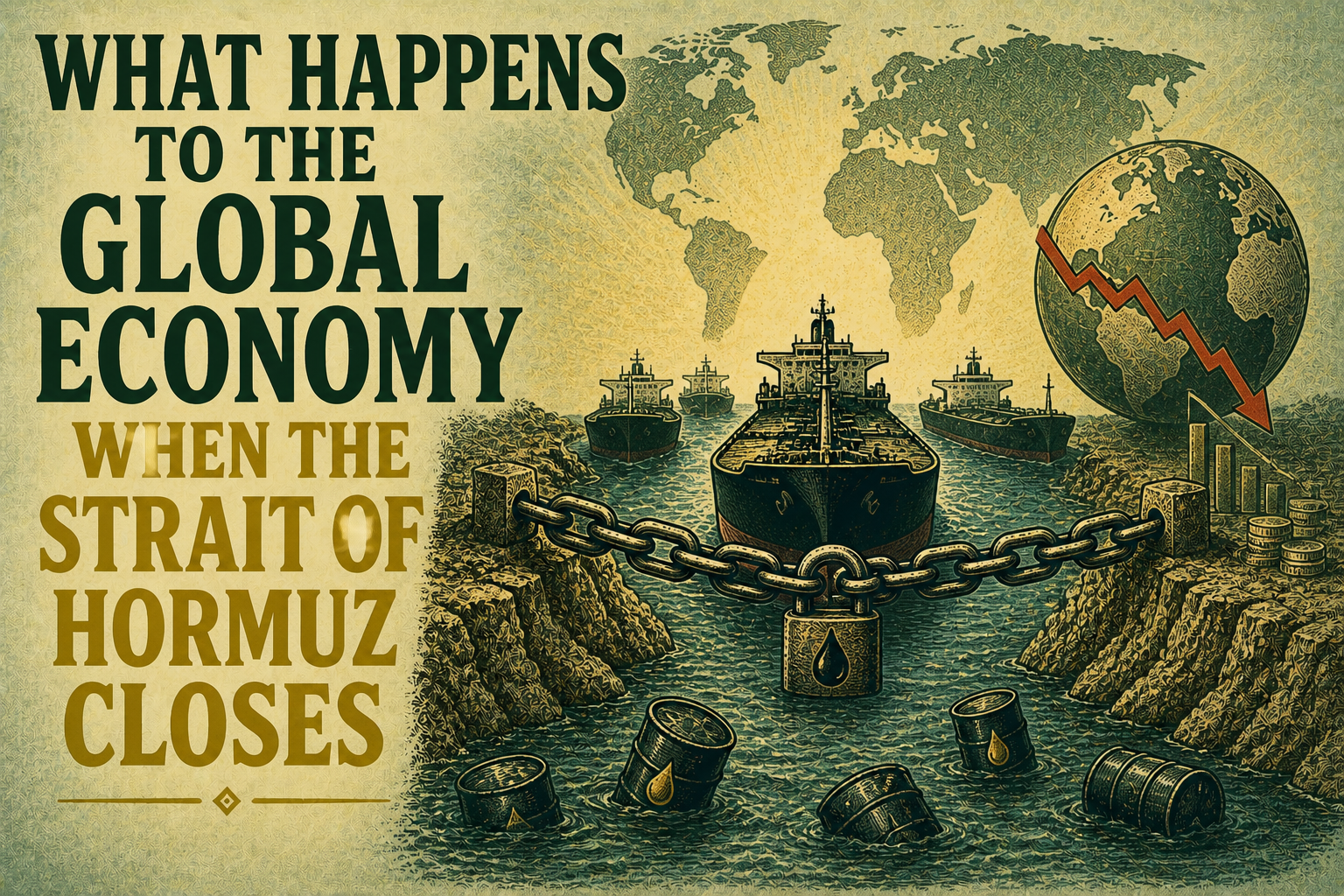
What Happens to the Global Economy When the Strait of Hormuz Closes
Hormuz Is Not Just an Oil Story
A Hormuz disruption is often reported as a simple oil shock.
That framing misses how the system actually transmits stress.
The real transmission moves through energy pricing, shipping insurance, industrial costs, trade settlement systems, and inflation expectations. Different economies absorb different parts of the shock at different speeds.
Some countries face physical supply shortages.
Others face higher prices without losing access to energy.
The distinction matters because a “closure” does not affect every economy equally.
WTI crude reached roughly $119 per barrel in early March 2026.
At the start of 2025, it was near $57.
The Strait had not been fully closed for more than 48 hours.
Large-scale oil stoppages had not yet occurred.
The market reacted to the credible threat of disruption rather than the disruption itself.
The gap between the physical event and the financial response explains how the Strait of Hormuz actually functions.
To understand that mechanism clearly, three different layers must be separated:
- The energy shock
- The pricing mechanism
- The currency dimension
What Is the Strait of Hormuz
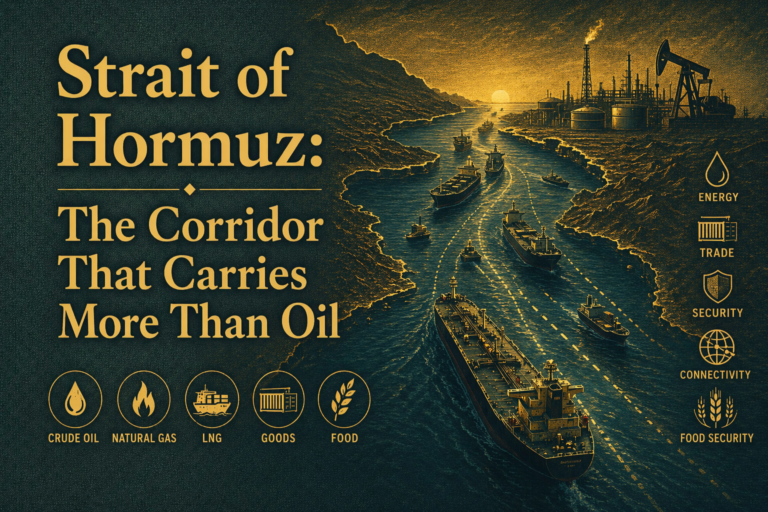
The Strait of Hormuz is a narrow maritime corridor between Iran and Oman.
- Approximately 21 nautical miles wide at its narrowest point
- Two shipping lanes, each roughly 2 miles wide
Despite its narrow size, it carries one of the highest concentrations of energy flow in the world.
Through the Strait moves:
- Roughly 20% of global petroleum liquids consumption
- Roughly 20% of global LNG trade
In 2024:
- Nearly 20 million barrels per day passed through Hormuz
- About 27% of global seaborne oil trade moved through the corridor
- About 20% of LNG trade depended on it
Several Gulf producers remain structurally dependent on the passage:
- Iraq
- Kuwait
- Qatar
- Bahrain
- Iran
These economies lack meaningful alternative export routes.
Their energy revenues depend directly on continued maritime access.
Saudi Arabia and the UAE possess partial bypass capacity through pipelines.
But estimates suggest only around 3.5 to 5.5 million barrels per day can realistically be rerouted.
That still leaves a potential shortfall of roughly 14.5 to 16.5 million barrels per day.
The price spike toward $119 reflected the market attempting to price that possibility.
What a Closure Actually Disrupts
A Hormuz disruption is not one event.
It is three overlapping mechanisms operating simultaneously.
1. The Supply Mechanism
Countries dependent on Gulf crude face immediate sourcing problems.
Around 89% of Hormuz crude flows toward Asia.
US direct exposure is comparatively limited, near 2% of domestic consumption.
The supply shock is therefore concentrated rather than evenly global.
The largest exposure sits with:
- China
- India
- Japan
- South Korea
Together, these economies account for roughly 69% of Hormuz energy flows.
Their manufacturing systems remain tightly connected to Gulf crude imports.
2. The Price Mechanism
Oil is globally priced.
That means risk in one region rapidly becomes a price shock everywhere.
Even countries that do not depend physically on Hormuz still pay higher prices.
That includes:
- Europe
- The United States
- Brazil
These economies may avoid direct shortages while still absorbing inflationary pressure through higher energy costs.
3. The Shipping Insurance Mechanism
Shipping markets react faster than physical supply chains.
Very Large Crude Carrier rates reportedly exceeded $200,000 per day.
War-risk insurance premiums surged.
Traffic patterns deteriorated quickly:
- An initial decline of roughly 70%
- Then periods of near-zero movement
The important point is timing.
Costs rise before shortages appear.
Energy markets react within hours.
Shipping systems adjust over days.
Manufacturing systems absorb the impact over weeks.
The Currency Layer Behind the Crisis
Behind the physical disruption sits a slower-moving system:
the currency layer.
The petroyuan represents an alternative settlement mechanism for energy trade.
China launched yuan-denominated oil futures in 2018.
Yet the system still represents less than 5% of global oil settlement activity.
The limitation is structural rather than political.
- The yuan is not fully convertible
- China maintains capital controls
Those constraints limit broader adoption in global reserve and settlement systems.
What the Conflict Changed
The conflict did not create alternative settlement systems.
It altered incentives around them.
Countries increasingly face a strategic tradeoff:
- Dollar settlement with uncertain geopolitical access
- Yuan settlement with potential access advantages
Russia demonstrated how quickly trade systems can adapt under pressure.
Roughly 90% of BRICS trade reportedly shifted toward local-currency settlement mechanisms.
Trade systems often move faster than reserve systems.
That distinction matters.
Why Asia and the United States Experience Different Outcomes
The economic asymmetry is central to understanding Hormuz.
Asia
- Faces direct supply risk
- Experiences rising industrial input costs
- Sees manufacturing competitiveness weaken
The disruption reaches factories, exports, logistics, and industrial margins.
United States
- Faces primarily a price shock
- Experiences inflation pressure
- May see tighter monetary policy conditions
The US produces roughly 13 million barrels per day.
It imports price pressure more than physical scarcity.
Hormuz as an Economic Clock
The most important variable is time.
Hormuz effectively measures how long the global system can absorb disruption before secondary effects begin compounding.
- Days produce a price shock
- Weeks produce an inflation shock
- Months produce a growth shock
Asia remains particularly vulnerable because industrial systems operate on continuous energy flow rather than short-term pricing alone.
The Three Variables That Matter Most
1. Duration
Strategic reserves can absorb temporary stress.
- US Strategic Petroleum Reserve: roughly 372 million barrels
- Total IEA reserve capacity: roughly 1.2 billion barrels
Weeks can be managed.
Months become structurally harder.
2. Selectivity
Iran has signalled the possibility of selective restriction rather than total shutdown.
Under that model:
- Western vessels face restrictions
- Some Asian flows remain partially operational
That fragments the market without completely stopping supply.
3. Bypass Capacity
Alternative routes provide partial relief:
- Saudi Petroline capacity: up to roughly 7 million barrels per day
- UAE pipeline systems provide additional support
None of these systems can fully replace Hormuz throughput.
When This Framework Works Best
Use This Framework When:
- Explaining price spikes without immediate supply loss
- Comparing regional economic exposure
- Understanding shifts in trade settlement systems
- Separating inflation effects from scarcity effects
Do Not Use This Framework When:
- Assuming all economies experience equal impact
- Treating every disruption as identical
- Projecting temporary shocks into permanent reserve-currency transitions
Frequently Asked Questions
What is the Strait of Hormuz?
A critical global energy chokepoint carrying roughly 20% of world oil supply and major LNG flows.
Why do oil prices rise before supply falls?
Because financial markets price risk immediately while physical shortages take longer to emerge.
Who is most affected by a Hormuz disruption?
Asian economies face the largest supply risk.
The United States faces stronger price and inflation pressure than direct scarcity.
What is the petroyuan?
Oil traded and settled in Chinese yuan instead of US dollars.
Its expansion remains limited by capital controls and convertibility constraints.
Can Hormuz close permanently?
No.
Economic dependence and military constraints make a permanent closure highly unlikely.
Do strategic reserves solve the problem?
Only temporarily.
They delay the economic impact rather than eliminate it.
The Mechanism in One Line
Hormuz is not just an oil route.
It is simultaneously a pricing engine, a supply chokepoint, and a currency battleground operating at three different speeds.
A short disruption raises prices.
A prolonged disruption reshapes trade behavior.
Somewhere between those two outcomes, the structure of the system itself begins to shift.