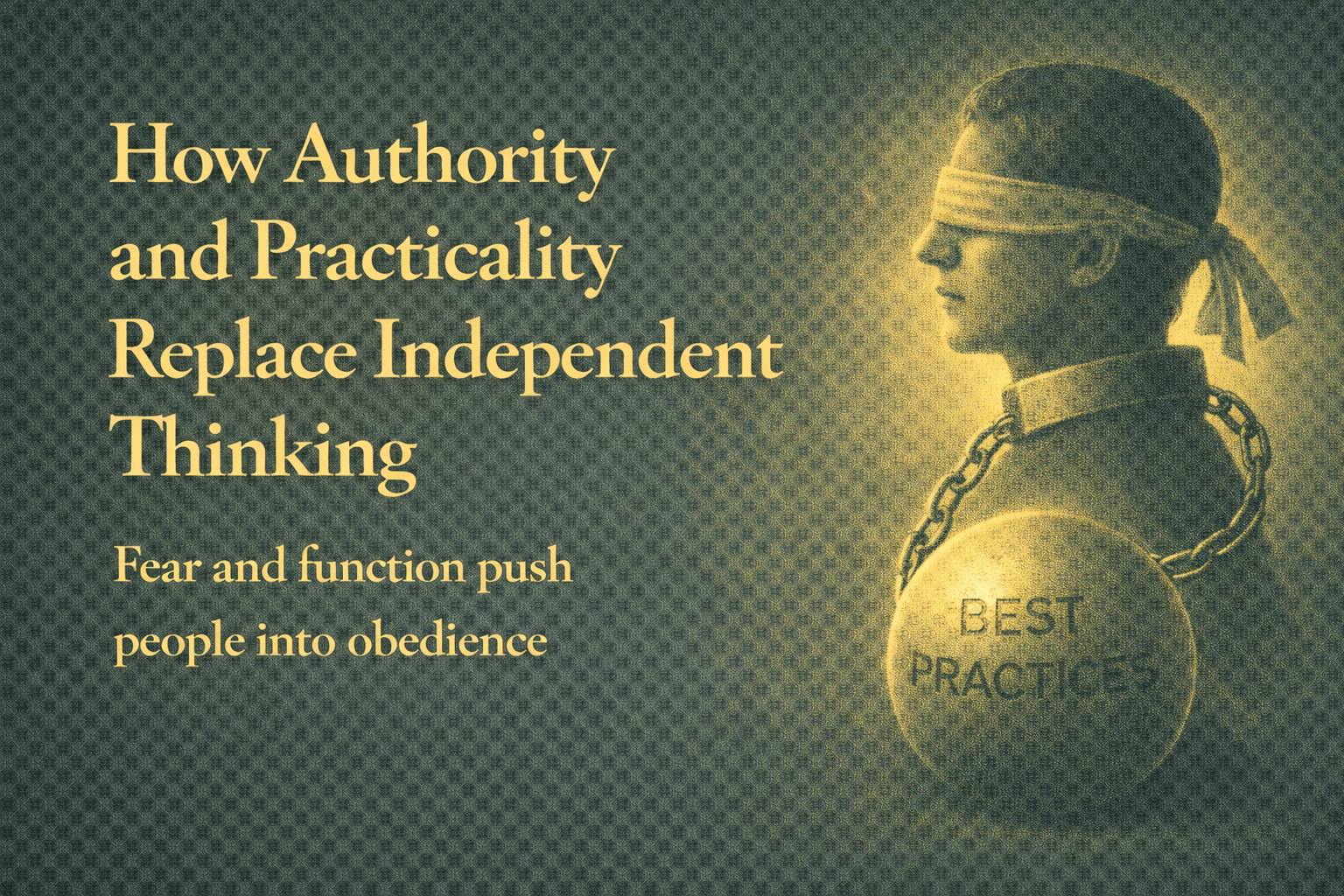
Judgment and Social Influence: How Authority and Practicality Replace Independent Thinking
Why Judgment Quietly Disappears Inside Functioning Systems
When people lack enough information to decide confidently, something predictable happens.
They look for external anchors:
- authority figures
- accepted norms
- professional expectations
- “practical” constraints
That is not weakness.
It is efficient adaptation under uncertainty.
The substitution starts slowly.
Independent evaluation gets compressed into:
- deference
- practicality
- group alignment
Not through force.
Through ordinary professional behaviour that produces acceptable outcomes.
Most judgment failures do not announce themselves dramatically.
They feel:
- mature
- responsible
- necessary
Decisions become easier.
Agreement arrives faster.
Dissent starts feeling unnecessary.
Nothing appears wrong.
This article examines how authority and practicality gradually replace independent evaluation without anyone noticing, and why capable people are often the last to realise it is happening.
By the end, you will understand:
- how judgment differs from obedience and conformity
- the mechanisms that compress independent evaluation
- why this survives longest inside successful systems
- when authority becomes dangerous rather than useful
- what changes once you recognise the pattern clearly
What Judgment Actually Means
People assume judgment fails during crises:
- panic
- confusion
- coercion
That is rarely where erosion begins.
Judgment often disappears after systems start functioning smoothly.
After outcomes look acceptable.
After disagreement begins feeling inefficient.
Judgment Means Evaluation Under Uncertainty
Judgment is not following a checklist.
It is not applying a process someone else already designed.
Judgment appears when:
- information is incomplete
- outcomes are delayed
- responsibility cannot be fully outsourced
It requires two things simultaneously:
- evaluation
- ownership
When judgment is present, someone is silently asking:
“If this goes wrong, am I willing to carry it?”
That question does more work than most formal processes.
Social Influence Works Through Substitution
Social influence rarely works through obvious persuasion.
It works through replacement.
External signals:
- authority
- group norms
- practical expectations
quietly replace internal evaluation.
Nothing feels forced.
The decision still feels personal.
But the evaluation no longer originated there.
Social influence works best when it sounds reasonable:
- “Trust expertise”
- “Be realistic”
- “This is standard practice”
The more sensible the substitution feels, the harder it becomes to notice.
Why Judgment and Influence Interact So Easily
Judgment is cognitively expensive.
Social influence is efficient.
Judgment requires:
- friction
- uncertainty tolerance
- personal exposure
Authority compresses those burdens.
Practicality shortens debate.
Group alignment lowers individual risk.
Over time, systems learn something simple:
Independent evaluation slows coordination.
So it gradually gets replaced.
Not by bad actors.
By functioning systems optimising for speed and stability.
Three Mechanisms That Quietly Replace Judgment
Judgment rarely disappears all at once.
It gets compressed gradually.
The system does not ask people to stop thinking.
It makes thinking feel unnecessary.
1. Authority Compresses Evaluation
Authority exists because rebuilding expertise from scratch every time would be impossible.
Credentials, institutions, and seniority store prior judgment.
That is useful.
The problem begins when authority stops being a reference and becomes a substitute.
The question quietly changes from:
“Does this make sense under current conditions?”
to:
“Who already approved this?”
Deference feels efficient because it is.
It:
- saves time
- reduces exposure
- limits personal responsibility
But it also shifts ownership upward.
People begin saying:
- “Leadership signed off”
- “This is standard procedure”
- “This came from the top”
The decision still happens locally.
The evaluation no longer does.
2. Practicality Functions as Social Camouflage
Practicality is persuasive because it sounds neutral.
Phrases like:
- “Be realistic”
- “This is how things work”
- “There’s no point overthinking this”
do not argue for correctness.
They argue for acceptance.
Practicality reframes:
- dissent as immaturity
- evaluation as delay
- alternatives as unrealistic
Once practicality dominates, the question shifts:
Not:
“Is this right?”
But:
“Will this work inside the current system?”
That distinction matters.
Many incorrect decisions are highly practical because they fit existing incentives and structures.
Practicality protects systems from friction.
Not because systems are evil.
Because friction slows coordination.
3. Signal Lag Hides the Cost
If judgment erosion caused immediate collapse, it would not survive.
The reason it persists is delay.
Most substituted judgments still produce acceptable short-term outcomes.
Authority-based decisions often work because authority is usually competent.
Practical decisions often work because systems absorb errors temporarily.
This creates signal lag.
The cost appears slowly:
- narrower options
- weaker dissent signals
- late corrections
- reduced sensitivity to changing conditions
Nothing visibly breaks.
Something quietly thins.
Because no immediate failure appears, systems conclude:
“This is working.”
The substitution becomes self-reinforcing.
Why Capable People Adapt Fastest
This process does not feel like decline.
It feels like professional maturity.
Decisions become:
- faster
- cleaner
- less confrontational
Alignment improves.
Conflict decreases.
The environment feels more efficient.
That is exactly why capable people often adapt quickly.
They recognise incentive structures early.
They learn:
- which disagreements create friction
- which evaluations get rewarded
- which concerns remain promotion-safe
Over time:
- independent judgment narrows
- acceptable thinking expands
- alignment becomes professionalised
Nothing dramatic occurs.
People are not manipulated.
They become efficient inside the system surrounding them.Where This Pattern Appears Most Clearly
Inside Organisations
Most organisational failures begin long before obvious mistakes.
Consensus starts arriving too quickly.
Meetings become smoother.
Disagreement disappears from public spaces.
Concerns emerge later:
- after execution
- after losses
- during postmortems
Everyone “saw it coming.”
Almost nobody said it early.
Not because they failed to notice.
Because independent evaluation stopped feeling worth the cost.
Inside Relationships and Families
Judgment erosion inside relationships rarely looks authoritarian.
It often arrives disguised as care:
- “Don’t complicate things”
- “Be practical”
- “This is just how life works”
Dissent begins feeling emotionally expensive.
Questioning norms feels disrespectful rather than analytical.
Over time, people internalise a rule:
“Good decisions are decisions that preserve harmony.”
Nothing visibly breaks.
Agency simply narrows gradually.
Inside Public Discourse
At scale, institutions compress complexity through:
- expert narratives
- simplified explanations
- social consensus
This is necessary for coordination.
The problem begins when explanation replaces evaluation entirely.
Narratives become moralised:
- “Responsible people agree”
- “Serious people accept this”
- “Questioning this is dangerous”
Practicality becomes a virtue.
Doubt becomes immaturity.
People stop evaluating publicly long before they stop thinking privately.
Where Authority and Practicality Stop Working
Authority and practicality are not inherently flawed.
They are essential coordination tools.
The problem appears when they operate outside their design range.
Novel Conditions
Authority encodes past success.
When environments change faster than institutions update, authority keeps speaking confidently from outdated assumptions.
The language sounds familiar:
- “This has always worked”
- “This is proven”
- “This is standard practice”
The system continues applying yesterday’s model to today’s uncertainty.
Nothing fails immediately.
That delay is precisely why the problem survives.
Value-Based Decisions
Authority and practicality function best when goals are measurable and shared.
They struggle when decisions involve:
- values
- trade-offs
- long-term direction
- human priorities
Practicality reframes value conflicts as feasibility questions.
Authority reframes them as already settled.
The system moves forward.
But the actual values involved may never have been evaluated directly.
Irreversible Decisions
Some choices cannot easily be corrected:
- career commitments
- reputational alignment
- institutional dependencies
- structural policy choices
Authority works best when mistakes remain reversible.
When reversibility disappears, compression becomes dangerous.
By the time consequences appear, adjustment may no longer be possible.
What Most People Misunderstand
Independent Thinking Is Not Rebellion
Rejecting authority automatically is not judgment.
That still makes authority the reference point.
Judgment evaluates authority.
It neither obeys automatically nor rejects automatically.
Practicality Is Not the Same as Accuracy
Practical decisions fit existing systems.
That does not guarantee they are correct.
Practicality optimises for compatibility, not necessarily truth.
Intelligence Does Not Prevent Influence
Competent people often adapt faster to systems because they recognise incentives earlier.
They learn:
- what gets rewarded
- what creates friction
- what remains acceptable to say publicly
That makes influence easier to internalise, not harder.
Final Understanding
Judgment rarely disappears through force.
It erodes through systems that function well enough to make independent evaluation feel unnecessary.
Authority compresses thinking.
Practicality rewards alignment.
Stable outcomes delay recognition of the cost.
Nothing dramatic needs to happen.
That is precisely why the process survives for so long.
Most people do not lose judgment during crisis.
They lose it gradually during normalcy:
- when agreement arrives too early
- when clarity feels inherited rather than examined
- when professionalism becomes indistinguishable from alignment
The danger is not that people stop thinking entirely.
It is that evaluation quietly moves somewhere else while everyone still believes they are deciding independently.
Most judgment failures are not dramatic collapses.
They are long periods of reasonable adaptation accumulating into intellectual dependence slowly enough that nobody notices until conditions change.
About the Author
Mr Chandravanshi writes about judgment under uncertainty, systems thinking, markets, and human decision errors.