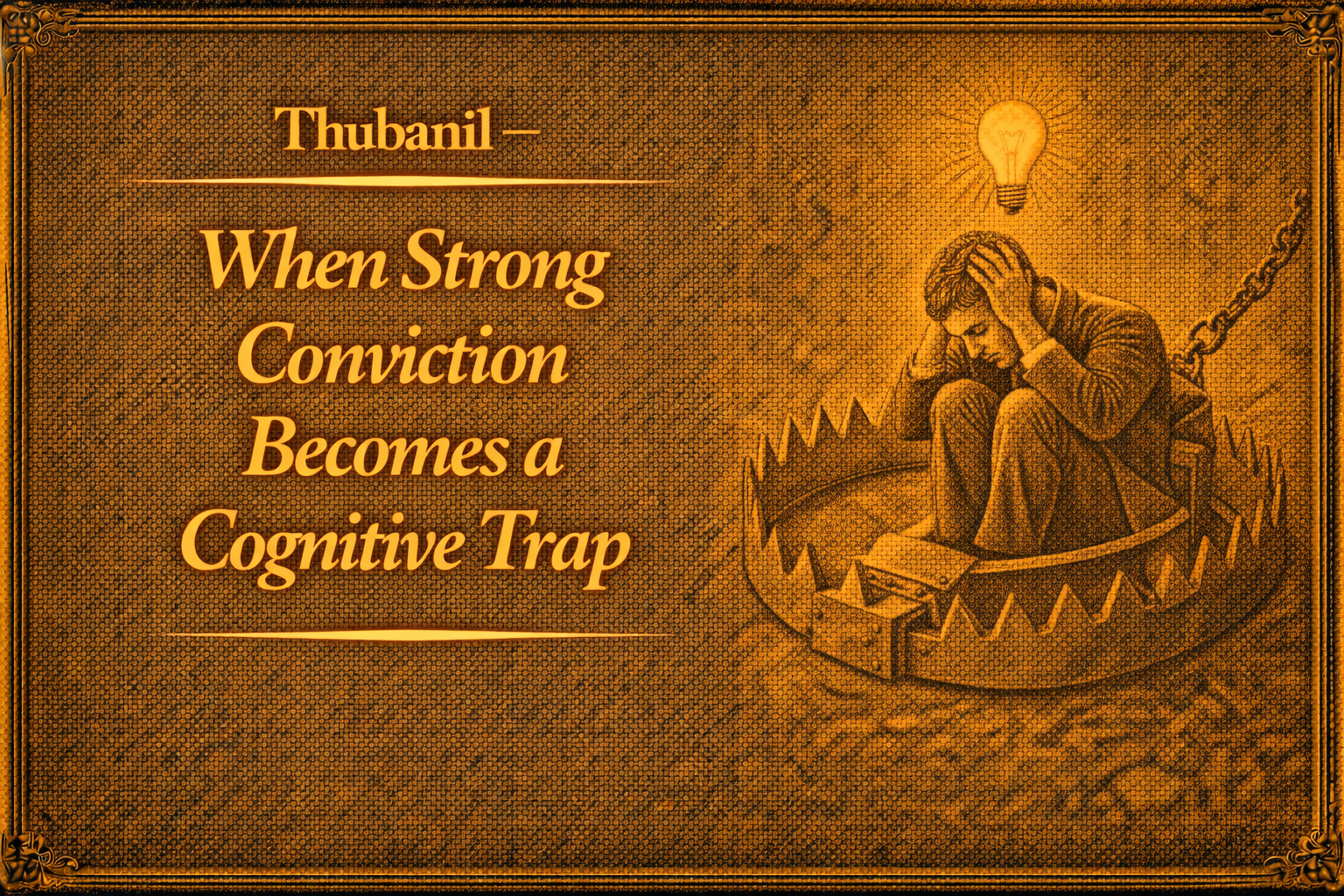
When Strong Conviction Becomes a Cognitive Trap
How Investors Interpret New Market Information as Support for Existing Positions
Confirmation bias in investing is the tendency to interpret new market information as support for an existing position, regardless of what that information actually says.
It compounds quietly inside portfolios and often disguises itself as discipline.
This article explains:
- What confirmation bias looks like inside an active portfolio
- How it differs from genuine analytical confidence
- Where it fails most visibly
- Signals suggesting a position should be exited rather than defended
By the end, you will understand:
- the structural difference between a strong thesis and a defended one
- the hidden cost of holding through signal degradation
- why many investors lose capital without noticing when the original thesis quietly stopped existing
Why Confirmation Bias Matters in Investing
Confirmation bias rarely feels irrational from the inside.
It usually arrives disguised as good investing behavior:
- “Staying the course”
- “Trusting the thesis”
- “Ignoring short-term noise”
These are legitimate investing principles.
That is precisely why confirmation bias becomes expensive.
It imitates virtues that genuinely exist in strong portfolio management.
Once capital is committed, the brain begins filtering information asymmetrically:
- Positive signals receive full attention
- Negative signals get reframed as temporary or irrelevant
Researchers such as Raymond Nickerson and Matthew Rabin with Joel Schrag documented how investors often reinterpret contradictory evidence as supporting evidence instead of treating it neutrally.
Confirmation bias differs from other behavioral biases:
- Anchoring: fixation on a price point
- Loss aversion: refusal to realize losses
- Overconfidence: inflated belief in analytical accuracy
The key diagnostic question is simple:
If equivalent evidence in the opposite direction would not change your view, confirmation bias is likely active.
How a Position Quietly Becomes “Defended”
Confirmation bias rarely appears all at once.
It develops gradually.
Stage 1: The Thesis Hardens After Entry
Before investing, uncertainty feels natural.
After investing, uncertainty begins collapsing.
The thesis slowly shifts:
from something being tested
to something that must be protected.
Research analyzing thousands of investor accounts found investors rated their original research as stronger after investments moved in their favor.
The emotional attachment grows with ownership.
Stage 2: Information Sources Narrow
Over time, investors unconsciously reshape their information environment.
They begin prioritizing:
- analysts favorable to the sector
- company presentations
- commentary aligned with the thesis
At the same time, they avoid:
- bearish research
- competitor data
- short-seller reports
Contradictory information creates cognitive friction because it forces model revision.
Confirming information fits smoothly into existing beliefs.
Stage 3: Language Changes
Language often reveals the transition from analysis to defense.
Early stage:
“Margins should recover next quarter.”
Later stage:
“This is just noise.”
“The market doesn’t understand the thesis.”
“Patient investors will benefit.”
The word patience becomes important here.
It reframes missing evidence as a test of character rather than a signal about the investment thesis itself.
Stage 4: Evidence Gets Reclassified
At this point, the analytical process changes.
The investor no longer asks:
“Does this information change my thesis?”
Instead, they ask:
“Why doesn’t this information change my thesis?”
The search process becomes defensive.
The conclusion almost always favors holding the position.
The Hidden Cost Most Investors Ignore
The visible cost of confirmation bias is obvious:
The position declines further than it should.
The hidden cost is opportunity cost.
Capital trapped inside a defended position cannot be redeployed elsewhere.
Research on institutional portfolio managers found:
- top-performing managers exited weak positions faster
- bottom-performing managers held failing positions far longer
The performance gap came not only from stock selection but from delayed exits.
Research Time Also Becomes Distorted
Investors often spend the most research time on positions already declining.
This feels like diligence.
But frequently it becomes:
re-confirmation research,
not genuine re-analysis.
The stock checked most often is often the one causing the most discomfort.
When This Framework Does Not Apply
Not every conviction hold is confirmation bias.
Contrarian Positions
Markets sometimes genuinely misprice securities.
Holding through temporary panic can be rational if:
- the thesis remains structurally intact
- exit conditions are clearly defined
If the thesis cannot be falsified under any condition, it has likely become belief rather than analysis.
Limited Information Markets
Small-cap and private markets often lack complete information.
Holding through uncertainty is different from holding through contradictory evidence.
Different Time Horizons
A six-month decline may appear irrational for a short-term trader.
For a long-term investor, the same decline may simply be volatility.
How to Distinguish Conviction from Bias
Conviction and confirmation bias feel almost identical internally.
The difference lies in structure.
The Pre-Mortem Test
Psychologist Gary Klein proposed the pre-mortem method.
Ask:
“Assume this investment fails completely. What caused it?”
A genuine thesis produces specific risks.
A biased position usually produces vague explanations.
The Asymmetric Update Test
Imagine:
- one strongly positive news event
- one equally strong negative event
If positive news dramatically increases conviction while negative news barely changes it, confirmation bias is likely active.
The Source Diversity Test
Ask yourself:
Who is the strongest bear on this stock?
And:
What are their arguments?
If you cannot answer, your information environment has narrowed.
Common Misconceptions About Confirmation Bias
Misconception 1: Only Inexperienced Investors Have It
Research often shows the opposite.
More active investors frequently display stronger confirmation bias because higher engagement increases emotional attachment.
Misconception 2: More Research Solves the Problem
More research often strengthens the bias.
The investor simply performs the same selective search with greater intensity.
The correct solution is adversarial research:
actively searching for evidence against the thesis.
Misconception 3: Losses Create Confirmation Bias
Confirmation bias begins at position entry, not after the first loss.
Winning positions can contain identical bias structures.
Exit Signals That Do Not Require Predicting the Bottom
Signal 1: The Original Catalyst Has Passed
If the expected catalyst occurred but the thesis failed to materialize, the original logic may already be invalid.
Key question:
If I did not own this stock today, would I still buy it?
Signal 2: Explanations Become Increasingly Complex
When a thesis requires constant new explanations to justify underperformance, defensive rationalization may be replacing analysis.
Signal 3: The Peer Group Recovers but Your Holding Does Not
If comparable companies recover while one position continues weakening, the issue may be company-specific rather than market-wide.
Frequently Asked Questions
How is confirmation bias different from a long-term investment view?
A long-term investment thesis still contains exit conditions.
Confirmation bias removes them.
Can confirmation bias affect selling decisions too?
Yes.
Investors can selectively search for information supporting their desire to sell as well.
Does position size increase confirmation bias?
Yes.
Larger positions create stronger emotional commitment.
What is the difference between confirmation bias and anchoring?
Anchoring concerns price references.
Confirmation bias concerns information filtering.
What practical technique helps reduce confirmation bias?
Define exit conditions before entering the position.
Pre-committed rules reduce emotional distortion later.
Final Takeaway
Confirmation bias in investing is the systematic overweighting of evidence that supports an existing position.
It operates through:
- selective attention
- narrowing information sources
- asymmetric belief updating
Most portfolio mistakes are not caused by weak original analysis.
They happen when good analysis continues long after the evidence stopped supporting it.
Recognizing the moment when a thesis ends—and a new analysis must begin—is where much of the recoverable capital inside a biased portfolio actually exists.
About the Author, Mrs Chandravanshi
Mrs Chandravanshi (Deepa Chandravanshi) analyses how marriage, motherhood, and workplace structures shape women’s timing, choices, and autonomy.
Her writing focuses on the daily negotiations women make at home and work, where gradual self-reduction slowly begins to feel normal.