The Russia Oil Trade Made Refiners Money. The Narrative Made Everyone Else Feel Smart.
The Forward Was Not Information
Four Seconds
The graphic arrived at 7am.
A crude barrel. A number. A face you recognised. You forwarded it before your second cup of chai.
Not because you had verified the number. Because the room needed to know which side you were on.
That decision took four seconds. The four seconds are worth examining.
The Credential, Not the Trade
Somewhere between the forward and the fire emoji, the Russia oil story stopped being a trade and became a credential. Not for traders. Not for refinery analysts tracking GRMs and shadow fleet insurance costs. For the dinner table. For the WhatsApp group. For the cousin who lost 40% last year and needed a new story about why that happened.
The credential works like this: share the graphic, receive the nod, become someone who understands how the world actually operates.
The nod is the product. The oil is incidental.
What the Dinner Table Actually Was
Watch what happens at the dinner table.
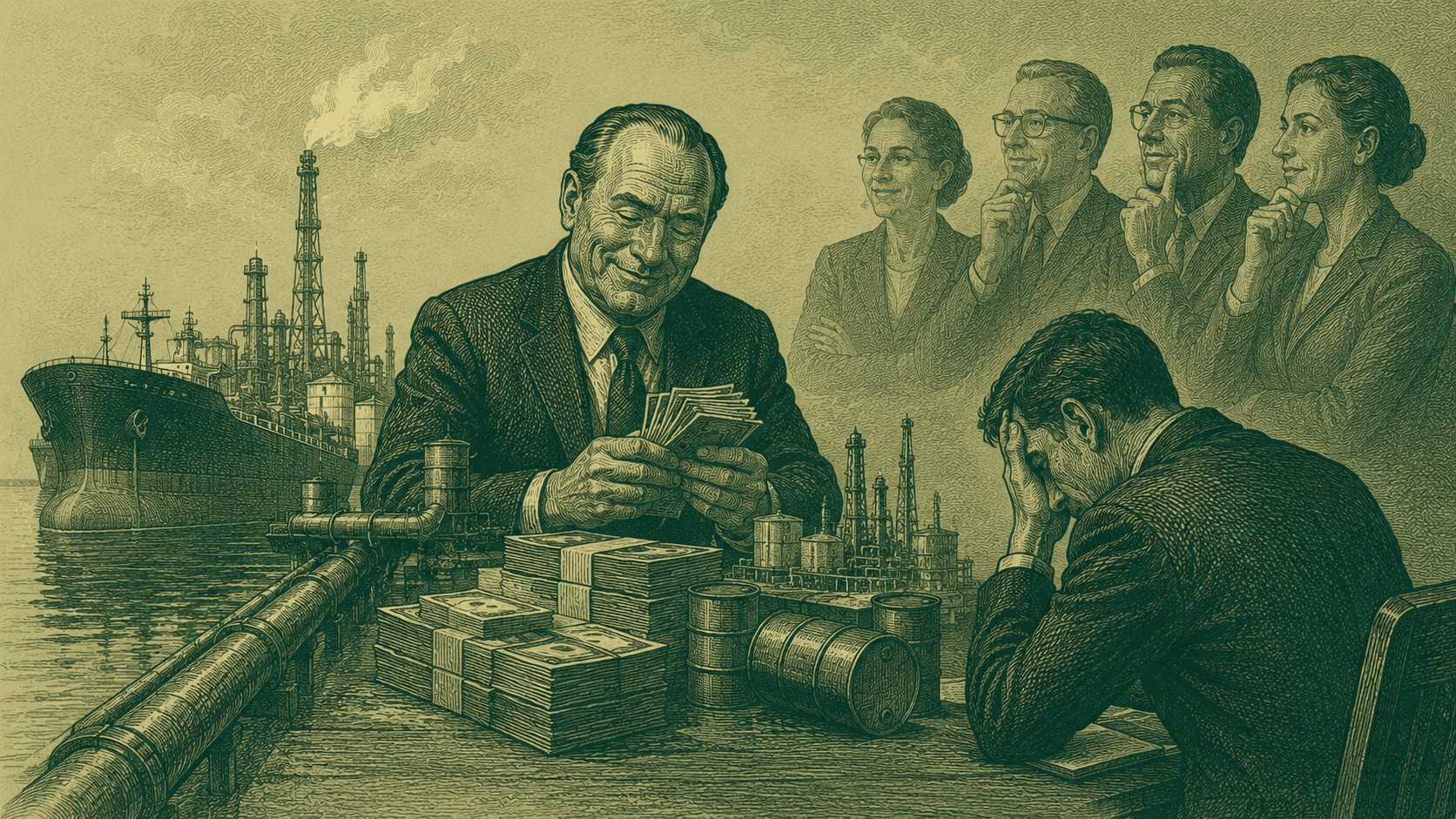
The uncle is three drinks in. He has explained sanctions arbitrage twice this month to different audiences. He will explain it again. The cousin — the one whose Demat account bled through most of last year — is nodding with an intensity that has nothing to do with crude oil.
The cousin is not nodding at geopolitics.
He is nodding at a version of himself that the narrative has briefly made possible. A version where last year’s losses were not errors. They were early positioning. They were dues paid by someone who understood things before the crowd caught up.
The uncle’s lecture is giving the cousin that version. The cousin’s nod is giving the uncle an audience that confirms he is a strategist, not a man explaining commodities trading at a dinner table after everyone has finished their rice.
They are each producing what the other needs.
Neither of them has read a GRM filing. Neither of them knows that crack spreads had collapsed from $16 to $3 per barrel by Q3. Neither of them knows that the private refiners who actually ran this trade were quietly managing rupee-rouble settlement failures and shadow fleet insurance spikes while everyone else was forwarding graphics.
They do not need to know. The performance does not require knowledge. It requires an audience.
What the Trade Actually Was
Here is what the trade actually was.
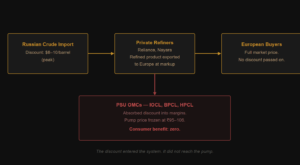
Russian crude went from roughly 2% of India’s imports to 36% across eighteen months. That shift was real. The discount at peak was real — somewhere between eight and ten dollars per barrel. The complexity underneath it was also real, and it is the part that never made it into the forward.
Private refiners like Reliance and Nayara bought Russian crude at the discount, refined it, and sold the product to European buyers at a markup. The discount went into their margins and out through their export terminals.

PSU oil marketing companies — IOCL, BPCL, HPCL — absorbed the crude discount into their refining margins but could not pass it to retail. Their pump prices are politically frozen. The man filling his Creta at ₹106, who said the government made petrol cheap, was not lying. He was describing a sensation, not a transaction.
The sensation was real. The petrol was still ₹106.
By the time the narrative hit peak volume on Telegram — “BUY OMCs BEFORE Q3 RESULTS, RUSSIA DISCOUNT = MARGIN EXPANSION” — OMC stocks had already underperformed Nifty for eighteen months. The 340 fire emojis under that post were not due diligence. They were a crowd producing certainty for each other.
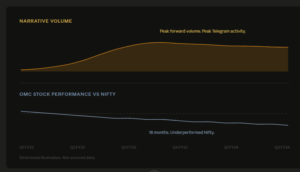
[Chart: OMC Stock Performance vs Narrative Volume — Q1 FY23 to Q2 FY24] Directional illustration. Not sourced data.
The crowd is the product. The trade is a prop.
The Forward Is Not Information
This is the thing nobody at the dinner table said out loud, and the thing that makes the whole architecture hold together.
When the uncle forwarded that graphic to 127 people in his society group, he was not distributing an analysis. He was distributing proof that 127 people share a belief. The proof is the point. Not proof that the trade works. Proof that you are not alone in believing it does.
When 127 people receive the same forward on the same morning, the forward starts to feel like a consensus. Consensus starts to feel like evidence. Evidence starts to feel like a reason to nod harder.

This is why asking a question breaks the room.
The IT support colleague who shared the Zee Business clip about India’s energy security masterstroke — he had never bought a stock. When someone asked which OMC he held, he did not answer the question. He felt insulted by it.
Not because the question was aggressive. Because the question introduced a test the clip had never required him to pass.
The clip, the share, the enthusiastic commentary — these were his membership ritual. The question was a request for credentials. And the insult was not anger. It was the specific fear that the room he had built his identity inside might have a problem. If the room has a problem, he is not a macro strategist. He is an IT support person who watches business news.
The group did not defend him or challenge him. They did not need to.
The clip was shared again two days later. The ritual continued.
The Spreadsheet at 11 pm
Now watch the other person at that table.
The one with the spreadsheet open at 11 pm. Cell F14. The cursor is blinking.
He has the GRM data. He has the OMC stock performance against Nifty. He has verified what the forward did not.
He sat at that dinner in careful silence while his uncle performed and his cousin nodded, and he ate his ice cream and said nothing, and he told himself the silence was because being right in a room full of performers is lonely.
That is also a performance.
The spreadsheet is a credential too. It just swipes at a different door.
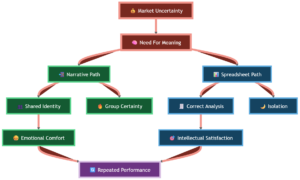
The uncle’s door says: I understand how India operates in a geopolitical world. The spreadsheet door says: I am too careful to fall for that. Both doors lead to the same room — the room where you feel like you understand money better than the people around you.
The self-deception in both cases is identical. The uncle uses a forward to feel like a strategist. The spreadsheet person uses refinery data to feel like the only sober person in the room. The feeling is the point in both cases. Not the trade.
And here is the cost the spreadsheet person has not yet named.
The uncle has a community. 127 forwards. A nodding cousin. A room full of people who feel smart together.
The spreadsheet person has cell F14 and the correct information, and no one to tell it to.
That is not a small cost. Sitting in verified knowledge alone, while people you care about build an identity on a graphic, that has a weight to it that the GRM data does not account for.
The correct analysis did not produce a community. The correct analysis produced a spreadsheet and silence.
The Exit No One Took
The private refiners who ran this trade in FY23 made money. Then the discount narrowed. The shadow fleet insurance costs rose. The payment mechanisms became more difficult. The “obvious” thesis that had been forwarded to 127 people became the obvious trap for anyone who adopted it eighteen months late as an identity rather than an input-cost calculation.
The retail investor who forwarded the graphic and nodded at the dinner table never got that memo.
He was still explaining crack spreads at parties in Q4 while the crack was at $3.
He had adopted a story about Indian energy dominance as a substitute for the harder work of understanding what a margin expansion actually requires to reach a stock price.
The story is available, shareable, and free. The harder work has no graphic.
What Neither of Them Has Added Up
Here is the unresolved thing.
The spreadsheet person is not wrong about the trade. The GRM analysis holds. The OMC underperformance is documented. The forward was not informative.
But the uncle went to sleep that night in a room full of people who agreed with him, and woke up the next morning with 127 confirmations in his phone, and will sit at the next dinner with the same confidence, and will feel like he understands the world.
The spreadsheet person will open cell F14 again.
Both are absorbing a cost. The uncle’s cost is invisible to him — the trade he never examined, the returns he attributed to a story rather than a decision. The spreadsheet person’s cost is visible but not named — the community that comes from shared certainty, which correct analysis specifically cannot produce.
Knowing the truth about a trade and building a life around knowing it are two different positions.
The uncle chose one without examining it. The spreadsheet person chose the other without admitting it was a choice.
The forward felt like information.
It was a membership fee. And so, in a quieter way, was the spreadsheet.
Neither of them has added that up yet.