To Understand China’s Rise, You Need a Go Board, Not a Chessboard
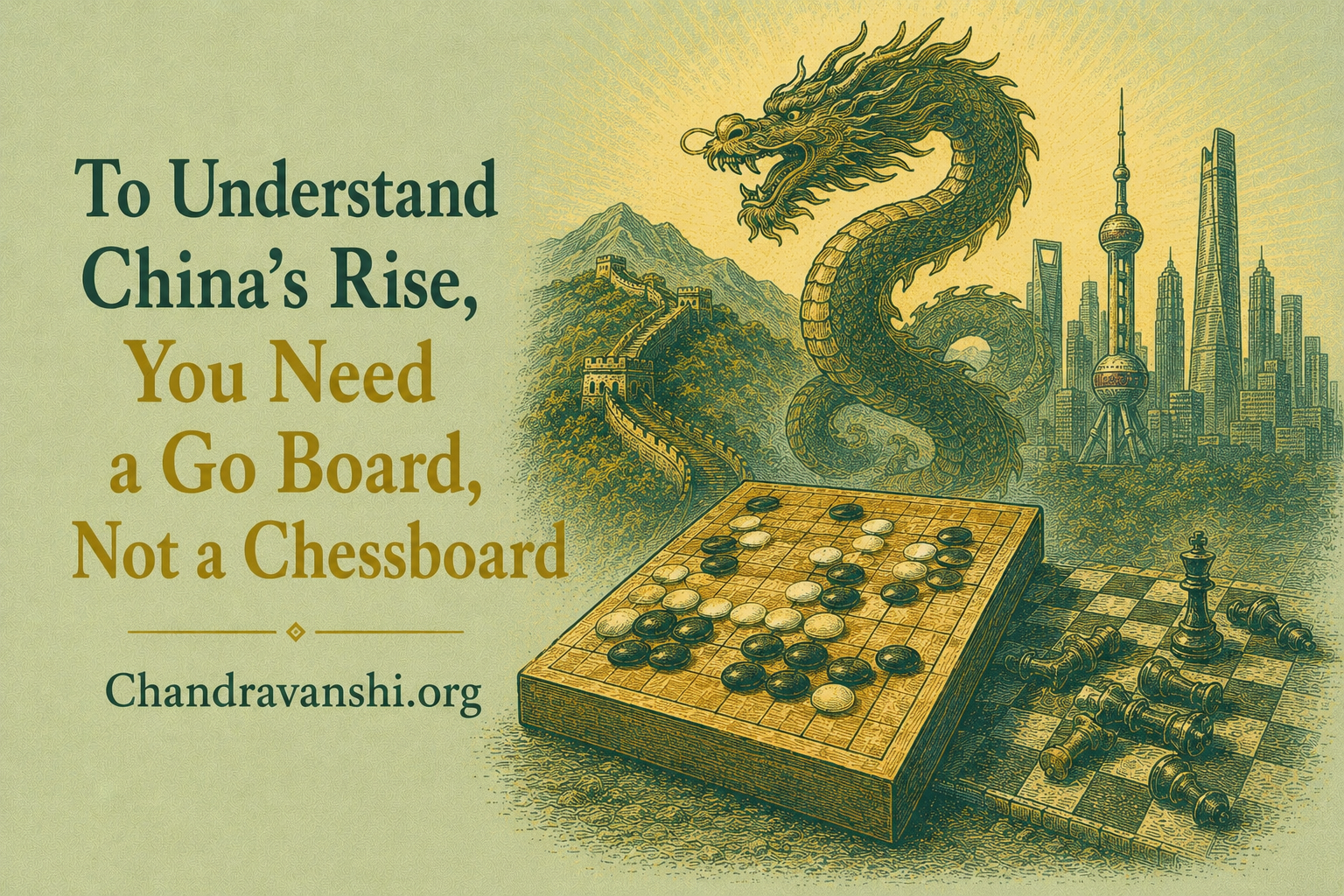
To Understand China’s Rise, You Need a Go Board, Not a Chessboard
The headline said Chinese vessels had entered disputed waters. You read it. Filed it somewhere. Moved on.
Nothing happened in the sense that the thing you were watching for did not arrive. No invasion. No declaration. No moment is clean enough to respond to. So you kept watching the news, the next incident, the next diplomatic protest, the next carrier group repositioned, and you kept moving on, because each event individually resolved into nothing.
This is not a failure of attention.
It is a failure of category.
You were watching for the right events inside the wrong game.
The Western Habit of Seeing China Through Chess
Western foreign policy commentary runs almost entirely on chess logic. Threat. Challenge. Countermove. Checkmate.
The implicit premise underneath all of it: power announces itself, there is a king somewhere, and if you can find and pressure it, the game resolves.
Read enough op-eds about China and the pattern becomes visible. Every piece is hunting for the moment, the confrontation, the declaration that makes the situation legible in terms of attack and defence.
Go works differently.
The board starts empty. You place stones not to attack but to claim, to make empty space yours before the other player understands what that space was worth.
There is no king.
There is no decisive battle.
There is only the accumulation of presence until your opponent’s available moves exist entirely inside the shape you built around them.
The board at the end looks almost identical to the board at the beginning.
No dramatic capture. No final blow. Just the creeping recognition, move by move, that there is nowhere left to go.
How Presence Becomes Power
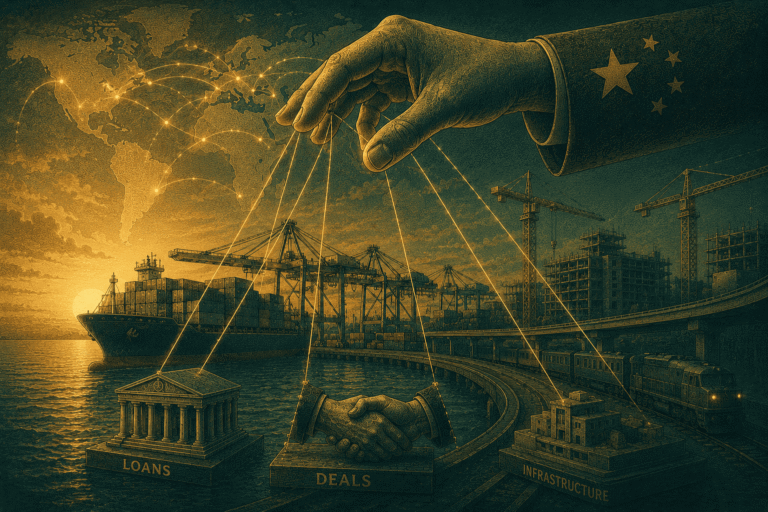
In Piraeus, the construction crew arrived at dusk. Welding equipment, hard hats, the specific purposeful noise of men improving infrastructure.
They made the port work better.
ul>
- Faster turnaround
- Deeper berths
- Modernized loading
The union liked the hours. The local government liked the tax revenue. The shipping companies liked the efficiency.
Five years later, COSCO held a majority stake.
The debt had been structured in ways that made the equity transfer logical rather than coercive.
On the map, it was still Greece.
On the board, that intersection had changed color.
No single moment warranted a formal objection. The objection would have had to be filed against convenience, against competence, against something working better than it had before.
That is not how Western legal or diplomatic language files complaints.
This is how fiber optic cables get laid through fourteen countries.
This is how vaccine shipments arrive before Western donors have finished their approval committees.
This is how lithium contracts get signed a decade before lithium becomes the thing everyone needs.
This is how student visas become research relationships become institutional presence in rooms where decisions get made.
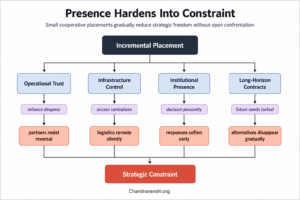
None of it is an attack. All of it is placement.
The Mistake Was Never Missing the News

The self-deception is not that you missed the news.
You read the news.
The self-deception is that reading it carefully felt like understanding it.
Careful reading of chess events inside a Go game produces a very specific kind of sophisticated confusion.
You track each move with precision. You file it. You note when protests are lodged and ignored. You observe the pattern of reefs becoming islands, islands getting airstrips, airstrips getting radar.
And then nothing happens, in the sense you were watching for, so you conclude that nothing has happened.
Meanwhile the board has changed.
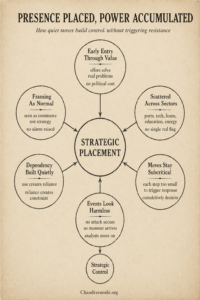
Dependency Is Built Long Before It Is Felt
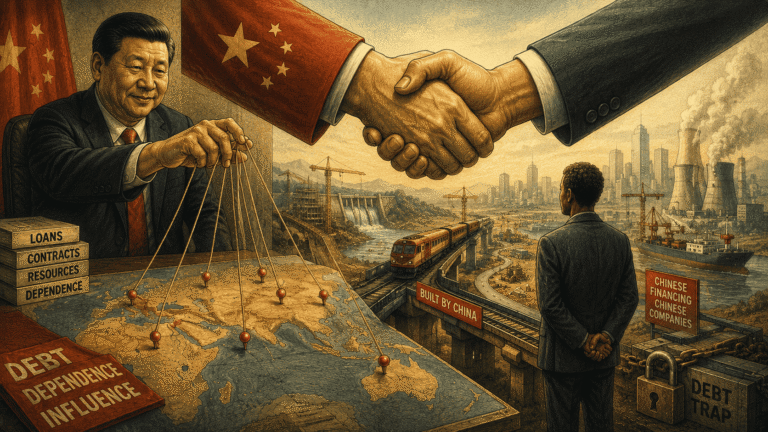
Calling this debt-trap diplomacy is the chess player’s way of making a Go move legible.
It frames the sequence as a trick: bait taken, trap sprung, victim identified.
But watch the actual sequence in almost any case:
- Infrastructure offered
- Infrastructure built
- Infrastructure used
- Infrastructure valued
- Infrastructure integrated
- Ownership transferred through contractual logic
It does not look like a trick from the inside while it is happening.
It looks like a different theory of what ownership means and how it is built.
The debt is not the weapon. The dependency is.
And dependency does not arrive in a moment.
It arrives as:
- Convenience
- Comfort
- Necessity
- Constraint
By then the board looks almost the same as it did at the start.
The Framework Problem Most Analysts Avoid Naming
Here is the internal argument most analysts are living with and not naming:
If the moves being made do not constitute a threat under any framework I currently have, then either there is no threat, or my framework is wrong.
Both possibilities are uncomfortable.
The first produces complacency.
The second produces a kind of vertigo, because if the framework is wrong, everything built on it is wrong too.
Most analysts choose a third path:
Treat each move as a potential threat within the existing framework, generate a response to it, watch the response get absorbed without consequence, and begin again.
This produces the feeling of engagement without the fact of it.
The analysis continues.
The board keeps changing.
The Filing Was the Problem
The honest question is not whether China is a threat.
The honest question is whether the tools being used to evaluate that question are suited to the game being played.
If you are watching for an attack and none arrives, you conclude there is no danger.
But in Go, the most consequential moves are the ones that look like nothing when they are made.
An empty intersection has no value until both players understand what controlling it means.
By then, one of them already does.
You read the headline.
Filed it.
Moved on.
The filing was the problem.
Sources & References
- The China Convergence — by N.S. Lyons — The Upheaval
- Reuters: China’s COSCO acquires 51% stake in Greece’s Piraeus Port
- Reuters: Greece completes transfer of 16% stake in Piraeus port to COSCO
- Council on Foreign Relations: China’s Massive Belt and Road Initiative
- CFR: The Rise and Fall of the BRI
- Taylor & Francis: Chinese debt-trap diplomacy: reality or myth?
- CSIS: It’s a (Debt) Trap! Managing China-IMF Cooperation Across Belt and Road
- Foreign Policy: Why Is China Buying Up Europe’s Ports?
- China’s resurgent Belt and Road is built to last | Reuters
- wsj.com
- On China
- Learning from the Stones