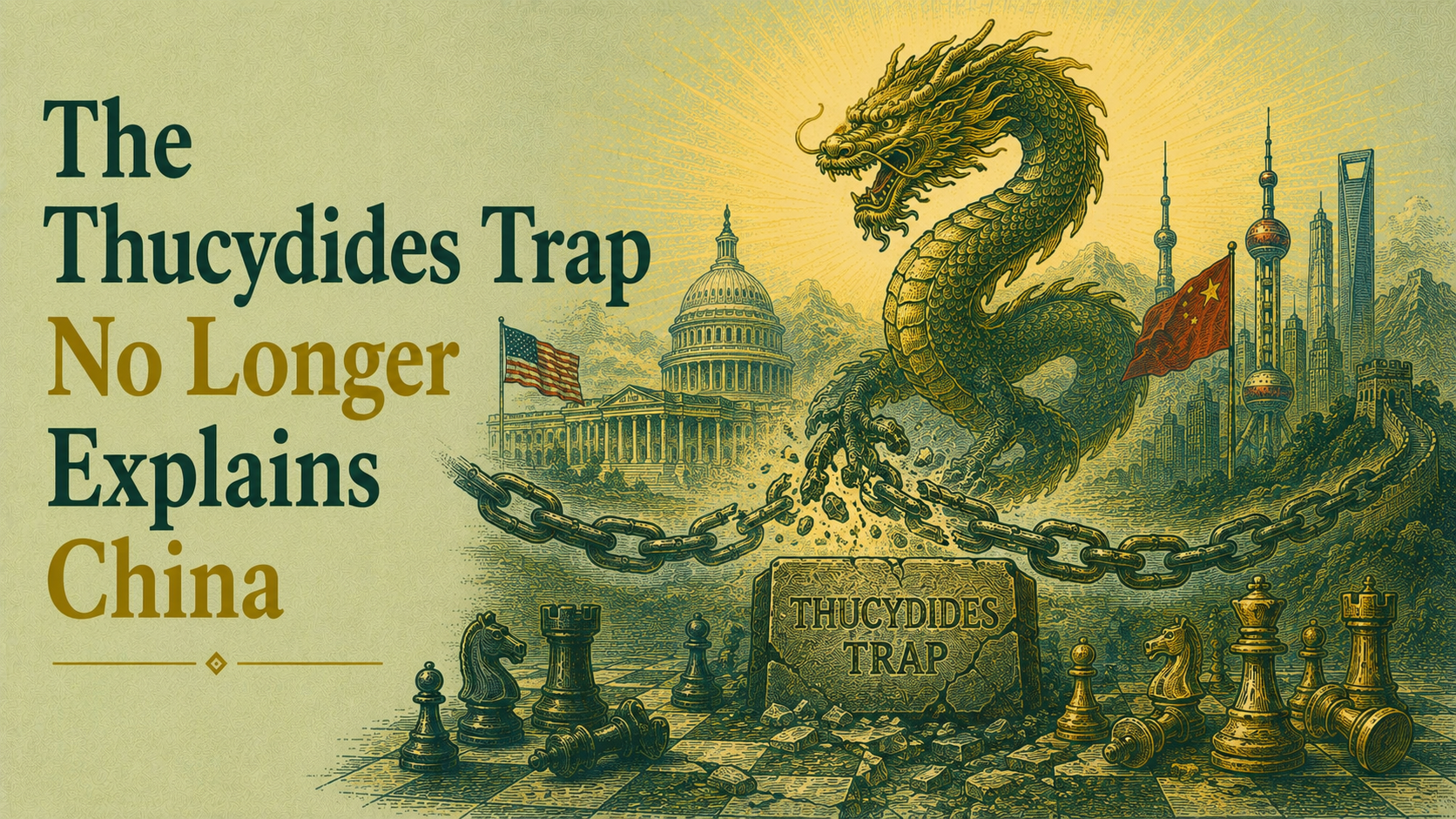
The Thucydides Trap No Longer Explains China
When your enemy owns your supply chain, the old maps stop working
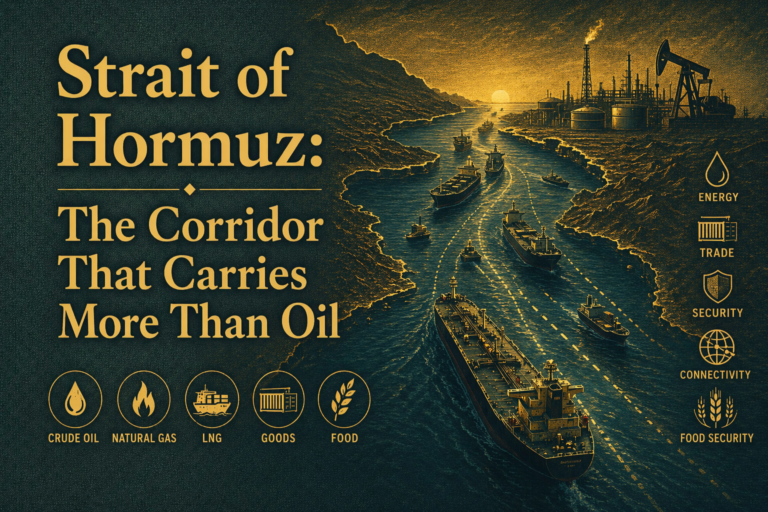
The same shipping container that carries your iPhone from Wuhan to Rotterdam might also carry a component bound for a naval radar system somewhere in the Mediterranean.
No one stops it.
No one needs to.
The cranes that unload it are Chinese.
The flag above them is Greek.
The cars waiting to load are German.
Everyone touched it.
Everyone profited.
Everyone is vulnerable.
This is not a failure of policy. It is the policy.
The world the last thirty years of trade decisions built, deliberately, piece by piece, until the container became too useful to inspect too carefully.
The Thucydides Trap gave us a clean story.
Rising power threatens the ruling power.
Conflict becomes inevitable because neither can afford to back down.
The frame is elegant, historically grounded, and explains roughly what happened between Athens and Sparta twenty-four centuries ago.
It does not explain a US fighter jet containing rare earth minerals processed in China.
It does not explain a Chinese missile guidance system running on chips designed in California.
It does not explain a European politician standing at a podium saying “we are deeply concerned about Chinese influence in our critical infrastructure” on the same afternoon his country’s pension fund announces new investments in Chinese battery manufacturers.
Thucydides assumed two separate powers bumping against each other from opposite spheres.
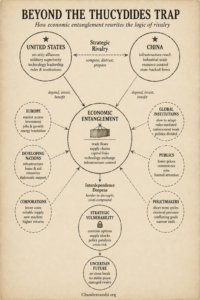
The thing we are actually inside is two powers that built each other’s capacity to compete, cannot afford to stop, and are now trying to selectively unwind a knot they tied while nobody was watching the hands.
The old map has a clean line between ally and enemy.
The actual map has a container moving between them at thirty-two knots.
The Soviet Union was comprehensible as an adversary because it was legible.
It sold ideology and fear.
The West sold Coca-Cola and missiles.
You knew where things came from.
You knew what each side wanted.
The script was clear enough that entire institutions were built around it — containment, deterrence, the logic of mutually assured destruction.
Pick a side.
Don’t trade with the enemy.
Wait for internal collapse.
China is not the Soviet Union.
This is said often and then immediately forgotten when the vocabulary arrives.
China is a hyper-competitive state that also has missiles.
It does not want to convert you.
It wants to sell to you, lend to you, build your roads, process your minerals, and then remind you — quietly, through contract language rather than ideology — who owns the terms.
The aggression is real.
The South China Sea, Taiwan, the cyber intrusions, the systematic acquisition of ports and infrastructure in countries with weak negotiating positions.
All of that is documented, ongoing, and serious.
But it arrives in the same packaging as the cooperation.
The country that threatens to blockade an island also ensures your pharmacy has antibiotics.
The government that hacks your hospitals also trained your engineers.
The firm that builds warships also builds the EV plant in Hungary that hired local workers, paid local taxes, and became part of the town’s rhythm before anyone finished the policy debate about whether to allow it.
Cold War vocabulary breaks here because it requires you to choose which of these is the real China.
The answer is both, simultaneously, by design.
The integration is not incidental to the competition.
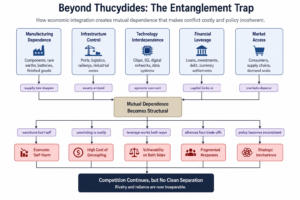
It is the competition.
Watch what the last decade of responses actually looked like.
Germany debated Huawei’s role in its 5G network for four years, reached a compromise, then quietly reversed it after the invasion of Ukraine reordered the threat landscape.
Italy signed the Belt and Road Initiative in 2019, became the only G7 country to do so, then withdrew in 2023 after the political cost of appearing naive outweighed the economic benefit of the investment pipeline.
Lithuania opened a Taiwan representative office and had its imports blocked for a year — a clean statement by Beijing about what diplomatic signals cost, delivered through trade rather than through a military move.
These are not coherent responses to a coherent threat.
They are individual countries attempting to manage an entanglement that predates the policy debate about whether the entanglement was wise.
The US response is more systematic and more revealing.
- The CHIPS Act
- The Inflation Reduction Act
- Export controls on advanced semiconductors
These are not the moves of a power confused about the game.
They are the moves of a power that read the board and understood it was playing economic competition while calling it security policy, for a decade, while the ports were being built and the contracts were being signed.
Washington is not ignorant. It is late.
And catching up is not the same as leading.
The knot was tied while no one watched the hands.
The identity the clear-eyed realist carries into this situation is that they understand the conflict better than the officials who keep getting it wrong.
They see through the naive optimism of the engagement era.
They see through the hawkish overreach of the containment advocates.
They hold both China’s genuine threat and Western policy failure in view simultaneously.
What that identity cannot easily hold: the confusion is not only Washington’s.
It is structural.
It lives in the situation itself.
The frame that separates strategic adversary from essential economic partner was not built for a relationship where both are simultaneously, dependably true.
A factory owner in Michigan wanted chips.
He did not care who made them.
He cared they were late and expensive.
That is not naivety about China.
That is a person whose daily reality does not resolve into the categories the policy debate offers him.
The European pension fund manager who invested in Chinese battery manufacturers on the same afternoon the politician was at the podium is not a hypocrite.
They are a person operating inside a system where the alternative — slower trains, more expensive cars, dimmer factories, higher inflation — still costs more than the risk.
The risk is real.
The cost of avoiding it is also real.
The vocabulary that makes one of those legible while erasing the other is the part that breaks.
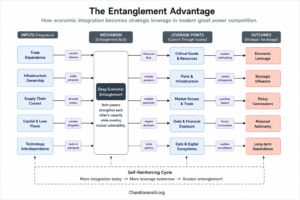
The trap, if there is one, is not that conflict is inevitable.
It is that the preparation for conflict is being built on a map of a war that will not arrive in the shape the map describes.
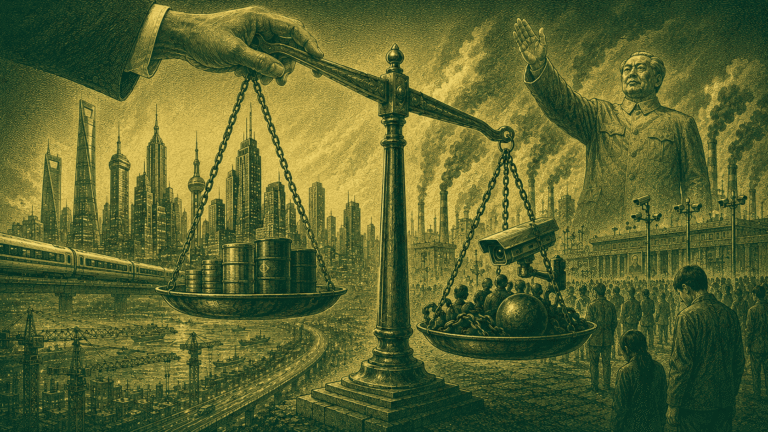
US military spending curves upward — submarines, hypersonic missiles, naval presence in the Pacific.
China’s Belt and Road spending curves too — ports, railways, mineral contracts, digital networks.
One builds things to destroy.
The other builds things to connect, which also means to control.
A port in Greece does not look like an aircraft carrier.
But if you own the port, you know what arrives, when, and where it goes.
If you process the minerals, you decide who gets batteries and who waits.
The competition is not military parity — though the military dimension is real and growing.
It is who sets the conditions of daily life for more people in more places.
The container at Piraeus will reach Rotterdam by morning.
The cranes will reset.
Another ship will arrive from Shenzhen.
The flag above the cranes will not change.
Neither will the ownership.
The old story said: identify the enemy by what they make and what they believe.
The actual situation says: identify the entanglement by what you cannot stop buying and cannot afford to unwind.
Those are different problems.
The first one has a solution.
The second one has a negotiation that will last longer than any administration conducting it.
We are not in a trap.
We are in something built too quickly to understand and moving too fast to escape.
The vocabulary that describes it clearly has not finished being invented yet.
That is the part the clean-eyed realist position has not fully priced in: the confusion is not someone else’s failure to read the board.
It is a property of the board.
Key Facts Referenced
- US fighter jets and rare earth dependence: The Lockheed Martin F-35 Lightning II contains roughly 900 pounds of rare earth elements used in magnets, radar systems, avionics, and electronic warfare components. China accounted for more than 70% of US rare earth imports during much of the 2020–2023 period, making the dependency strategically significant.
- Chinese missile systems and US-designed chips: US authorities prosecuted cases such as Yi-Chi Shih involving California-designed monolithic microwave integrated circuits (MMICs) allegedly routed to Chinese entities connected to missile and radar programs. The case highlighted how advanced semiconductor design, manufacturing, and defense supply chains remain globally entangled.
- Huawei and European infrastructure debates: Germany and several European states spent years debating the role of Huawei in 5G infrastructure after Chinese telecom equipment had already become deeply integrated into existing networks and supplier ecosystems.
- Italy and the Belt and Road Initiative: Italy became the only G7 nation to formally join China’s Belt and Road Initiative in 2019 before later withdrawing in 2023 under growing geopolitical pressure and security concerns.
- Lithuania trade pressure case: After Lithuania allowed a Taiwan representative office using the name “Taiwan,” China restricted trade flows and blocked imports linked to Lithuania, demonstrating how economic leverage and supply-chain exposure can be used as geopolitical tools without direct military escalation.
- CHIPS Act and industrial policy response: The CHIPS and Science Act, semiconductor export controls, and related industrial policies reflect Washington’s attempt to rebuild domestic manufacturing capacity after decades of deep integration with Chinese-centred supply chains.