India Sector Analysis: Industrial Bottlenecks & Strategic Supply Chains Industry
India’s Industrial Bottlenecks: Where the Real Money Sits Across Eight Critical Sectors
Table of Contents
- The Battery Sector
- Logistics
- Hospitals
- Fertilizers
- CRDMO Pharma
- Clean Energy Transition
- Warehousing
- Tyres
- Where Capital Should Go First
- The Cross-Sector Pattern
India’s economy is often described as a demand story. That framing is incomplete. Demand is real, broad, and accelerating across energy, healthcare, mobility, and logistics. But demand does not determine which companies win.
Supply does — specifically, control over the chokepoints in the supply chain: raw materials, processing capacity, network density, chemistry. Across eight sectors, the same logic applies. The obvious investment thesis is the incomplete one.
1. The Battery Sector: India Is Paying China to Power Its Own Energy Transition
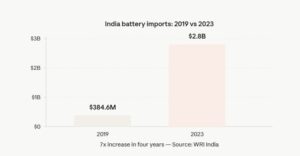
Here is the number that frames India’s battery problem: battery imports rose from $384.6 million in 2019 to $2.8 billion in 2023. That is more than a seven-fold increase in four years, driven almost entirely by electric vehicles and grid storage. The demand is domestic. The supply is not. WRI India
Import dependency currently sits near 100 percent. Even optimistic projections put it at around 20 percent by FY27, contingent on giga-scale domestic manufacturing coming online as planned. That conditional clause matters. India has allocated capacity under the policy. It has not yet been built on a commercial scale. Energetica India
The belief the market tends to defend here is that India’s battery opportunity is an EV story. It is not, or at least not only. The sharper read is that India’s battery challenge is a chemistry and processing story.
A battery has four main components: cathode, anode, electrolyte, and separator. The cathode alone accounts for roughly 35 percent of battery cost, and the anode another 10 percent. Together, those two components represent half the cost of a finished cell.

India has limited commercial-scale capacity for either. Companies doing final pack assembly using imported cells are not battery manufacturers in any meaningful sense — they are importers with an extra step. Grand View Research
The chemistry question compounds this. LFP batteries — lithium iron phosphate — are cheaper and safer but carry lower energy density. NMC batteries offer higher density but cost more.
Globally, China dominates lithium-ion battery exports, with over 80 percent of imports into major markets coming from China. India has no equivalent position in either chemistry. TradeImeX
The government has allocated 40 GWh of integrated battery production capacity under the Advanced Chemistry Cell PLI scheme, with fund allocation increased significantly for FY 2023-24.
But allocating capacity and building it are different activities. As of 2023, domestic manufacturing had reached 18 GWh, with the current focus remaining primarily on assembling battery packs using imported cells rather than manufacturing the cells themselves. Energetica IndiaWRI India
Battery pack prices in India fell to USD 115 per kWh in 2025 from USD 132 per kWh a year earlier, with locally produced NMC cells reaching USD 95 per kWh by early 2026. The cost gap with Chinese cells is narrowing. The processing bottleneck upstream has not closed. Mordor Intelligence
The investor question in this sector is not which EV company will sell the most vehicles. It is the question of which company will control cathode or anode processing at a commercial scale within India. Those are not the same companies, and the battery supply chain in India analysis rarely separates them clearly enough.
Sources: WRI India | Energetica India | Mordor Intelligence
Bottleneck: Cathode and anode processing capacity at commercial scale.
Who controls it: Upstream chemical players and foreign cell manufacturers — currently not India.
Investor takeaway: Avoid equating pack assembly with value capture. The company that assembles the pack is not the same as the company that captures margin from the battery supply chain.
2. Logistics: Why the Sector’s Most Profitable Companies Are Not the Fastest-Growing Ones
India’s logistics market was valued at around USD 230 billion in 2024 and is projected to reach USD 360 billion by 2030. Those are large numbers. They are also largely irrelevant to the question of where profit concentrates, because logistics in India is a network business, not a volume business. Volume creates revenue. Network density creates margin. MarkNtel Advisors
The GST transition restructured this sector more than any other single policy change. Before GST, companies built warehouses in each state to minimize tax burden. After GST, that logic inverted. The optimal configuration became centralized hubs serving large geographies — fewer facilities processing more volume. That shift rewarded companies that could afford to consolidate and punished those that couldn’t.
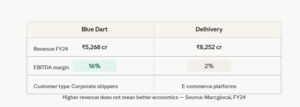
The logistics profitability in India picture reflects this directly. Blue Dart maintained a 16 percent EBITDA margin on revenue of ₹5,268 crore in FY24. Delhivery, with higher revenue, ran at a 2 percent EBITDA margin and a negative 3 percent PAT margin for the same period. Both companies operate in logistics.
They operate in entirely different businesses. Blue Dart runs a premium, time-definite air express network serving corporate shippers who absorb higher rates for reliability. Delhivery runs high-volume e-commerce parcel delivery at rates compressed by platform bargaining power. Marcglocal
Who your customer is, and what they are paying for, determines the profitability ceiling far more than revenue size.
GST e-way bill volumes rose 20 percent year-on-year for Q4 FY25, signaling robust B2B growth. Delhivery’s PTL segment specifically grew 20 percent in the same period.
B2B freight, particularly the Part Truck Load segment, carries meaningfully better economics than consumer e-commerce delivery because the shipper mix is different and pricing holds better against competition. Business Today
The overlooked variable is operating leverage. Logistics infrastructure is expensive to build and cheap to fill once built. A company with 100 sortation centres at 60 percent capacity generates thin margins.
The same infrastructure at 85 percent generates strong ones, without proportionally higher costs. Delhivery reported revenues of ₹8,252 crore in FY25, turning profitable with a net profit of ₹112.53 crore — its first annual profit, compared to a loss of ₹812 crore in FY23.
That trajectory is not a business transformation. It is a fixed-cost business reaching the utilization threshold where the economics begin working. Infrastructure Today
The risk that actually matters is in-sourcing. Amazon and Flipkart built their own last-mile networks precisely because logistics margin eventually conflicts with marketplace economics. A logistics company building its revenue base on one or two large e-commerce clients is not building a business. It is building a dependency.
Sources: Infrastructure Today | Mordor Intelligence | Business Today
Bottleneck: Hub density and utilization rate — not reach, not fleet size.
Who controls it: Blue Dart in premium air express. Delhivery in surface volume, now crossing the utilization threshold.
Investor takeaway: Track EBITDA per shipment, not total EBITDA. Revenue inflated by e-commerce volume without margin improvement is not a business upgrading — it is a business waiting for its customer to in-source.
3. Hospitals: A Genuine Earnings Franchise in a Sector That Looks Simple Until the Beds Fill Up
The hospital sector’s revenue formula is almost insultingly direct: beds multiplied by occupancy multiplied by revenue per occupied bed per day (ARPOB). The sector looks uncomplicated. It isn’t, for one reason: the relationship between capacity expansion and earnings is nonlinear and time-lagged in ways that consistently mislead investors.
When a hospital adds 500 beds, costs rise immediately — new hires, depreciation, equipment, power. Occupancy builds slowly. A new facility typically requires three to five years to reach the 70-plus percent occupancy that makes the economics compelling.

During that ramp period, new beds drag on consolidated margins even when the group is operationally excellent. Investors reading margin compression as a quality signal during an expansion phase are misreading the data.
The demand tailwind is real and long-dated. India’s combination of aging population, growing insurance penetration, and rising chronic disease burden means hospital visits per capita will rise for decades, regardless of GDP cycles.
India currently has roughly 1.3 hospital beds per 1,000 people against a WHO reference benchmark of three. That gap cannot be closed quickly, and it creates sustained pricing power for quality operators in locations where supply remains constrained.
The distinction that matters for hospital sector margins India analysis is between ARPOB growth and bed growth. ARPOB growth — which reflects case mix, speciality mix, and insurance realization — is structurally more valuable than bed additions because it requires no proportional capital expenditure.
A hospital group that grows ARPOB at 10 percent annually through oncology, cardiac care, and neurology deepening is compounding on existing capital. A group adding greenfield facilities is consuming capital on a three-to-five-year payback clock.
The risks are specific. Regulatory price caps on stents and implants, introduced in 2017, directly compressed ARPOB for certain procedures. The direction of policy on insurance claim caps matters significantly to hospitals with high cashless insurance volumes.
And a hospital group with tens of thousands of beds in development is only as valuable as its execution capacity for each of those locations separately.
Bottleneck: Speciality depth and ARPOB at same-store facilities — not total bed count.
Who controls it: Groups with established super-speciality brands in Tier 1 cities, where replication by new entrants takes a decade of clinical reputation-building.
Investor takeaway: Watch same-store ARPOB growth and three-year-plus occupancy at mature facilities. Both numbers tell you the real business, separate from the noise of new openings.
4. Fertilizers: The Sector Where Policy Distortion Is the Business Model
India’s fertilizer sector is not primarily an agricultural input business. It is a subsidy management business. Understanding that distinction is the starting point for any useful analysis.
India imports roughly 60 percent of its DAP (di-ammonium phosphate) and 100 percent of its MOP (muriate of potash). The total import bill for fertilizers runs at approximately $18 billion annually.
That figure does not represent a normal commodity import. It represents a policy-driven purchasing commitment because domestic prices are held artificially low through government subsidy, which stimulates demand beyond what would exist at international prices, which drives higher import volumes, which further inflate the subsidy bill. The cycle reinforces itself.
The urea problem compounds this. India applies urea at rates significantly above agronomic optimum, partly because it is the most heavily subsidized fertilizer and therefore the cheapest option at the farm gate. The NPK imbalance that results degrades soil quality over time, which increases the volume of inputs required to maintain yields. The policy designed to support farmers is, over a 20-year horizon, making farming harder.
The fertilizer subsidy economics India thesis for investors is essentially a bet on policy continuity, not on business quality. Companies that manufacture domestically benefit from assured offtake at regulated prices with subsidy flow from the government.
That is closer to a regulated utility than a competitive business, with the government’s fiscal position as the primary counterparty risk. Companies that distribute imported fertilizers are exposed to global commodity price swings and government procurement decisions.
The genuine long-range question is whether India can develop domestic phosphate and potash mining capacity that would reduce import dependency. That is a 15-to-20-year story, not a current-cycle one.
Bottleneck: Government subsidy flows and the fiscal capacity to sustain administered pricing.
Who controls it: The government — which makes this sector a policy trade, not a business quality trade.
Investor takeaway: Watch subsidy arrear payment timelines. When payments lag, working capital stress at fertilizer companies rises sharply before it appears in reported earnings. That is the leading indicator most coverage misses.
5. CRDMO Pharma: The Part of the Value Chain Indian Pharma Investors Most Often Skip
Most Indian pharma investment analysis focuses on formulations — finished drugs sold in domestic or regulated export markets. The contract research, development, and manufacturing (CRDMO) segment sits further upstream and carries fundamentally different economics.
A CRDMO earns at two points: research services (early-stage chemistry, process development) and commercial manufacturing (making the molecule at scale for an innovator company over multi-year contracts). The first business generates fees. The second generates annuity revenue tied to the commercial success of a drug. The value gap between the two is large.
The global CRDMO market is estimated at $140-150 billion. India’s share sits at approximately 3 percent. The China-plus-one shift in pharmaceutical sourcing, accelerated by COVID-era supply disruptions, has created a real window for Indian players.
But the window requires specific capabilities: end-to-end integration from discovery chemistry through commercial manufacturing, a regulatory track record with the US FDA and EMA, and the financial capacity to invest in dedicated manufacturing tied to long-term client contracts.
Molecule pipeline dependency is a genuine risk that balance sheets do not surface clearly.
A CRDMO generating 40 percent of its commercial manufacturing revenue from one innovator client’s drug is exposed to that drug’s clinical and commercial outcomes, not just its own operational performance.
Investors reading revenue growth need to examine contract structure — specifically, whether revenue comes from molecules in Phase III trials or molecules already in commercial launch with multi-year supply agreements.
Bottleneck: Regulatory trust built over years of US FDA and EMA inspection history — not chemistry capability alone.
Who controls it: Companies with clean compliance records across multiple inspection cycles, which are far fewer than those with chemistry competence.
Investor takeaway: Track new molecule wins at Phase II or III that are not yet generating revenue. These represent pipeline value invisible in current earnings but determinative of earnings three to five years forward.
6. Clean Energy: An Ecosystem, Not a Technology Bet
India’s power demand is projected to roughly double — from approximately 1,700 to 3,500 TWh — over the next two decades. The three components driving that shift are solar, hydrogen, and electric vehicles. The relationship between them is not additive; it is sequential. Solar generates the electricity. Electricity charges the vehicles and produces the hydrogen. The grid is the enabling layer for all three.
Investors treating solar, EV, and hydrogen as three separate sector bets are missing the dependency chain. A company that supplies solar panels but has no position in storage or grid transmission is betting on one link in a system whose value concentrates at different nodes depending on where bottlenecks form. As India’s solar capacity grows, grid integration and storage become the constraints — not generation itself.
The policy risk here is specific: tariff revision cycles and renewable purchase obligation enforcement by state electricity boards, both of which have historically been inconsistent. A project that wins a tariff today at viability gap funding support is not the same as a project generating cash flows at that tariff in year eight.
Bottleneck: Grid integration and storage capacity — not solar generation, which is now widely available.
Who controls it: Transmission companies, storage operators, and companies with long-duration offtake agreements with creditworthy counterparties.
Investor takeaway: Generation capacity additions are widely reported and fully priced. Storage and transmission capacity additions are less covered and less priced. That is where the analytical gap sits.
7. Warehousing: Where Location Does More Work Than Square Footage
India’s warehousing market spans roughly 50 crore square feet across Grade A, B, and C stock. The distinctions between those grades matter more than the aggregate figure, because demand concentrates at Grade A — temperature-controlled, structurally sound, technology-enabled facilities near logistics corridors — while supply has grown fastest at the grades below.
The yield on Grade A warehousing runs at approximately 7.5 to 8 percent. That looks attractive until oversupply in specific micro-markets compresses occupancy. Vacancy risk is real and geography-specific: a warehouse on the Delhi-Mumbai Industrial Corridor is a different asset from one 80 kilometres off the nearest expressway serving a fragmented industrial cluster.
E-commerce, manufacturing, and consumption-driven distribution are the three demand sources. Of those, manufacturing-linked warehousing — serving auto, pharma, and electronics supply chains — generates longer lease tenures and more stable tenants than e-commerce-linked warehousing, where rapid fulfillment network changes can void a facility’s demand thesis within a quarter.
Bottleneck: Location relative to demand density and infrastructure corridors — not total square footage.
Who controls it: Real estate investment platforms and developers with assets on established freight corridors and near major consumption clusters.
Investor takeaway: Vacancy rate at the micro-market level, not the national level. National occupancy data masks enormous local variation that determines actual rental realization.
8. Tyres: A Commodity Business With One Route to Better Economics
The tyre sector has limited pricing power relative to its raw material exposure. Natural rubber and crude oil derivatives account for roughly 45 percent of production costs, and both move with commodity cycles the companies cannot control.
OEM (original equipment manufacturer) demand is subject to auto sales cycles. Replacement demand is more stable but operates in a competitive environment with limited brand differentiation at the lower end of the product range.
The one genuine margin lever is segment mix. Off-highway tyres — serving mining, agriculture, and construction equipment — carry meaningfully higher margins than passenger vehicle tyres.
Export-market sales to premium segments also carry better realizations. Companies that have built technical capability in specialized applications are in a structurally better position than those competing on cost in the mainstream replacement market.
Sodium-ion and solid-state battery development, if it accelerates EV adoption, creates a second-order risk: fewer replacement tyres per vehicle lifetime, because EVs have lower maintenance friction and their tyre wear patterns differ from combustion vehicles. That is a five-to-ten-year consideration, not a current-quarter one. But it belongs in any long-horizon sector view.
Bottleneck: Segment mix tilted toward off-highway and specialty applications — not production volume.
Who controls it: The two or three players with established technical capability in radial and specialty segments.
Investor takeaway: Track the revenue contribution from off-highway and export premium segments separately from mainstream replacement. Companies where that share is rising are compounding quality. Companies where it isn’t are depending on volume growth for earnings.
Where Capital Should Go First
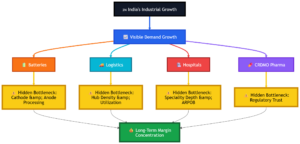
Not every bottleneck is equally investable right now. Ranking the eight sectors by the combination of bottleneck clarity, control concentration, and near-term earnings visibility:
Strongest bottlenecks — highest conviction for capital allocation:
Hospitals carry a combination of durable demand, pricing power in speciality segments, and a clear earnings formula at the same-store level. The bottleneck (speciality depth and clinical reputation) takes years to replicate, making existing quality operators genuinely protected.
CRDMO pharma, for companies with clean regulatory records and Phase III pipeline exposure, offers annuity-like commercial manufacturing revenue that does not appear in current earnings screens. Logistics, specifically PTL freight operators, carries operating leverage that is now beginning to convert as utilization crosses the threshold where fixed costs are covered.
Medium conviction — real opportunity, but more conditional:
Batteries are a generational opportunity with a currently unbridgeable domestic supply gap. The conviction will increase as PLI disbursements prove actual value-addition rather than assembled imports.
Clean energy transition is large and real, but the investable opportunity has shifted from generation (well-covered, fairly priced) to storage and transmission (less covered, less priced). Grade A warehousing in high-demand corridors generates a stable yield, but micro-market selection is the entire decision.
Weakest for direct allocation right now:
Fertilizers are a policy trade with government fiscal health as the primary variable. Tyres are a commodity business where segment mix improvement is gradual, and the long-term EV headwind is real. Neither sector is uninvestable, but neither offers a bottleneck so clearly owned that investor conviction is straightforward.
The Cross-Sector Pattern: Bottleneck Control Is the Thesis
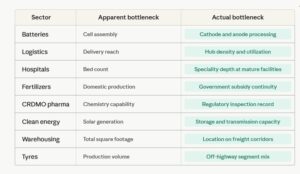
Running across all eight sectors is a single organizing logic. India’s demand is real, broad, and durable. India’s supply is constrained, import-dependent, and fragmented. Winners are companies that own or control the part of the value chain where capacity is genuinely scarce.
The bottleneck is not always where it appears. In batteries, it is not cell assembly — it is cathode and anode processing. In logistics, it is not delivery reach — it is hub density and utilization. In hospitals, it is not bed count — it is speciality depth at mature facilities.
In fertilizers, it is not domestic production — it is the government’s fiscal ability to sustain subsidy flows. In CRDMO, it is not chemistry capability — it is regulatory trust built over inspection cycles.
Each sector is moving along the same axis: from importing to localizing, from fragmentation to scale, from volume growth to efficiency improvement.
The companies that will compound capital over the next decade are those positioned at the actual chokepoint in each of these transitions — not those positioned where the transition is merely visible.
The market prices the visible part. The chokepoint is usually one layer upstream from where most analysis stops.
Key Sources & References
These sources support the analysis of India’s industrial bottlenecks across batteries, logistics, hospitals, fertilizers, CRDMO pharma, clean energy, warehousing, and tyre manufacturing. The references focus on supply-chain constraints, import dependence, utilization economics, policy exposure, and value-chain positioning.
Battery Sector
- WRI India: Lithium-Ion Battery Manufacturing in India
https://wri-india.org/perspectives/lithium-ion-battery-manufacturing-india-revisiting-missing-links - Ministry of Heavy Industries: PLI ACC Battery Scheme
https://heavyindustries.gov.in/en/pli-scheme-national-programme-advanced-chemistry-cell-acc-battery-storage - Energetica India: Import Dependency May Fall to 20% by FY27
https://www.energetica-india.net/news/indias-lithium-ion-battery-import-dependency-to-drop-to-20-percent-by-fy27–report - Mordor Intelligence: India Lithium-Ion Battery Market
https://www.mordorintelligence.com/industry-reports/india-lithium-ion-battery-market - Grand View Research: India Lithium-Ion Battery Market Report
https://www.grandviewresearch.com/industry-analysis/india-lithium-ion-battery-market-report - TradeImeX: Global Battery Import & Export Trends
https://www.tradeimex.in/blogs/global-battery-import-data-top-importers-2024-25 - IEA Global EV Outlook 2024
https://www.iea.org/reports/global-ev-outlook-2024
Logistics
-
- MarkNtel Advisors: India Logistics Market Outlook
https://www.marknteladvisors.com/research-library/india-logistics-market.html - Grand View Research: India Logistics Market
https://www.grandviewresearch.com/industry-analysis/india-logistics-market-report - Infrastructure Today: Delhivery FY25 Profitability & Logistics Trends
https://infrastructuretoday.co.in/fastest-growing-logistis-companies-in-india/
- MarkNtel Advisors: India Logistics Market Outlook
- Business Today: PTL Freight & Logistics Stocks
https://www.businesstoday.in/markets/stocks/story/delhivery-vrl-logistics-blue-dart-express-tci-express-target-prices-for-logistics-stocks-471206-2025-04-08 - Delhivery Investor Relations
https://www.delhivery.com/investor-relations/ - Blue Dart Investor Relations
https://www.bluedart.com/investor-relations
Hospitals
- WHO Global Health Observatory Data
https://www.who.int/data/gho - India Journal of Community Medicine & Healthcare Study on Hospital Beds
https://www.ijcmph.com/ - ICRA Hospital Sector Reports
https://www.icra.in/ - NABH Accreditation Standards & Hospital Quality Framework
https://nabh.co/ - Apollo Hospitals Investor Relations
https://www.apollohospitals.com/investors/ - Fortis Healthcare Investor Relations
https://www.fortishealthcare.com/investors - Max Healthcare Investor Relations
https://www.maxhealthcare.in/investors - IBEF Healthcare Industry Report
https://www.ibef.org/industry/healthcare-india
Fertilizers
-
- Ministry of Chemicals & Fertilizers
https://mocf.gov.in/ - Union Budget Subsidy Documents
https://www.indiabudget.gov.in/ - Reuters: India Fertilizer Import Bill & Subsidy Stress
https://www.reuters.com/ - Angel One: Fertilizer Import Dependency & Subsidy Analysis
https://www.angelone.in/
- Ministry of Chemicals & Fertilizers
- FAO Fertilizer & Soil Nutrient Reports
https://www.fao.org/ - IFFCO Corporate & Industry Reports
https://www.iffco.in/en/corporate
CRDMO Pharma
- Future Market Insights: Global CRDMO Market
https://www.futuremarketinsights.com/reports/crdmo-market - McKinsey Life Sciences Insights
https://www.mckinsey.com/industries/life-sciences/our-insights - EY India Pharma & CRDMO Reports
https://www.ey.com/en_in/life-sciences - India Ratings Pharma Sector Reports
https://www.indiaratings.co.in/ - Syngene International Investor Relations
https://www.syngeneintl.com/investors/ - Divi’s Laboratories Investor Relations
https://www.divislabs.com/investor-relations/ - Laurus Labs Investor Relations
https://www.lauruslabs.com/investors_home.html - U.S. FDA Inspection Database
https://www.fda.gov/
Clean Energy Transition
- International Energy Agency India Energy Outlook
https://www.iea.org/countries/india - Ministry of Power India
https://powermin.gov.in/ - Ministry of New and Renewable Energy
https://mnre.gov.in/ - Solar Energy Corporation of India (SECI)
https://www.seci.co.in/ - Central Electricity Authority
https://cea.nic.in/ - BloombergNEF Energy Transition Research
https://about.bnef.com/ - NITI Aayog Energy Transition Reports
https://www.niti.gov.in/
Warehousing
- Knight Frank India Warehousing Reports
https://www.knightfrank.co.in/research - CBRE India Logistics & Warehousing Reports
https://www.cbre.co.in/insights/reports - JLL India Warehousing Outlook
https://www.jll.co.in/en/trends-and-insights/research - Warehousing Association of India
https://www.wrai.in/ - Prologis Logistics Industry Research
https://www.prologis.com/logistics-industry-research - Delhi-Mumbai Industrial Corridor (DMIC)
https://nicdc.in/projects/national-industrial-corridor-development-programme/delhi-mumbai-industrial-corridor-dmic
Tyres
- Automotive Tyre Manufacturers Association (ATMA)
https://www.atmaindia.org.in/ - CEAT Investor Relations
https://www.ceat.com/investors.html - MRF Investor Relations
https://www.mrftyres.com/investor-relations - Balkrishna Industries Investor Relations
https://www.bkt-tires.com/ww/us/investors - JK Tyre Investor Relations
https://www.jktyre.com/investor/investor-presentations - CRISIL Auto Components & Tyre Sector Reports
https://www.crisil.com/content/dam/crisil/our-analysis/reports/Ratings/documents/2019/november/auto-componets-slow-drive.pdf
Cross-Sector Industrial Bottlenecks
- CSEP: India Manufacturing Competitiveness & Supply Chains
https://csep.org/ - NITI Aayog Infrastructure & Industrial Reports
https://www.niti.gov.in/ - IBEF Industrial Sector Reports
https://www.ibef.org/ - DPIIT Industrial & Manufacturing Data
https://dpiit.gov.in/
Suggested Reader Note
Data and industry references sourced from IEA, WRI India, WHO, Ministry of Power, Ministry of Chemicals & Fertilizers, CBRE, Knight Frank, McKinsey, EY, CRISIL, BloombergNEF, CSEP, NITI Aayog, logistics market reports, and company investor filings.
Claims regarding battery import dependence, logistics utilization economics, hospital occupancy dynamics, fertilizer subsidy exposure, CRDMO regulatory positioning, renewable energy transition bottlenecks, warehousing demand concentration, and tyre segment economics are based on publicly available industry and institutional research.
The analytical framework throughout the article focuses on bottleneck control, upstream processing capacity, utilization thresholds, regulatory trust, and supply-chain positioning rather than headline demand growth alone.