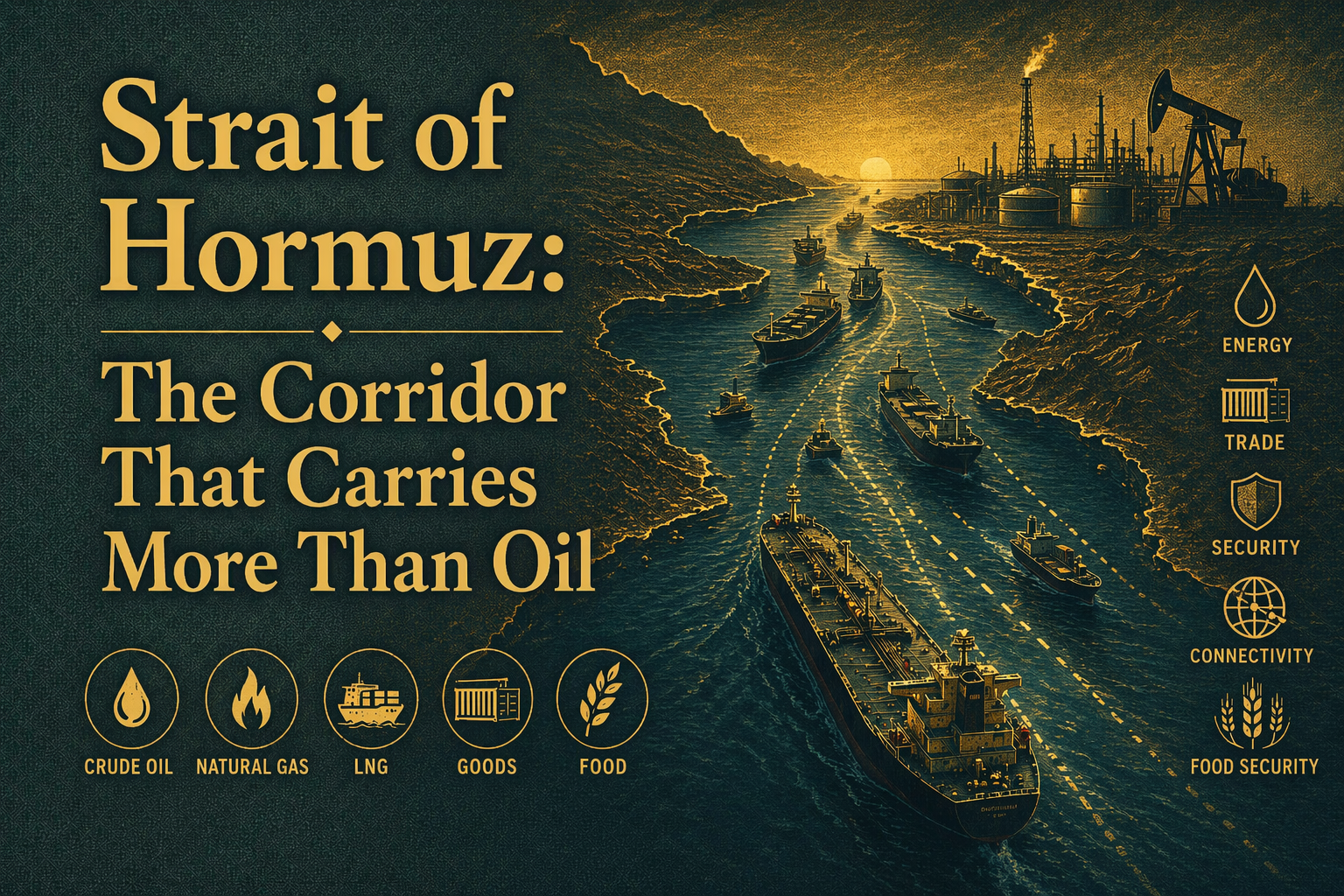
Strait of Hormuz: The Corridor That Carries More Than Oil
What Exists Inside the World’s Most Strategic Chokepoint Beyond Energy Numbers
Roughly 21 million barrels of crude oil move through the Strait of Hormuz every day.
The corridor narrows to around 21 miles at its tightest navigable section.
That statistic turned the strait into a percentage:
About one-fifth of global oil supply.
A chokepoint.
A risk variable inside energy markets.
But percentages flatten places.
What disappears inside the energy arithmetic is everything else that survived there:
- Coral systems that tolerate lethal heat
- Mangrove forests desalinating seawater biologically
- Passive cooling systems older than modern air conditioning
- Boat-building traditions transmitted without written plans
- Languages assembled through centuries of trade routes
The strait is not just an oil corridor.
It is also a concentrated archive of adaptation under extreme conditions.
The Coral That Should Not Exist
The Persian Gulf regularly exceeds the temperature thresholds that normally destroy coral reefs.
Summer water temperatures can rise above 35°C.
At those levels, most coral systems experience:
- Mass bleaching
- Breakdown of symbiotic algae
- Colony starvation
- Large-scale reef death
That sequence defines reef collapse across much of the world.
Around Hormuz Island and nearby islands, many reefs continue functioning anyway.
Marine biologists studying Gulf reef systems found coral populations shaped by extreme thermal selection across thousands of years.
Organisms without heat tolerance died.
Survivors reproduced.
Over generations, heat resistance stopped being an exception and became the biological baseline.
The reefs effectively contain a living record of the Gulf’s thermal history encoded inside the organisms themselves.
The Forest Running Without Machinery
Along the southeastern coast of Qeshm Island sits the:
Hara Forest.
The ecosystem is dominated by mangroves from the species:
Avicennia marina
These trees survive in saltwater through a biological filtration process.
Salt enters through the roots.
The tree expels excess salt through the leaves as visible crystals.
No pumps.
No electricity.
No industrial desalination infrastructure.
Only evolutionary adaptation refined over millions of years.
The forest also functions as a biological nursery for the wider Gulf ecosystem.
Its protected tidal channels support:
- Juvenile shrimp
- Fish populations
- Marine breeding cycles
Fishing economies across the region historically depended on this output long before the ecological relationship was formally measured.
The Engineering Hidden Inside the Walls
Summer temperatures on Qeshm Island regularly exceed 45°C.
Humidity from the Gulf transforms the heat into something more difficult than desert conditions.
Not dry heat.
Wet atmospheric pressure.
Communities there solved the problem architecturally centuries before electrical cooling existed.
In the village of Laft, traditional homes use:
Windcatcher towers.
These towers capture airflow above roof level and redirect cooler moving air downward into interior spaces.
Internal channels and pressure differentials create passive cooling without electricity.
Indoor temperatures can remain 15–20°C cooler than exterior conditions.
The solution was embedded directly into the structure itself.
Cooling became architecture rather than infrastructure.
The Boat-Building Knowledge That Exists Without Blueprints
Traditional wooden vessels called:
Lenge boats
Are still built along parts of the Gulf coastline.
What makes the craft unusual is not only the design.
It is how the knowledge survives.
The construction process historically depended almost entirely on apprenticeship and physical demonstration.
Not written manuals.
Not engineering drawings.
The hull geometry exists through repetition stored in human memory and practice.
The positioning of timber, keel balance, and hull curvature are transmitted hand-to-hand across generations.
That creates a vulnerability modern systems struggle to preserve:
Knowledge without documentation disappears when transmission breaks.
A Language Built Through Trade Routes
Near the strait, communities developed:
Kumzari.
The language combines elements from:
- Persian
- Arabic
- Portuguese
- Hindi
- Other regional trade languages
The result is effectively a linguistic archive of centuries of maritime contact.
The trading history was not only recorded in ports or documents.
It survived in everyday speech.
Isolation helped preserve it.
Community continuity sustained it.
The language itself became the historical record.
Function Before Symbolism
Traditional face coverings worn by women on Hormuz Island are often interpreted primarily through culture or identity.
But their earliest function was environmental.
The coverings protected against:
- Intense ultraviolet exposure
- Salt-heavy air
- Extreme sunlight reflection from sea surfaces
Practical adaptation came first.
Social and cultural meaning accumulated later.
The pattern appears repeatedly across harsh environments:
Survival solutions gradually become tradition.
What the Strait Actually Holds
The Strait of Hormuz carries around 20% of globally traded crude oil.
That fact dominates geopolitical discussion because energy markets can quantify it easily.
What is harder to quantify is the concentration of adaptive knowledge layered around the corridor itself.
The region contains working examples of:
- Thermal biological adaptation
- Passive climate engineering
- Ecological desalination
- Non-written technical transmission
- Civilizational linguistic accumulation
The strategic value of the strait is usually discussed in terms of oil disruption.
But the deeper record inside the corridor may be something else entirely:
How human systems remain functional in conditions that should have made permanence difficult.