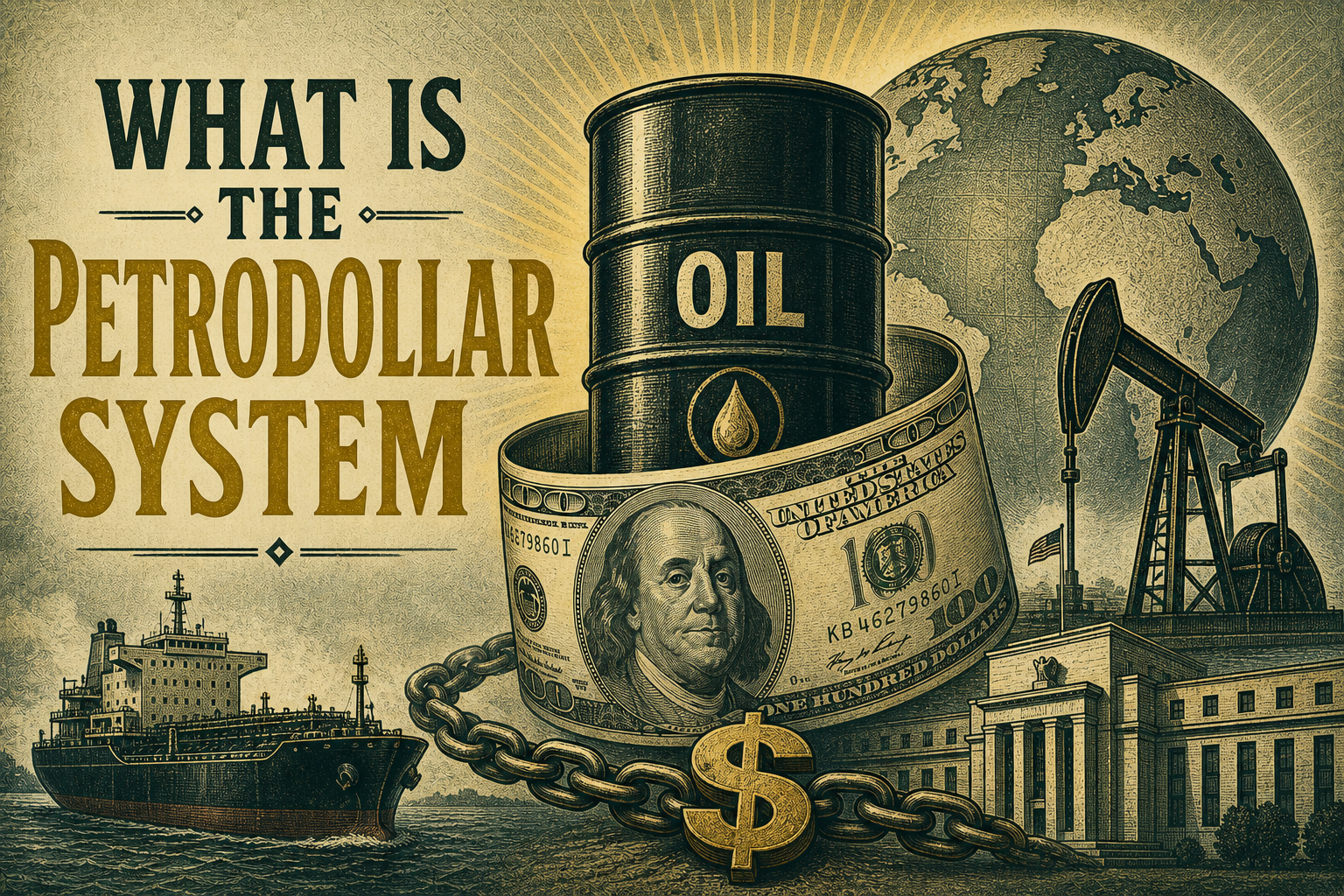
What Is the Petrodollar System — And What Its Slow Erosion Actually Means for Your Money
The Petrodollar Is Not Collapsing. It Is Compressing.
The dollar is still 58% of global reserves. The yuan is still under 3%. The petrodollar is not collapsing.
But the mechanism that has funded American military, borrowing, and sanctions power for 50 years is being restructured, in oil contracts and central bank vaults, at a pace that is now measurable.
The dollar lost 12% of its value in 2025.
Gold hit $3,500 an ounce.
Central banks bought more than 1,000 tonnes of gold for the third consecutive year.
And the Iran conflict triggered financial moves that analysts are still unpacking.
None of those four things are unrelated.
They are all downstream of the same system, a 52-year-old financial architecture most people have heard mentioned but few understand mechanically.
Understanding it doesn’t require economics training.
It requires following one loop from beginning to end.
What the Petrodollar Actually Is
The popular version of the petrodollar story has a clean narrative.
- Nixon ended gold convertibility in 1971
- The dollar needed a new anchor
- Kissinger flew to Riyadh in 1974
- Saudi Arabia agreed to price oil exclusively in dollars
Dollar dominance was secured.
That story is mostly right in outcome and partly wrong in mechanism.
The real deal was more subtle.
On June 8, 1974, the US and Saudi Arabia established the Joint Commission for Economic Cooperation.
Officially:
- Technical cooperation
- Military assistance
Unofficially:
A recycling mechanism.
There was never a formal rule forcing oil to be priced only in dollars.
Saudi Arabia continued accepting other currencies initially.
The shift toward the dollar came from inertia and convenience.
By the mid-1950s:
- The dollar had already surpassed the pound
- The Eurodollar market already existed
- Global trade already leaned toward the USD
The system was not imposed.
It evolved around what already worked.
What the 1974 structure actually created:
A recycling loop.
- Oil exporters earn dollars
- They invest those dollars into US Treasuries
- That creates permanent demand for US debt
This is what produced the “exorbitant privilege.”
The Three Structural Advantages
The value of the system is not pricing oil in dollars.
It is what that pricing forces and enables.
Every country must acquire dollars to buy energy.
That creates:
1. Currency Strength
The dollar stays strong because the world needs it continuously.
2. Cheap Borrowing
Global demand for Treasuries keeps US interest rates lower than they otherwise would be.
3. Financial Power
Sanctions work because global transactions flow through the dollar system.
Cut access to the dollar and you cut access to global trade.
These three together fund:
- Military power
- Fiscal deficits
- Sanctions capability
The petrodollar is not a side feature.
It is infrastructure.
What the Numbers Show Is Changing
The system is not collapsing.
It is compressing.
Since 1999:
Dollar reserves fell from 71% to approximately 57%.
IMF 2025 data:
- Dollar: approximately 56%
- Euro: approximately 20%
- Yuan: under 5%
A slow, continuous decline.
At the same time:
- CIPS transaction volume is rising sharply
- mBridge enables direct settlement
- More than 130 countries are exploring CBDCs
Saudi Arabia:
- Joined BRICS
- Joined mBridge
- Signalled openness to non-dollar oil trade
Central banks:
- Bought more than 1,000 tonnes of gold annually
- 73% expect lower dollar share ahead
This is not fringe behaviour.
It is institutional positioning.
What the Iran Conflict Added
Iran introduced a symbolic but important signal.
Oil transit became linked to yuan settlement discussions.
The Strait of Hormuz handles roughly 20% of global oil flows.
The enforcement is uncertain.
The signal is not.
Russia already demonstrated the broader pattern:
Approximately 90% of BRICS trade shifted toward local currencies under sanctions pressure.
The adjustment happened rapidly.
Trade systems can shift faster than reserve systems.
The pattern is clear:
Sanctioned countries build alternatives first.
Each successful workaround lowers the cost for the next participant.
The Structural Constraint
Dollar dominance is a network effect.
The dollar is used because it is already used.
Replacing it requires:
- Deep bond markets
- Open capital flows
- Institutional trust
- Legal transparency
The yuan lacks full convertibility.
The euro lacks unified debt markets.
Gold is not a transaction system.
No full replacement currently exists.
What is happening instead:
Compression, not replacement.
What Compression Actually Means
The effect appears first through borrowing costs.
Global demand for Treasuries keeps US rates artificially lower than they otherwise would be.
As external demand weakens:
- Treasury yields rise
- Borrowing costs increase
- Pressure builds on fiscal stability
For decades, the rest of the world effectively subsidized US deficits through Treasury demand.
That subsidy is shrinking.
Where This Breaks Down
- Trade is still overwhelmingly dollar-based
- Reserve diversification is ahead of trade diversification
- The yuan cannot scale fully without capital freedom
- Gold cannot replace transaction infrastructure
- Parallel systems remain smaller than SWIFT
Short-term signals and long-term monetary structure are not the same thing.
What Most Readers Miss
- The 1974 arrangement created a recycling loop, not a pricing mandate
- The dollar’s decline is gradual, not event-driven
- Gold accumulation reflects hedging, not outright replacement
- Yuan growth remains constrained by structural limits
- Compression impacts borrowing costs before dominance disappears
Frequently Asked Questions
What is the petrodollar system?
A loop where oil trade generates dollar demand, which supports US debt markets and broader financial dominance.
Is the petrodollar ending?
No.
It is weakening gradually at the margins, not collapsing.
Why are central banks buying gold?
To reduce exposure to dollar-based sanctions and counterparty risk.
How does the dollar system enable sanctions?
Because global trade and settlement systems still flow heavily through dollar infrastructure.
What does this mean for individuals?
Potentially higher borrowing costs and greater inflation pressure over time.
Did the Saudi deal expire?
No.
The system is evolving, not expiring.
The Loop in One Line
Oil requires dollars.
Dollars require Treasuries.
Treasuries fund deficits.
Deficits fund power.
Power protects oil.
Oil requires dollars.
That loop operated for 50 years.
What is changing is not its existence.
It is its exclusivity.
The dollar remains dominant.
The margin of that dominance is shrinking.