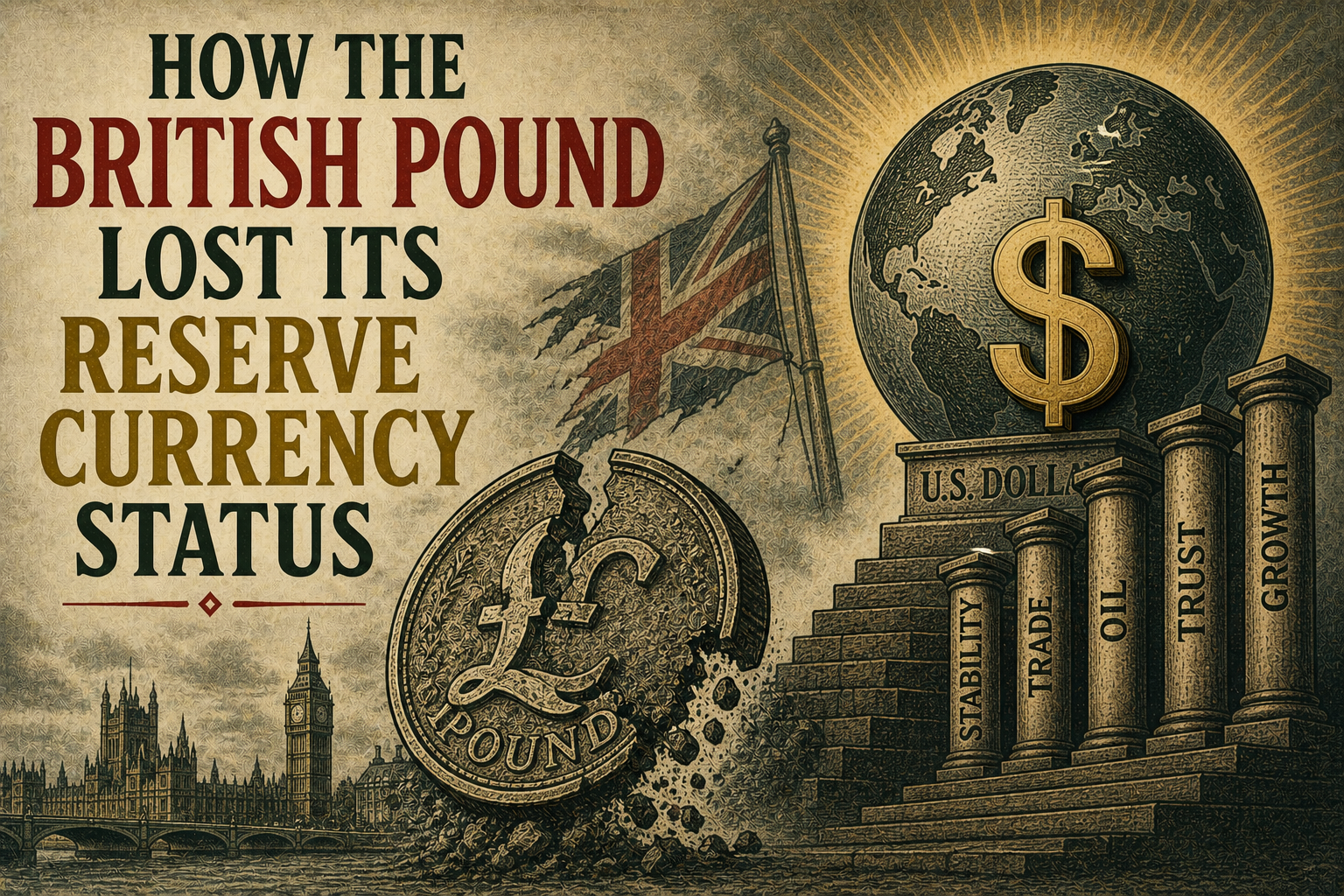
How the British Pound Lost Its Reserve Currency Status — And What the Decline Actually Looked Like
Britain Lost the Currency Before It Lost the Empire
Most accounts frame Britain’s postwar decline as a story about empire and decolonisation. The financial sequence runs differently: sterling lost its reserve currency status first, over two decades of documented, measurable compression.
The empire became unsustainable as a consequence. Understanding the mechanism matters because reserve currency decline has never looked like a collapse — it has always looked like a slow erosion that feels, from inside, like ordinary economic difficulty.
Britain won the Second World War.
It also ended the war holding £3.7 billion in sterling liabilities against gold and dollar reserves of only £620 million.
A country could be militarily victorious and financially insolvent at the same moment.
The financial condition, not the military one, determined what came next.
What Sterling’s Reserve Role Actually Was
Sterling was not just a currency.
It was the backbone of global reserves.
From 1945 to 1970:
- 81%
- 58%
- 35%
- 11%
A 70-point decline over 25 years.
That is not a collapse.
It is compression.
The shift happened gradually:
- War debt accumulated
- Trade deficits persisted
- Confidence declined
No single event caused it.
How the Mechanism Worked
Reserve currency status creates a structural conflict.
Countries hold your currency because they trust it.
Maintaining that trust requires:
- Fiscal discipline
- Monetary restraint
But domestic reality demands:
- Welfare spending
- Reconstruction
- Employment support
Those two forces pull in opposite directions.
The result showed up in markets:
Bond yields rose from 3% to 9% between 1950 and 1970.
A continuous signal of declining trust.
Not a crisis.
A 20-year warning.
The Two Devaluations
1949
The pound devalued 30.5%.
$4.03 → $2.80
Sterling was overvalued.
The decision was made rapidly under pressure.
1967
The pound devalued 14%.
$2.80 → $2.40
The government spent years trying to avoid it.
Political credibility collapsed alongside the currency.
Harold Wilson stated:
“The pound in your pocket has not been devalued.”
Technically arguable.
Public reaction:
Credibility destroyed.
What It Looked Like on the Ground
There was no dramatic collapse.
Instead:
- Slower wage growth
- Rising import costs
- Savings losing international value
- Persistent underperformance
The decline was felt, not announced.
A saver did not lose pounds.
They lost purchasing power silently.
Why the Empire Became Unsustainable
The link is direct.
Sterling reserve status required:
- Convertibility
- Strong reserves
Empire required:
- Military presence
- Administrative cost
Both could not be maintained together.
Suez, 1956:
- Military action began
- The US threatened currency support
Britain withdrew.
Not from military defeat, but financial pressure.
That was the turning point.
The Transmission Nobody Saw Clearly
There was no single collapse moment.
Instead:
- Gradual inflation
- Rising borrowing costs
- Repeated currency pressure
- Declining competitiveness
The 1976 IMF bailout made the problem visible.
But the mechanism had already been operating since 1945.
What Most Analysts Miss
- The monetary decline came before imperial contraction
- Devaluations were delayed, not sudden
- The decline was continuous, not episodic
- Suez revealed financial dependence, not military weakness
- Bond yields reflected a permanent credibility loss
The empire did not fall first.
The currency weakened first.
Frequently Asked Questions
How did sterling lose reserve status?
Through sustained deficits, war debt, and declining trust over 25 years.
Why were devaluations necessary?
Because the exchange rate exceeded economic reality.
Did the empire collapse first?
No.
Financial weakness made the empire unaffordable.
What did the decline feel like?
Gradual loss of purchasing power and slower growth.
Why did Wilson’s statement matter?
Because it exposed a credibility gap between policy and reality.
What is the broader lesson?
Reserve currency decline is gradual and structural.
It does not look like crisis.
It looks like drift.
The Mechanism in One Line
Sterling lost trust slowly, lost value periodically, and lost dominance quietly.
81% to 11%.
No collapse.
Just 25 years of compression.
The empire followed the currency.
Not the other way around.