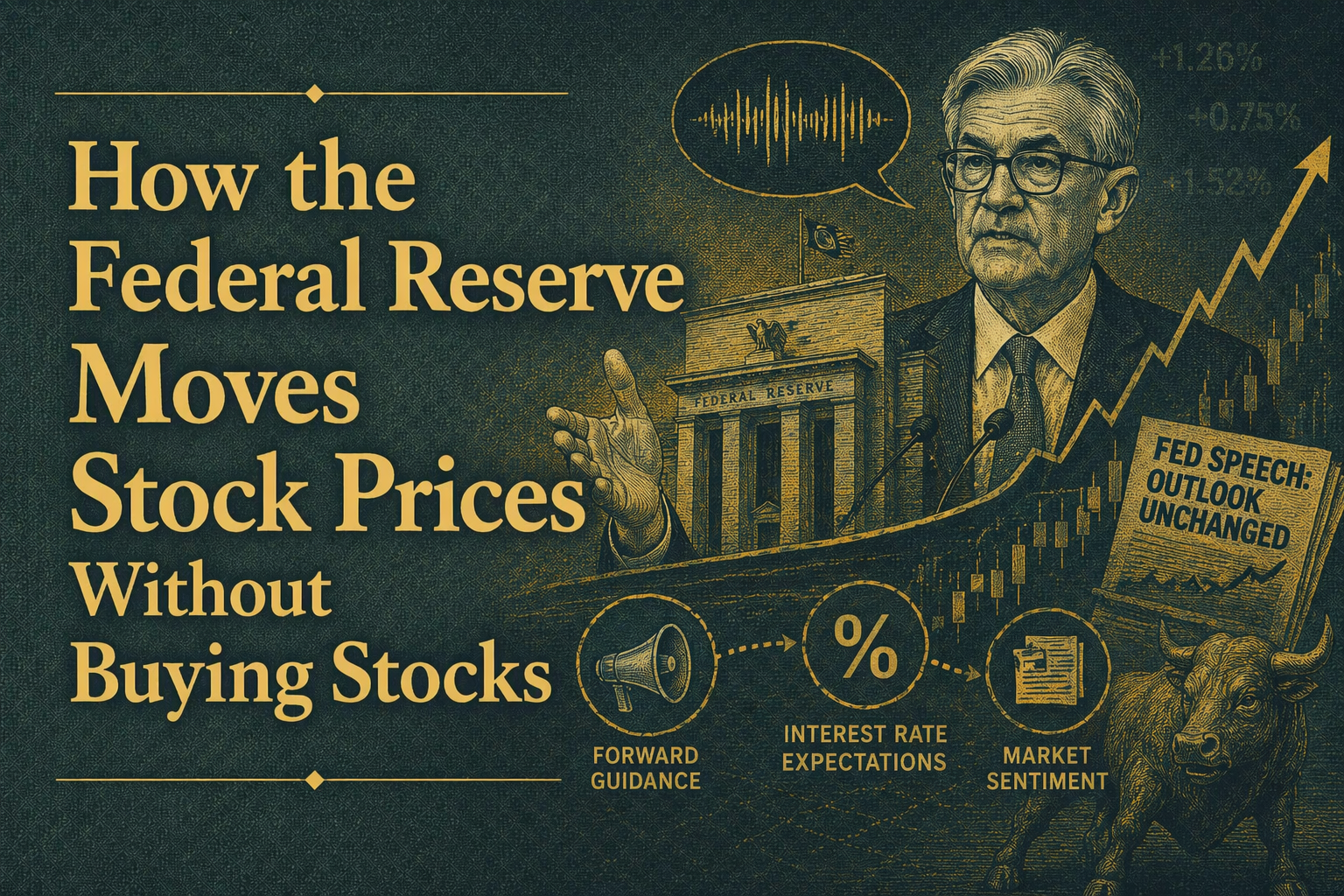
How the Federal Reserve Actually Moves Stock Prices
The Hidden Mechanisms Behind Fed Rate Decisions, Language, and Market Reactions
The Federal Reserve does not buy or sell stocks.
It sets short-term lending rates between banks, buys government bonds, and publishes policy statements several times a year.
By the arithmetic of financial markets, none of that should directly move the share price of companies like:
- Apple
- Amazon
- Tesla
Yet markets react to Federal Reserve language constantly.
In September 2022, :contentReference[oaicite:0]{index=0} delivered an eight-minute speech at :contentReference[oaicite:1]{index=1} in :contentReference[oaicite:2]{index=2}.
There was:
- No major policy surprise
- No unexpected economic data
- No emergency action
Markets still fell sharply.
The following week erased trillions in market value globally.
Understanding why requires understanding three hidden mechanisms that sit underneath modern financial markets.
Channel One: Expectations Move Markets Before Policy Does
The Federal Reserve uses something called:
Forward guidance.
The phrase sounds technical.
The mechanism is psychological.
A business deciding whether to expand operations does not care only about today’s interest rate.
It cares about where borrowing costs are likely heading next year.
If the Fed can shape expectations about future rates, it changes present behaviour immediately.
The statement itself becomes part of policy.
Why Markets Read Every Word
Fed statements are dissected line by line.
Small wording changes matter because they signal future direction.
In 2015, the Fed replaced the word:
“patient”
With:
“data-dependent.”
Markets moved within hours.
Not because rates changed.
Because expectations changed.
The signal moved first.
Channel Two: Interest Rates Change the Math Applied to Stocks
A stock price is not just a reflection of current earnings.
It represents the present value of expected future earnings.
Those future earnings are discounted back into today’s dollars using interest rates.
When rates stay low:
- Future profits look more valuable today
- Investors pay higher valuations
When rates rise:
- Future profits become worth less in present terms
- Valuations compress
The business itself may not change at all.
The math changes.
Why Growth Stocks Fall Harder
High-growth companies depend heavily on future earnings expectations.
Much of their valuation sits years ahead.
When discount rates rise sharply, those distant earnings shrink in present value much faster.
That is why companies like:
- :contentReference[oaicite:3]{index=3}
- :contentReference[oaicite:4]{index=4}
- :contentReference[oaicite:5]{index=5}
Experienced large declines during 2022.
The underlying companies did not suddenly stop functioning.
The valuation framework shifted.
Channel Three: Liquidity Changes Asset Prices
The Federal Reserve also influences markets through its balance sheet.
This became especially visible during:
- The 2008 financial crisis
- The 2020 pandemic response
The mechanism is called:
Quantitative easing.
How Quantitative Easing Works
When the Fed buys government bonds:
- Cash enters the financial system
- Safe assets become scarcer
- Investors search for higher returns elsewhere
That capital often moves into:
- Stocks
- Corporate bonds
- Risk assets generally
Asset prices rise partly because liquidity rises.
Not necessarily because underlying earnings improved.
The Reverse Process
When the Fed reduces its balance sheet:
- Liquidity contracts
- Safe yields become more attractive
- Risk assets lose support
This process is called:
Quantitative tightening.
By early 2022, the Fed’s balance sheet had expanded toward $9 trillion.
That liquidity environment supported higher asset prices across markets.
The reversal created pressure in the opposite direction.
The Dot Plot: When a Chart Moves Trillions
The Federal Reserve publishes something called the:
Dot Plot.
Each dot represents where individual Fed officials expect interest rates to move in the future.
Markets react immediately to shifts in those expectations.
Even before any actual rate decision happens.
Between September and December 2022, projected rate expectations moved upward.
Financial assets repriced rapidly in response.
This is forward guidance operating at scale:
A projected future path changes present market behaviour.
Where the System Breaks Down
Forward guidance only works if markets trust the signal.
That trust weakened during 2021 and 2022.
Inflation was repeatedly described as:
“transitory.”
Markets initially believed the characterization.
Inflation persisted instead.
The Federal Reserve responded aggressively afterward with multiple rate hikes.
The cost was credibility pressure.
Guidance works only when investors believe future policy will roughly match current communication.
Why Investors Say “Don’t Fight the Fed”
This phrase exists because Fed policy affects nearly every layer of financial markets simultaneously.
When the Fed tightens policy:
- Borrowing costs rise
- Liquidity falls
- Valuations compress
- Risk appetite weakens
Markets often move together because the same underlying rate structure influences everything.
But there is an important limit:
Markets react not only to what the Fed does.
They react to what investors believe the Fed will do next.
The Core Mechanism
Stock prices are not determined only by company performance.
They are company performance filtered through:
- Interest rates
- Liquidity conditions
- Future expectations
The Federal Reserve influences all three.
The Three Transmission Channels
- Language shapes expectations
- Rates change valuation math
- Balance sheet policy changes liquidity
In 2022, all three forces moved in the same direction simultaneously.
That alignment explains why markets reacted so violently.
Final Insight
The Federal Reserve does not directly buy stocks.
What it changes is more fundamental:
The mathematical framework investors use to value every stock that already exists.