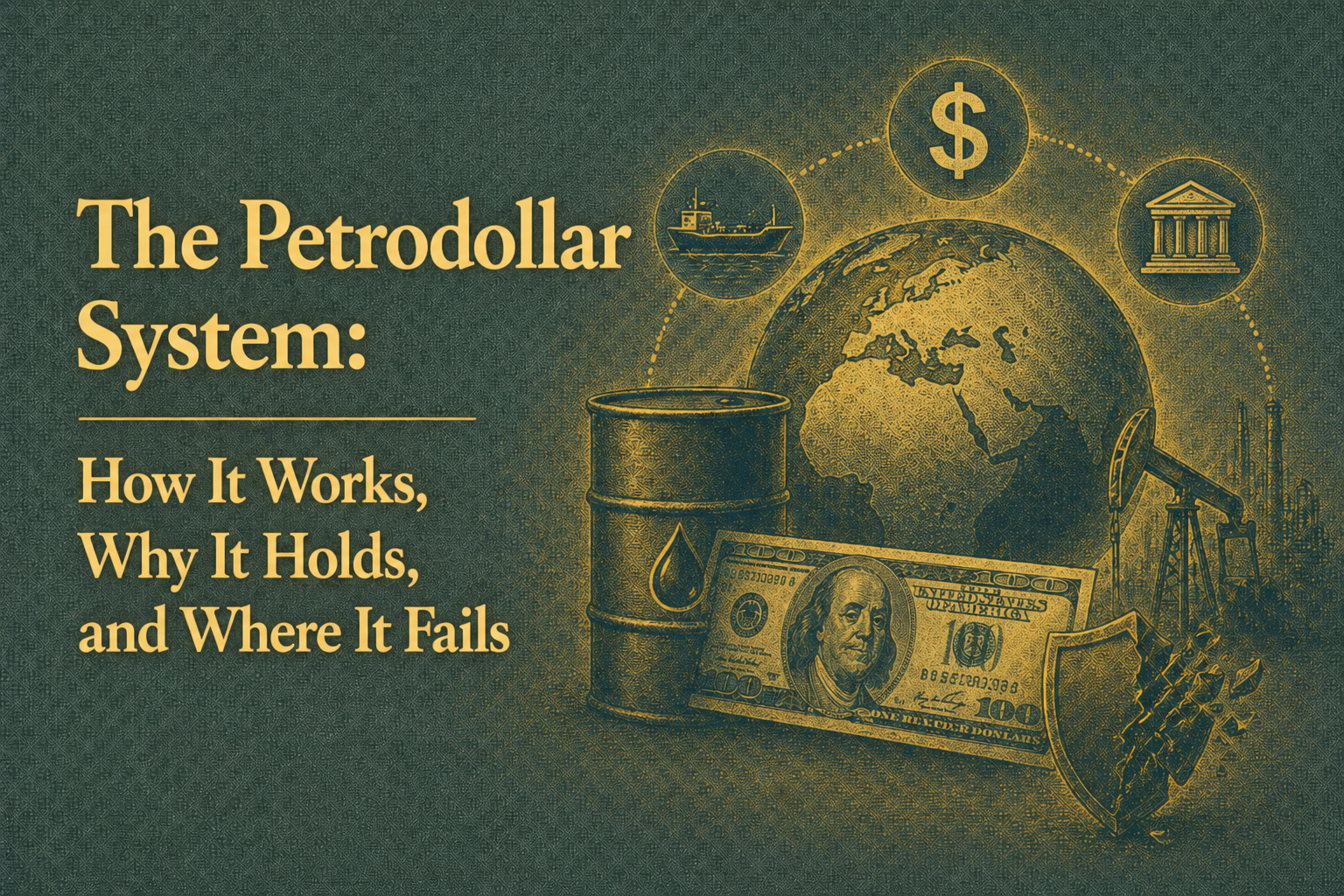
The Petrodollar System: How It Works, Why It Holds, and Where It Fails
Why the Dollar Needed a New Foundation After 1971
The Bretton Woods system, agreed at a New Hampshire conference in 1944, made the US dollar the world’s reserve currency by anchoring it to gold at $35 per ounce.
Every other major currency fixed its value to the dollar. Countries held dollars because dollars were convertible to gold on demand.
The system required one condition to function: the United States had to hold enough gold to back all the dollars in circulation.
By the late 1960s, that condition was no longer met.
American spending on the Vietnam War and Lyndon Johnson’s domestic programs had pushed far more dollars into the world than the gold at Fort Knox could cover.
Charles de Gaulle’s government in France began demanding gold for French dollar holdings in the mid-1960s, a legal right under Bretton Woods, and other governments followed. The reserves drained visibly.
On August 15, 1971, Richard Nixon announced on television that the United States would no longer convert dollars to gold at any price.
This ended Bretton Woods. It is called the Nixon Shock. It was not a reform. It was a controlled exit from a system that was failing under pressure.
The immediate problem it created: why would any country continue holding dollars if dollars were no longer backed by anything?
The answer that emerged was not designed in advance. It was assembled under pressure over the following four years.
How the Petrodollar System Was Built
In October 1973, Arab members of OPEC imposed an oil embargo on countries that had supported Israel in the Yom Kippur War.
The United States was a primary target. Oil prices went from roughly $3 per barrel to over $11 within months.
Fuel queues formed across American cities. Inflation, already running above 6% annually, accelerated.
The embargo revealed something the Nixon administration had not fully absorbed: the United States, despite its military and economic size, was physically dependent on oil from governments that did not share its interests.
Between 1973 and 1975, the United States and Saudi Arabia negotiated a set of agreements whose complete terms have never been fully declassified.
The core exchange involved two commitments. Saudi Arabia would price its oil in US dollars and invest its surplus oil revenues in US Treasury bonds. In return, the United States would provide military equipment, security guarantees, and political support for the Saudi government.
Because Saudi Arabia was the world’s largest oil exporter and the effective leader of OPEC at the time, other major producers followed.
By 1975, dollar pricing of oil was the global standard.
This was not an agreement about oil. It was an agreement about the dollar’s new foundation.
Gold had been replaced by oil, not as a backing asset, but as the commodity whose universal necessity created universal demand for the currency used to buy it.
The Three Things the System Produces
1. A floor under the dollar’s value
Every country that imports oil must hold dollar reserves.
Japan, Germany, South Korea, India, and Brazil, none of these countries has a significant trade surplus with the United States, but all of them must accumulate dollars to secure their energy supply.
This manufactured demand places a floor under the dollar’s exchange value that operates independently of US economic performance in any given year.
A country can lose confidence in American fiscal policy, watch the US run a $1.7 trillion deficit as it did in fiscal year 2023, according to the US Congressional Budget Office and still need to hold dollars.
The energy dependency is prior to the investment decision.
2. Cheaper government borrowing
When foreign central banks accumulate dollar reserves, they typically hold them in US Treasury bonds, the most liquid dollar-denominated asset available at scale.
This creates a large buyer for American government debt that is not buying for return on investment. It is buying because reserve management requires it.
The result: the United States borrows at interest rates lower than its actual fiscal position would justify.
Valéry Giscard d’Estaing, then France’s finance minister, called this the “exorbitant privilege” in the 1960s. He meant it as a complaint about the advantage the US held by issuing the reserve currency.
The petrodollar system locked that privilege in place structurally rather than letting it depend on confidence in US economic management.
3. Financial reach as a tool of foreign policy
Dollar transactions, including oil purchases between two non-American countries, flow through US-regulated banks and the SWIFT messaging network, which operates under US legal jurisdiction for dollar-clearing.
This gives the United States the ability to impose financial sanctions with genuine force.
When the US sanctioned Iran under the Obama and Trump administrations, or Russia following the 2022 invasion of Ukraine, the primary damage was not from American trade restrictions.
It was from cutting those countries off from the dollar-clearing networks that underpin most international commerce.
That power is derived entirely from the dollar’s central position in global trade, and that position is derived substantially from oil pricing.
How the Money Cycles Back
Oil-producing countries collect dollars faster than their domestic economies can absorb them.
Saudi Arabia, the UAE, Kuwait, and Qatar sell oil priced in dollars to customers across Asia, Europe, and the Americas. The surplus accumulates.
They do not leave it as cash. They invest it.
They invest it primarily in dollar-denominated assets: US Treasury bonds, American equities, real estate, and stakes in global financial institutions.
This is petrodollar recycling.
Oil-importing countries send dollars out. Oil-exporting countries send dollars back.
That investment demand keeps US borrowing costs low and US asset prices supported. Low borrowing costs help the US run deficits without a currency crisis.
The strong dollar makes dollar-denominated oil pricing more stable as a global benchmark. The benchmark reinforces the requirement to hold dollars.
The Gulf sovereign wealth funds are the institutional form of this recycling.
These are not passive savings accounts. They are the structural mechanism by which petrodollar surplus re-enters dollar markets.
Why Leaving the System Is Operationally Harder Than It Sounds
The petrodollar has faced serious challenges since 1975. The euro’s launch in 1999, Iraq’s brief switch to euro pricing before the 2003 invasion, Iran’s repeated attempts to sell oil in non-dollar currencies, and China’s launch of yuan-denominated oil futures in 2018 all were described at various points as threats to dollar dominance.
None produced the disruption their proponents predicted.
The reason is not political loyalty. It is operational constraint.
Transaction depth
The US dollar market is deep enough that very large transactions of several billion dollars in a single trade can be executed without meaningfully moving the price.
No other currency provides this at scale.
Legal infrastructure
Dollar-denominated oil contracts are governed by New York law or English law.
Both legal systems have deep case records, predictable enforcement, and credibility across jurisdictions.
The hedging architecture
Refineries, shipping companies, airlines, and power utilities manage oil price risk using financial instruments calibrated to dollar benchmarks.
The infrastructure of price risk management for the entire global energy industry is built around dollar pricing.
Changing the pricing currency requires rebuilding the system, not just changing the invoice.
What Russia and China Have Actually Done
Russia and China are the two countries with both the motivation and the resources to challenge the petrodollar.
After the February 2022 invasion of Ukraine, Western sanctions cut Russia off from dollar-clearing systems for a significant share of its trade.
Russia shifted oil settlement to rubles and yuan with China and India.
This worked in the sense that Russia continued exporting oil and collecting revenue.
It did not work without cost.
Russian crude sold at discounts of $20 to $35 per barrel below global benchmark prices.
China’s approach is more methodical.
The Shanghai International Energy Exchange launched yuan-denominated crude futures in March 2018.
The fundamental constraint remains: the yuan is a capital-controlled currency.
Countries cannot hold yuan reserves with confidence that they can liquidate them quickly when needed.
Until that changes, the yuan cannot function as a full reserve currency.
The Tension Built Into the Foundation
There is a contradiction inside the petrodollar system that its advocates rarely name directly.
The United States issues the world’s reserve currency. The world needs a continuous supply of dollars to function.
The only way to supply dollars to the world is for the United States to run persistent trade deficits.
But persistent trade deficits hollow out domestic manufacturing over time.
Robert Triffin identified this in 1960.
The reserve issuer must run deficits, and those deficits weaken the system that made the currency credible.
This is the Triffin Dilemma.
It is a description of what the United States has been doing continuously since the 1970s.
Where the System Actually Fails
The honest limits of the petrodollar system are specific.
- It does not apply equally to all commodities.
- It does not prevent currency crises in the United States.
- It does not make US Treasury debt risk-free.
- It does not operate identically in a world of energy transition.
Reserve status provides a cushion, not immunity.
How the System Works: The Short Version
- Oil is priced in dollars globally, requiring all importing countries to hold dollar reserves
- Saudi Arabia agreed to price oil in dollars; other OPEC members followed
- Dollar demand creates a floor under the currency’s value
- Oil exporters recycle surplus into US assets
- Dollar clearing gives the US financial leverage
- Replacing the system requires solving three operational constraints simultaneously
- The system is fragmenting gradually, not collapsing
- The internal contradiction remains unresolved
What Actually Changes When It Shifts
The petrodollar will not end with a single announcement.
It will be done through bilateral arrangements, alternative payment networks, and regional currency agreements.
The dollar’s share of global reserves has declined, but it remains dominant.
What changes is not just how oil gets invoiced.
US borrowing costs rise. Sanctions lose reach. Inflation becomes harder to export.
For every other country, the transition brings more currency management complexity and more exchange-rate risk.
Eventually, it also brings more monetary independence.
The system does not break. It erodes.
The petrodollar is not a conspiracy or a secret architecture.
It is a set of interlocking incentives built under specific historical conditions that proved durable far beyond their original context.
Understanding it is not optional.
It is the operating logic of global finance.
Frequently Asked Questions
What is the petrodollar system in simple terms?
It is the arrangement by which oil is bought and sold globally in US dollars.
Because every country that imports oil needs dollars to pay for it, this creates permanent global demand for the dollar.
How does petrodollar recycling work?
Oil-exporting countries collect dollars and invest them back into US assets.
Dollars go out for oil. Dollars come back through investment.
Why can’t countries just stop using dollars for oil?
Three constraints: transaction depth, legal systems, and hedging infrastructure.
It is not a policy switch. It is a system rebuild.
What has China actually achieved?
China has built yuan-based oil trading and settlement agreements.
But capital controls limit the yuan’s role as a reserve currency.
What is the Triffin Dilemma?
The country issuing the reserve currency must run deficits to supply it.
Those deficits weaken the same system that gives the currency power.
Where does the system fail?
It does not cover all commodities, does not prevent crises, and depends on oil demand continuing.
Its strength is structural. Its limits are also structural.