China Builds Dependence: How China Turns Infrastructure Into Long-Term Influence
The train runs on time. The port handles the containers. The power plant keeps the capital’s lights on. The debt is real, the terms were signed, and somewhere in the fine print, there is a clause about what happens if the payments stop.
Most analyses stop at the clause. The clause is not where the leverage lives.
Somewhere in Nairobi, a passenger buys a ticket on the Mombasa Standard Gauge Railway. The ticket is cheap. The ride takes four hours instead of the twelve the old road demanded.
The benefit is real, and the engineer who spent three years building the line was not wrong when he said so. He was also not wrong about the other thing — said quietly, the way you say something you have been carrying for a while: “Now we owe them more than we can pay back. And the port is theirs if we default.”
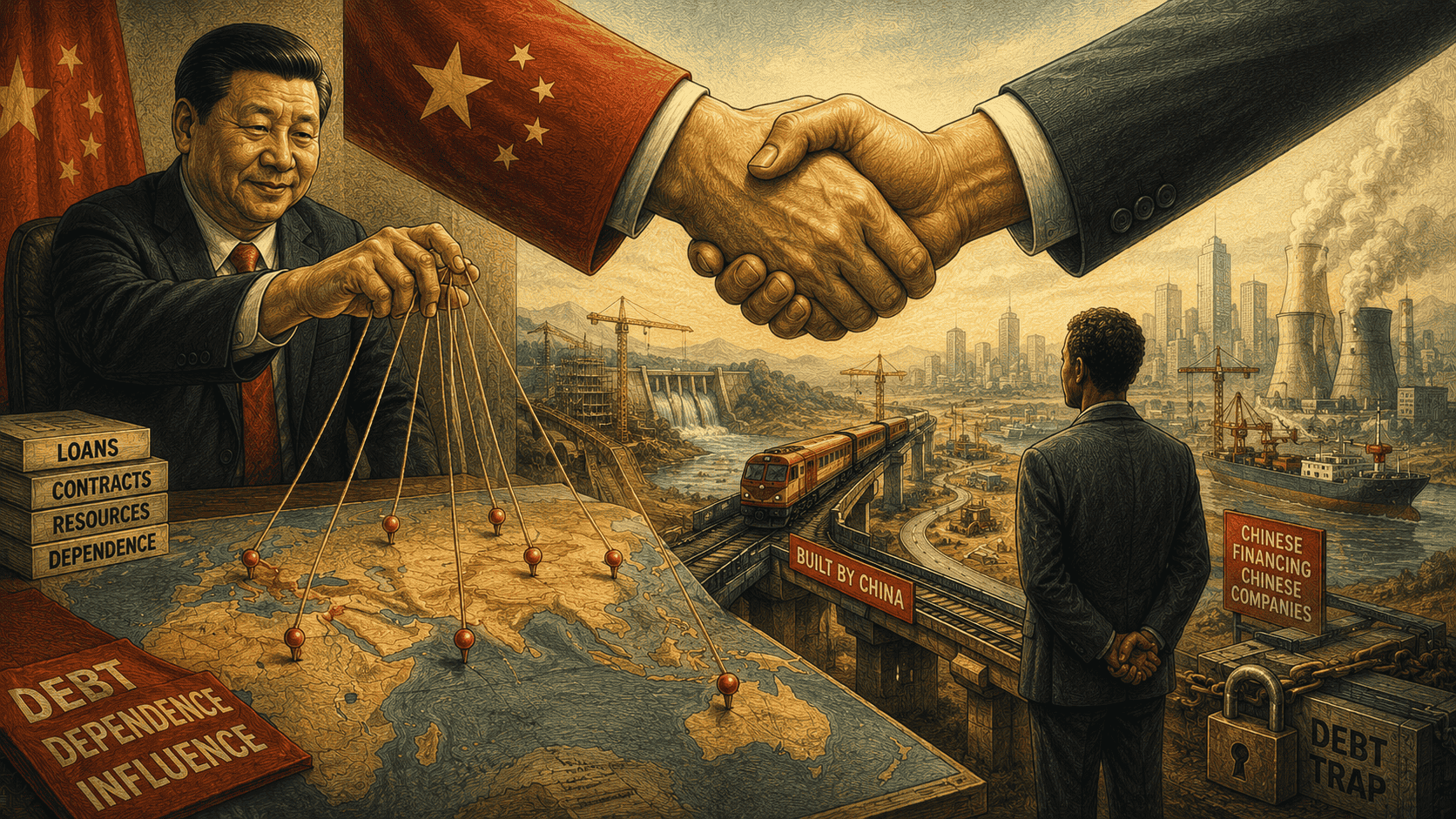
That second sentence gets filed as the story. Debt trap. China lends money, developing countries cannot repay, and China acquires strategic assets through contract enforcement. The frame is clean, the villain is identifiable, and the mechanism is legible.
It also locates the leverage in the wrong place, which is why every policy response built on it keeps arriving after the actual leverage is already installed.
The port collateral matters. What matters more is that the port now handles a volume of Kenyan trade that makes the question of default increasingly theoretical. Not because the contract prevents it. Because the operational cost of disrupting what the port does on an ordinary Tuesday is borne entirely by Kenya, not by the party holding the contract.
The debt is the receipt. The transaction was something else.
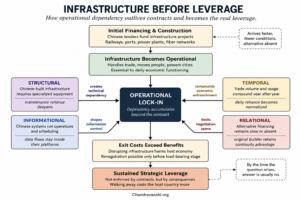
Infrastructure becomes leverage when daily economic function grows dependent on staying connected.
Lay two maps side by side.
The first: US military installations worldwide. Roughly 750 bases across 80 countries, dense in Europe, the Middle East, and East Asia. The map follows the logic of the last century’s conflicts — where the wars were, where the oil was, where alliances required a physical American presence.
The second map: Belt and Road projects. Ports, railways, power plants, fiber optic cables across East Africa, Central Asia, Southeast Asia, the Pacific Islands, and Latin America. The two maps do not overlap much.
China showed up in places where it simply arrived faster with fewer conditions attached. Nairobi needed a railway. Djibouti needed a port. The financing offer arrived before the alternative.
By the time the alternative arrived, the financing offer was already three years into construction.
The Mombasa-Nairobi railway runs on standard gauge — the same specification used across Europe and Japan. The lock-in is not in the gauge.
It is in everything surrounding it: financing from Chinese state banks, equipment requiring Chinese technicians for maintenance, port operations running on Chinese scheduling systems, and management software that functions most efficiently when the original installer remains involved.
The dependency is not written into a single clause. It accumulates through operational logic — through the ordinary fact that systems work best when the people who built them stay nearby.
Every BRI project carries two prices. China pays the construction cost. The recipient country pays a different price — across years, through rerouted trade flows, through the slow narrowing of options that were theoretically available before the railway existed.
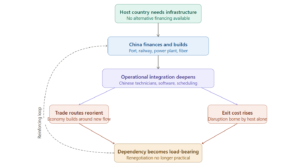
Renegotiation is only possible before the infrastructure becomes load-bearing.
Countries have renegotiated BRI terms. Malaysia cancelled projects in 2018. Tanzania walked away from a port deal. But renegotiation is only possible before the port handles 40% of your exports, before the power plant is the reason the capital has electricity.
After that, the leverage is not in the contract. It is in what walking away costs you, which is a calculation the host country runs alone.
A debt can be restructured at a summit. An operational dependency that your economy has built its daily functioning around cannot.
In Djibouti — a country smaller than New Jersey, positioned at the mouth of the Red Sea — there is a Chinese-built, Chinese-operated commercial port. Three kilometres away sits one of the largest US military bases on the African continent.
Two different theories of presence, in the same small geography, for entirely different purposes.
The Americans watch the Red Sea shipping lanes. The Chinese port watches the trade passing through them, processes it, and it becomes increasingly difficult to remove without consequences, which the Djiboutian government absorbs alone.
Soldiers can be asked to leave. Infrastructure that runs a port, powers a city grid, and handles the trade that keeps an economy functioning cannot be asked to leave without a question the host country has to answer first: what replaces it tomorrow morning?
The old empires needed a story. The British had the civilising mission. The Americans had democracy and development. China’s approach requires neither. It requires only one.
Whether you admire the country that built these things is irrelevant. Whether you resent it is also irrelevant. The only question that matters, by the time the question becomes real, is whether you can afford to turn it off. By the time the question becomes real, the answer is usually no.
The internal argument this produces is unresolved and worth sitting with rather than resolving quickly.
These countries signed the contracts. The terms were available to read. The dependency was not hidden — it was the operational logic of every infrastructure agreement ever signed, regardless of who was doing the financing.
It also means that the countries signing these contracts in 2010 and 2013 were signing during a window when the alternative financing was not showing up. The West was not absent from Nairobi because it evaluated the terms carefully and declined. It was absent because the political conditions for that kind of long-term infrastructure commitment did not exist at the time.
China filled the space. The dependency that followed is real. So is the railway.
The Kenyan engineer was right about both things. The train runs. The port is collateral. Both sentences are true. The analysis that treats the second sentence as the story and ignores the first one misses why this keeps working — and why the countries signing these agreements are not simply being tricked.
The gift is genuine. The dependency it creates is genuine. You do not have to choose between those two facts. You just live inside both of them.
And on a map being updated in a government building far away, a dot marks the place where you now are.