AI as a Job Threat: The Hype Is Bigger Than the Reality subtitle please
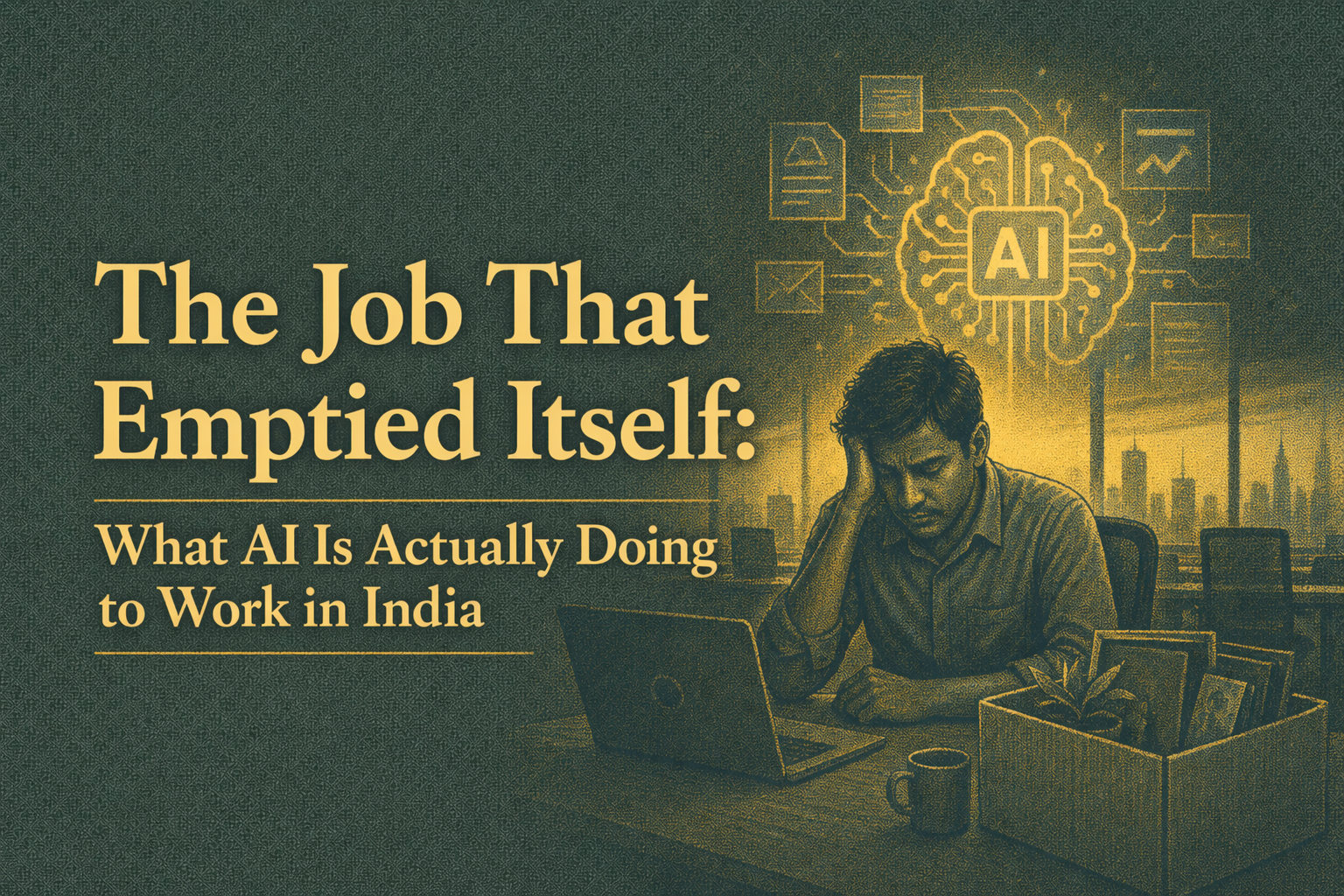
The Job That Emptied Itself
What AI Is Actually Doing to Work in India
Rajan approves twelve hundred rows before lunch.
The software read the invoices.
The software matched the vendors.
The software entered the numbers.
He checks the three per cent it flagged as uncertain, clicks through the exceptions, and closes the laptop.
His mother thinks he got promoted.
He told her:
“I became a babysitter for a robot.”
She did not understand.
He stopped trying to explain it.
The Story Everyone Keeps Telling
Most conversations about AI and jobs in India split into two loud extremes.
One side says:
“AI will eliminate millions of jobs.”
The other says:
“Nothing serious will happen. People will adapt like they always do.”
Both stories flatten what is actually happening inside offices right now.
Because the visible structure of work often remains intact:
- The company still exists
- The employee still has a salary
- The title still appears unchanged
- The laptop still opens every morning
What changes is harder to describe.
The job stays.
The skill inside the job starts thinning out.
What the Fear Narrative Misses
The common automation story assumes a clean sequence:
Automation arrives → jobs disappear → unemployment rises
That is not what Rajan is experiencing.
He still works at a finance firm in :contentReference[oaicite:0]{index=0}.
His designation is still:
Accounts Executive.
But the actual work changed almost completely.
Earlier, his day involved:
- Reading messy invoices
- Cross-checking vendor information
- Finding inconsistencies manually
- Learning patterns through repetition
Now the workflow looks different:
- AI processes the invoices
- AI matches vendors automatically
- AI flags uncertain entries
- Humans review exceptions
The software handles almost everything.
He reviews what remains.
One tool absorbed the repetitive layer that previously trained junior workers through exposure and repetition.
The title survived.
The developmental ladder inside the work weakened.
The Arithmetic Behind the Shift
The numbers explain the structure clearly:
- 1200 invoice rows processed
- ~3% flagged for review
- ~36 items checked manually
The remaining 97% passes through without human engagement.
From a productivity perspective, the system works extremely well.
From a skill-building perspective, something changed quietly.
The repetitive layer that once built pattern recognition disappeared from the daily workflow
What the Optimistic Story Also Misses
The adaptation argument is not wrong.
Workers do adapt.
Technology has repeatedly changed labour markets before.
But adaptation depends on whether the new work deepens capability or simply supervises automation.
Rajan’s father learned spreadsheet software in his fifties.
It was uncomfortable.
Slow.
Humbling.
But the new skill created long-term leverage:
- More analytical capability
- Better employability
- Transferable knowledge
Rajan’s current work does not compound in the same way.
Reviewing AI-generated outputs develops a narrower form of competence.
It resembles monitoring more than mastery.
Same Technology, Different Outcomes
Near the market, another story is unfolding.
An 18-year-old learned design from YouTube.
He uses AI tools to:
- Create logos
- Generate social media graphics
- Edit marketing copy
He charges ₹300–₹500 per client and finishes projects faster than older freelancers who built workflows around manual design processes.
AI expanded his opportunity.
For Rajan, AI compressed the developmental depth of existing work.
Same technological wave.
Different starting position.
The Difference Is Timing
The divide is not primarily talent.
It is timing relative to the arrival of the tools.
Rajan had already spent years inside a structured accounting workflow when automation absorbed the repetitive layer.
The younger designer entered the workforce after AI-assisted creation already existed.
One experienced erosion of an existing ladder.
The other built directly on the new terrain.
The Skill Formation Problem
Inside consulting firms, finance teams, marketing agencies, and operations departments, a quieter shift is spreading:
Junior employees increasingly review work rather than build it from scratch.
AI drafts.
Humans approve.
Output increases.
Turnaround time compresses.
Everything appears more efficient.
But efficiency and skill formation are not identical processes.
Earlier, writing a report meant:
- Understanding the numbers deeply
- Struggling through ambiguity
- Learning through revision
- Building intuition gradually
Now:
- The draft arrives quickly
- The formatting is polished immediately
- The first-pass structure already exists
The friction disappears.
And friction, historically, was where much professional learning happened.
The Gap Appears Later
A 23-year-old analyst approving AI-generated reports may look highly productive today.
The missing layer becomes visible later when she needs to:
- Build analysis independently
- Structure thinking from scratch
- Handle uncertainty without generated scaffolding
- Hold complexity mentally without automation assistance
That gap does not show up immediately in performance metrics.
It appears years later, when foundational capability is suddenly required.
Who Gets Heard and Who Doesn’t
The loudest voices in AI conversations often come from:
- Tech founders
- Consultants
- Newsletter writers
- Conference speakers
For many of them, AI expands leverage dramatically.
Their work benefits visibly from acceleration.
The quieter group rarely appears in these conversations:
- Operations staff reviewing AI outputs
- Junior analysts validating generated work
- Employees supervising systems they no longer fully build themselves
The transformation inside their work is harder to explain publicly because the job technically still exists.
How the Hollowing Actually Works
Three workers can experience the same technological shift completely differently:
1. Already Deep Inside a Repetitive Skill
- Automation absorbs the developmental layer
- The role remains
- Growth slows quietly
2. Forced Mid-Career Transition
- Adaptation is painful but possible
- New skills eventually form
- The transition costs time and confidence
3. Entered After AI Became Normal
- No previous workflow to lose
- Builds directly on AI-assisted systems
- Learns faster within the new environment
The outcomes differ not because the technology changed.
The starting position changed.
What AI Is Actually Changing
The shift is not simply:
- Job creation
- Job destruction
It is something more difficult to measure:
- The removal of repetition from work
- The weakening of slow skill formation
- The preservation of structure without the same developmental depth
Historically:
- Repetition built competence
- Friction deepened understanding
- Time created mastery
Now:
- Automation removes repetition
- Speed removes friction
- Output arrives before understanding fully forms
Final Insight
Rajan closes the laptop.
The work finished faster than before.
The metrics improved.
The company became more efficient.
His mother asks:
“Is the work getting better?”
He says yes.
The job still exists.
But the thing that once slowly grew inside the job:
The depth.
The intuition.
The accumulated skill formed through repetition.
That part is thinning quietly.
And until that missing layer is named clearly, it will remain mostly invisible inside headlines about AI and employment in India.
Quick FAQ
Is AI already reducing jobs in India?
In many sectors, the immediate effect is not direct job elimination but task compression and workflow restructuring inside existing jobs.
What is the deeper risk?
The larger long-term risk may be weakened skill formation rather than immediate unemployment.
Who benefits most from AI integration?
Workers entering industries after AI tools became standard often adapt faster because their workflows are built around the tools from the beginning.
Who is most vulnerable?
Workers whose expertise depended heavily on repetitive structured tasks may experience erosion of the developmental layer inside their work.
Does this mean AI is bad for productivity?
No. Productivity gains are real. The question is whether faster output also preserves the mechanisms through which expertise traditionally formed.