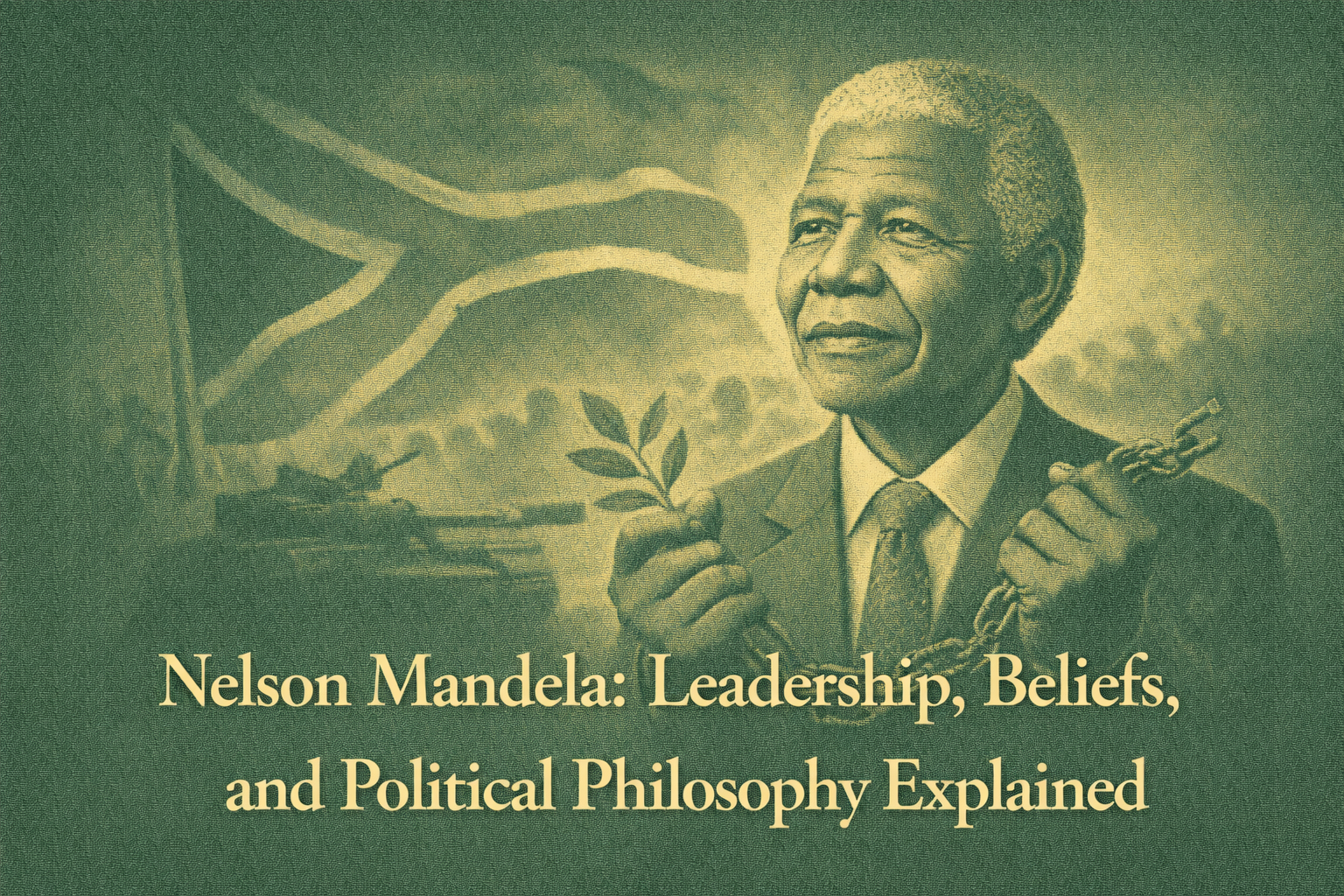
Nelson Mandela: Leadership, Beliefs, and Political Philosophy Explained
Nelson Mandela: Political Philosophy, Leadership, and the Strategy Behind Reconciliation
Nelson Mandela stands as one of the twentieth century’s most significant political figures.
His leadership spanned decades of anti-apartheid resistance, 27 years of imprisonment, and a presidency that pursued reconciliation over revenge.
This guide examines:
- Mandela’s core political beliefs and how they evolved
- His leadership approach under extreme pressure
- The philosophical framework that shaped his decisions
- Where his methods succeeded and where they faced limits
- Common misunderstandings about his political strategy
By the end, you will understand the system of thought that guided Mandela’s actions, not just the outcomes those actions produced.
Understanding Mandela’s Political Foundation
Mandela’s political philosophy developed through direct confrontation with apartheid’s legal structure.
He did not begin as a radical.
His early political involvement focused on constitutional reform within existing legal frameworks.
The African National Congress (ANC), which Mandela joined in 1944, initially pursued change through petitions, strikes, and passive resistance.
Mandela helped establish the ANC Youth League, pushing the organisation toward more assertive action while still maintaining nonviolent methods.
This reflected two early assumptions:
- Moral authority mattered in political struggle
- International pressure could force systemic change
Both assumptions faced severe testing when the South African government banned the ANC and escalated repression.
The Sharpeville Massacre in 1960, where police killed 69 unarmed demonstrators, became a turning point.
The state’s response to nonviolent protest was increasing violence.
That created the strategic boundary where Mandela’s earlier methods stopped producing results.
The Mechanics of Mandela’s Leadership Philosophy
Mandela’s leadership operated through several interconnected principles that remained surprisingly consistent even as tactics evolved.
Collective Decision-Making Under Constraint
Mandela rarely positioned himself as an isolated decision-maker.
Even when he became the global face of resistance, the ANC continued operating through collective structures.
Consensus was preferred where possible. Majority voting was used where necessary.
This was not symbolic idealism.
It was strategic survival.
Collective leadership reduced dependence on any single individual and allowed the movement to survive arrests, assassinations, and state repression.
It also meant Mandela’s own judgments remained exposed to internal challenge instead of hardening into isolation.
Strategic Flexibility With Fixed Goals
Mandela’s central objective remained consistent:
End apartheid and establish universal political rights.
What changed were the methods.
When peaceful resistance met escalating state violence, Mandela co-founded Umkhonto we Sizwe (MK), the ANC’s armed wing.
This was not abandonment of principle.
It reflected recognition that nonviolence as a strategy only functions when opponents accept limits on force.
When the state responded to peaceful protest with lethal repression, continuing exclusively peaceful action became strategically unsustainable.
MK’s early operations focused on sabotage against infrastructure while deliberately attempting to avoid civilian casualties.
This preserved a distinction between armed resistance and indiscriminate violence.
Authority Through Sacrifice, Not Position
Mandela’s authority emerged from demonstrated sacrifice rather than title alone.
Twenty-seven years in prison, including 18 years on Robben Island, created credibility that rhetoric alone could never generate.
This mattered later during negotiations.
When Mandela advocated compromise and reconciliation, opponents inside the liberation movement could challenge his strategy but not his commitment.
He had already paid the highest visible personal cost.
Prison also separated Mandela from day-to-day tactical politics while preserving his symbolic authority.
That unusual combination allowed him to return as both a historical figure and an active strategist.
Reconciliation as Strategic Necessity
Mandela’s emphasis on reconciliation is often portrayed as moral generosity alone.
The reality was more structurally complex.
South Africa faced a genuine possibility of civil war.
The white minority controlled:
- The military apparatus
- Technical infrastructure
- Most economic capital
The black majority possessed demographic strength and moral legitimacy but lacked institutional control.
A total conflict would likely devastate the country regardless of outcome.
Reconciliation therefore became strategic necessity as much as ethical aspiration.
The Truth and Reconciliation Commission
The Truth and Reconciliation Commission (TRC) attempted to balance competing demands:
- Justice for victims
- Political stability
- Avoidance of revenge cycles
- Institutional continuity
Amnesty was not unconditional.
Perpetrators had to publicly disclose crimes in exchange for reduced prosecution risk.
The process satisfied no side completely.
But it created a politically survivable transition.
Mandela understood something central:
Perfect justice pursued without regard for stability can destroy the conditions necessary for any justice at all.
Mandela’s Political Philosophy in Practice
The Rivonia Trial
During the Rivonia Trial in 1964, Mandela faced possible execution.
Instead of focusing solely on legal defence, he used the courtroom as a political platform.
He openly acknowledged participation in sabotage while arguing that apartheid itself made obedience to law morally indefensible.
His famous statement concluded:
“It is an ideal for which I am prepared to die.”
This forced the apartheid regime into a difficult position:
- Execution risked martyring him internationally
- Imprisonment preserved his symbolic relevance
The regime chose imprisonment.
That decision unintentionally strengthened Mandela’s long-term political authority.
Secret Negotiations in Prison
During the 1980s, Mandela initiated quiet discussions with government officials while still imprisoned.
This carried major political risk.
Some inside the ANC could have interpreted negotiations as surrender or compromise without mandate.
Mandela recognised that governments cornered without exit options often become more dangerous.
Negotiation therefore became a method of creating a controlled path away from apartheid instead of forcing total collapse.
Had those channels not opened when they did, the transition might have become far more violent.
Presidential Governance
Mandela served only one presidential term despite overwhelming popularity.
That decision established democratic precedent in a region where leaders frequently remained in power indefinitely.
Mandela also maintained a Government of National Unity that included members of the former apartheid establishment.
This approach preserved technical capacity while reducing fears of total institutional purge.
The strategy prioritised continuity alongside transformation.
Where Mandela’s Approach Reached Its Limits
Economic Transformation
Political liberation did not immediately produce economic equality.
Mandela’s government pursued growth-oriented economic policies that largely preserved existing market structures.
This reduced immediate risk of economic collapse and capital flight.
But it also meant wealth concentration remained deeply unequal.
The limitation reflected real constraints rather than simple oversight.
Rapid redistribution might have destabilised the transition itself.
Gradual reform preserved stability but delayed economic justice.
That trade-off remains debated today.
Institutional Corruption
The ANC’s transition from liberation movement to governing party created opportunities for patronage and corruption.
Mandela’s personal integrity did not automatically produce institutional integrity.
This revealed an important limitation:
Leadership rooted heavily in personal moral authority becomes difficult to institutionalise after the leader exits.
Regional Replication
Mandela’s reconciliation model depended heavily on South Africa’s unique conditions:
- Military stalemate
- International sanctions
- Economic pressure
- Contained geography
- High global visibility
Attempts to apply similar frameworks elsewhere produced mixed results because those structural conditions often did not exist.
Common Misunderstandings About Mandela’s Politics
“Mandela Was Always Committed to Nonviolence”
This oversimplifies his strategy.
Mandela supported nonviolence when it offered strategic leverage.
He accepted armed resistance when nonviolent methods stopped producing political openings.
His commitment was to liberation, not to any single tactic permanently.
“Reconciliation Meant Forgiveness Without Justice”
The TRC involved compromise, not unconditional absolution.
Mandela understood that full-scale prosecutions risked destabilising the transition itself.
The process prioritised:
- Truth-telling
- Public acknowledgement
- Controlled transition
Rather than maximal punishment.
“Mandela’s Authority Came From Suffering Alone”
Imprisonment mattered enormously.
But suffering alone does not generate lasting political authority.
Mandela’s authority depended equally on:
- Strategic judgment
- Organisational leadership
- Negotiation skill
- Political timing
Prison amplified credibility that already existed.
“Mandela Proves Moral Leadership Always Wins”
Mandela’s success depended on structural conditions aligning with moral positioning.
International sanctions weakened apartheid economically.
Domestic resistance raised governance costs.
Cold War dynamics shifted.
The regime increasingly lacked sustainable long-term options.
Mandela’s leadership mattered enormously.
But leadership alone without leverage rarely produces transformation.
Interpreting Mandela’s Leadership Approach
Leadership Through Shared Risk
Mandela’s authority came partly from willingness to accept comparable risks to those he asked others to bear.
This created unusual credibility.
It also provides a useful framework for evaluating political leadership more broadly:
Do leaders personally absorb consequences alongside supporters, or mainly distribute risk downward?
Why Simple Narratives Fail
Mandela’s story is often reduced into a moral fable:
A patient, forgiving leader defeats evil through virtue alone.
Reality was harder and more politically complex.
His leadership involved:
- Strategic violence
- Calculated compromise
- Secret negotiations
- Power balancing
- Difficult trade-offs
Understanding Mandela requires accepting those tensions rather than erasing them.
What His Leadership Reveals About Political Judgment
Mandela demonstrated that principled leadership does not require rigid attachment to tactics.
It requires consistency of purpose while adapting methods to changing conditions.
That distinction matters.
Leaders unable to adapt become ineffective.
Leaders who change principles alongside tactics become unreliable.
Mandela maintained a relatively stable purpose while allowing strategic flexibility underneath it.
Common Questions About Mandela’s Political Philosophy
What motivated Mandela’s political activism?
Mandela’s activism emerged from direct experience with apartheid’s legal discrimination and exposure to ANC organisers during his university years.
Personal encounters with racial exclusion transformed intellectual disagreement into active resistance.
How did Mandela’s beliefs evolve over time?
Mandela moved gradually from narrow African nationalism toward broader nonracial democratic politics.
This evolution came through multiracial organising, prison exposure to different political traditions, and practical coalition-building needs.
Was Mandela a socialist?
Mandela engaged with socialist thought and maintained alliances with communists inside the anti-apartheid struggle.
But his presidency pursued pragmatic mixed-economy policies rather than revolutionary socialist restructuring.
Why did Mandela reject conditional release offers?
The apartheid government repeatedly offered release if Mandela renounced violence or accepted political restrictions.
He refused because conditional release would legitimise the regime’s authority over the liberation struggle and weaken the movement’s leverage.
How did Mandela maintain influence while imprisoned?
Through smuggled communications, symbolic importance, prison writings, and continued influence over internal ANC debates.
His imprisonment increased his visibility internationally while preserving political relevance domestically.
Did reconciliation fully satisfy justice demands?
No.
Many victims felt accountability remained incomplete.
Mandela’s approach prioritised social stability alongside partial justice rather than maximal punishment.
The moral debate surrounding that compromise continues.
Further Reading
- Long Walk to Freedom — Mandela’s autobiography detailing his political development and imprisonment
- Conversations with Myself — Collection of Mandela’s letters and prison reflections
- Mandela’s Way by Richard Stengel — Examination of Mandela’s leadership principles
- The Rise and Fall of Apartheid by David Welsh and J.E. Spence — Analysis of apartheid’s political structure and collapse
- Armed and Dangerous by Ronnie Kasrils — Insider account of ANC armed resistance strategy
Final Understanding
Mandela’s political philosophy emerged from specific historical conditions:
- Apartheid South Africa
- Cold War geopolitics
- Decolonisation movements
- International economic pressure
Understanding Mandela requires recognising how moral conviction and strategic calculation reinforced one another instead of operating as opposites.
His leadership succeeded not because he rejected pragmatism for principle or principle for pragmatism.
It succeeded because he understood how each could strengthen the other under the right conditions.
Mandela’s example does not provide a universal political template.
Most societies do not replicate South Africa’s exact circumstances.
What his leadership offers instead is a framework for thinking about political judgment under extreme constraint.
That distinction matters.
Because leadership under pressure is rarely about choosing between morality and strategy.
It is usually about understanding how fragile both become when separated from each other.