The Price You Didn’t Pay: The Hidden Cost Behind Authoritarian Economic Miracles
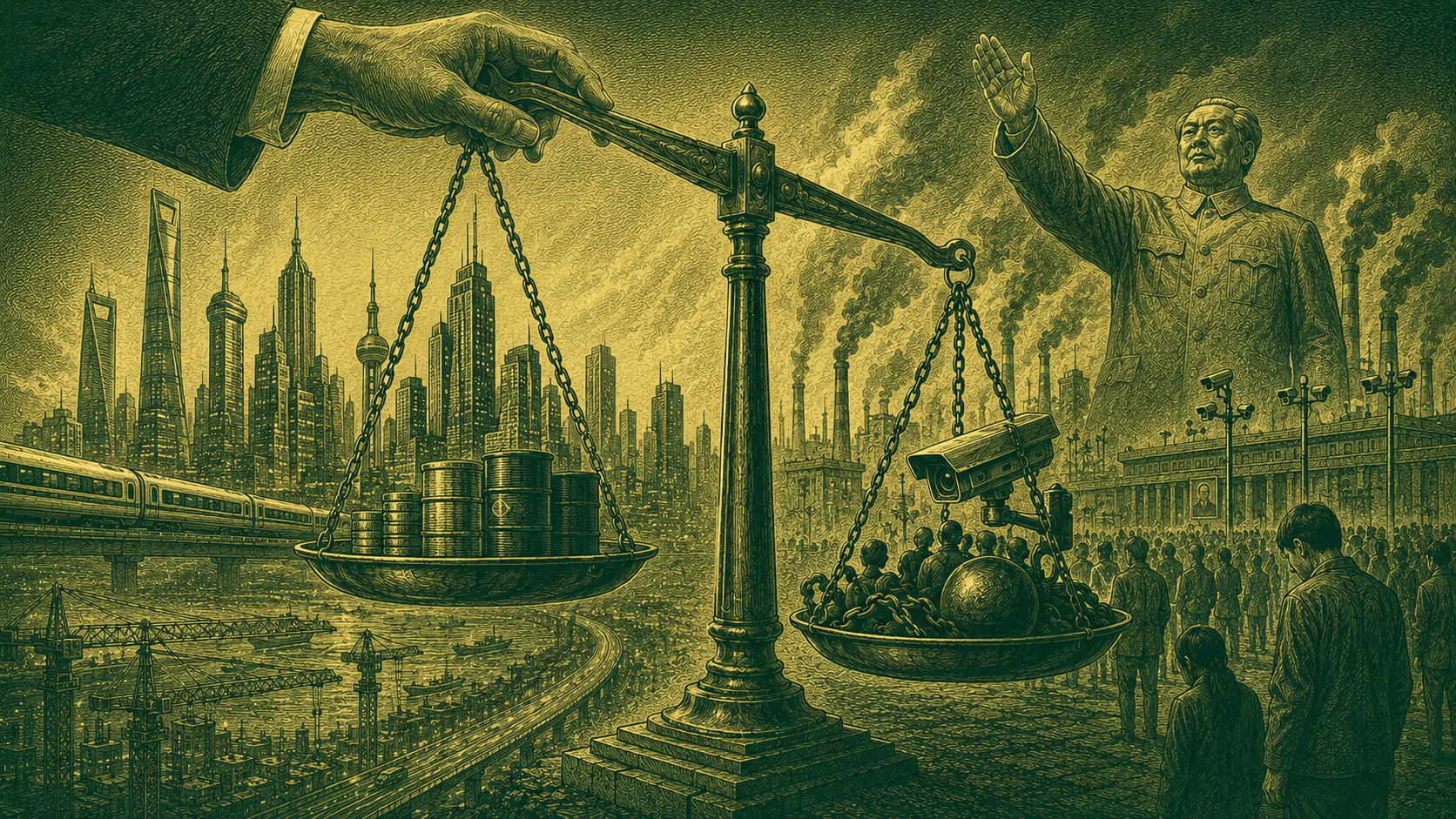
South Korea, China, Singapore, Rwanda, Yugoslavia. Five development stories are often presented as proof that concentrated power works faster than democracy. The numbers are real. The growth happened. But so did the people forced to absorb the cost without consent.
The Growth Numbers Tell Half the Story. Here Is the Other Half.
Park Chung-hee held meetings at the Blue House where he personally reviewed export performance numbers and distributed decorations to top executives like a general awarding campaign medals.
Fourteen-hour shifts in unventilated factories. Amphetamine injections to keep teenage girls awake at their stations. GDP has been growing above 8% annually for three decades.
These facts appear in the same paragraph because they are not in tension with each other. They are the same phenomenon.
The reader who gets through that paragraph and lands on the growth number is doing something. Not ignoring the factory conditions — the paragraph makes that impossible. Something subtler: filing the conditions as context and the number as the point. The cost goes into the background. The result comes forward. This is a choice, and it is made quickly enough that it does not feel like one.

The Method Behind the Miracle
South Korea in 1961 had a GDP per capita comparable to Ghana’s. By 1990, it had a semiconductor industry.
The compression is real. Park’s method was a state that functioned as a capital allocator with coercive power — pick the winners, direct the credit, remove the downside risk that normally disciplines investment, and enforce compliance with export targets through consequences that were not theoretical.
Miss your target and the support disappears. This was not a market. It was a command with financial instruments attached.
The uncomfortable question is not whether this produced results. It clearly did. The uncomfortable question is whether the person reading this, in the act of acknowledging the results clearly, is doing something honest — or is doing something that feels like honesty and produces a different effect.
Who This History Attracts
There is a specific reader this history attracts. Someone who has read enough development economics to be frustrated with its conclusions.
Who has watched institutions slow things down, watched consensus processes produce compromised outcomes, watched accountability mechanisms catch failures that less accountable systems would never have permitted to surface, because they would have been suppressed.
This reader approaches Lee Kuan Yew or Deng Xiaoping as a kind of permission. Not to replicate the method. To feel vindicated in the observation that distributed authority has costs that concentrated authority does not. That observation is accurate. It is also incomplete in a specific way.
The Person Who Was Not Asked
Lee Kuan Yew made English Singapore’s working language, not for cultural reasons but because it made the workforce legible to multinational capital. This is described, correctly, as a strategic decision that produced extraordinary results.
Singapore’s GDP per capita today exceeds $90,000. The result is real. What the framing tends to drop is that the people whose cultural relationship to language was subordinated to this decision were not asked.
The decision was made once, implemented without the process of persuasion, and the results justify it in the eyes of anyone tabulating GDP figures.
The person who was not asked is not in the GDP figure.
This is not a sentimental point. It is a structural one. Every case on this list involves a decision that produced measurable aggregate improvement — and a cost that was distributed to people who did not choose to bear it, at a weight they did not agree to, in conditions they could not exit.
- Park’s factory workers.
- The students Deng sent the tanks toward in 1989.
- The opposition politicians in Singapore were sued and financially ruined through legal proceedings.
- Kagame’s critics, who were kidnapped.
The calculation that makes these decisions look correct is performed by the people who made them, using metrics they selected, applied to outcomes they defined as the relevant ones.
The Shape of the Self-Deception
The reader who finds this history compelling — who feels that development economics is too squeamish, that it applies democratic prerequisites to situations that democratic systems never actually faced — is performing the same calculation. From a position of not being the one who absorbs the downside.
This is the specific shape of the self-deception. It does not look like cruelty. It looks like realism. The realism has two moves: acknowledge the costs, then proceed to the analysis as though the acknowledgment was sufficient.
The costs were named. The conclusion comes from the results. The person who names costs they do not pay and then advances to results has not actually reckoned with the costs. They have used the naming as a reason not to.
Deng’s Numbers and Deng’s Framing
Deng Xiaoping reduced extreme poverty in China from 88% to under 2% between 1981 and 2019.
Over 800 million people moved out of extreme poverty — roughly three-quarters of all global poverty reduction in that period. These numbers are not in dispute. They are also the numbers Deng’s political system selected as the metric by which success would be measured.
The metric excludes: the students killed at Tiananmen Square, the political prisoners, and the systematic absence of the freedoms that Western development theory treats as both instrumentally and intrinsically valuable.
That exclusion was not incidental. It was the agreement. Economic liberalization would continue. Political liberalization would not. The deal was enforced by force and has remained in force.
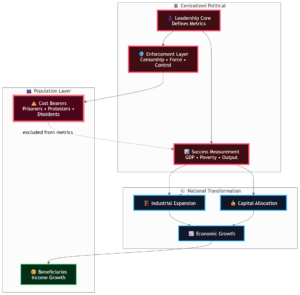
The reader who processes this as “Deng made a hard trade-off that produced extraordinary results” has accepted Deng’s framing. The trade-off was not Deng’s to make. The people who absorbed the political side of the deal were not at the table when it was set.
Rwanda: Extraordinary Conditions, Extraordinary Control
Kagame rebuilt Rwanda from a condition that has no equivalent in modern leadership history. The genocide killed nearly one million people in 100 days. He took power while the killing was still ongoing. Life expectancy was 28 years.
His results — 7 to 8% annual growth for two decades, life expectancy now at 70, the cleanest city in Africa — are, by any aggregate welfare measure, extraordinary. He is also still in power. His election results run between 93 and 99%. Critics have been kidnapped.
The question of whether extraordinary starting conditions justify extraordinary political control does not have a clean answer. It has a real answer, which is: only if you are the one setting the terms of what counts as extraordinary, and only if you are not the one living under the control.
Yugoslavia: The Case That Breaks the Narrative
Yugoslavia is the case that the realist narrative handles most awkwardly. Tito’s funeral drew delegations from 128 of 154 UN member states.
He had turned structural isolation from Moscow into global leverage, built the Non-Aligned Movement, and created material conditions that were uniquely livable by communist-world standards.
He was also the only thing holding the country together. Eleven years after his death, 130,000 people were killed and 2.4 million displaced in the bloodiest European conflict since World War II. The institutions he built did not outlast him.
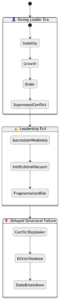
This is not an exception to the authoritarian development story.
It is the disclosure of what the story was always built on: one person’s authority substituting for the institutional capacity that distributed systems develop slowly, and that concentrated systems never need to develop because the person is still alive.
The Feature That Attracts the Reader
The single variable all five leaders share is the ability to make irreversible decisions without building consensus.
Park nationalized the banking system. Deng rolled the Xiaogang farming model out nationally without persuading anyone that it was right.
Lee is mandating technology transfer as the price of access. These decisions were right in ways that became visible after they were irreversible.
The reader drawn to this history is drawn to that feature. The ability to decide once and implement. The absence of the friction that the distributed authority creates.
This is an honest attraction, and it is also one that is only available to the person who is going to be on the deciding side of the irreversible decision.
The teenage girl in the unventilated factory had a different relationship to Park’s irreversibility. The student at Tiananmen had a different relationship to Deng’s. They are not in the growth figures. They are in the history. Both are real.
What These Cases Actually Demonstrate
What these five cases actually demonstrate is narrower than the realist reader wants them to be. They demonstrate that concentrated authority can produce compressed transformation at a speed that distributed systems cannot match.
They also demonstrate that the price of that compression is paid by people who were not asked, cannot exit, and are not included in the metric used to declare success.
The countries that survived their leaders are the ones where the institutions turned out to be stronger than the individuals who built them. The countries that didn’t are the ones where the individual was the institution, and the institution left when the individual did.
The Harder Version of the Analysis
The internal argument this produces does not resolve. Concentrated authority produces outcomes that distributed authority cannot. It also distributes the cost of those outcomes to people who have no say in whether the trade was worth it.
You can hold both of these things as true simultaneously. Most people who engage with this history hold one of them clearly and use the acknowledgment of the other as permission to proceed from the first.
Knowing which one you’re doing is harder than it sounds.