China’s System Looks Contradictory Until You Realize Contradiction Is the System
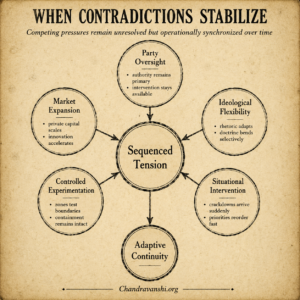
Two diagrams. The operating rhythm cycle — because the article’s core argument is that China runs on a rhythm, not toward a destination, and prose alone can’t show a cycle clearly. And the priority order — because the tech crackdown section reveals a fixed hierarchy that the reader needs to see once, cleanly, to carry through the rest.
Formatting now.
China’s System Looks Contradictory Until You Realize Contradiction Is the System
Why China’s economy can simultaneously empower billionaires, expand markets, strengthen party control, and remain internally coherent on its own terms.
Walk down the right street in Shanghai, and you pass a state-owned bank, a party committee office, an Alibaba cloud center, and a bubble tea startup with venture funding — in that order, in about four minutes.
Each one runs on a different logic. Each one considers itself normal. Nobody on the street finds this remarkable.
That last detail is the most important one.
Call the system capitalist, and someone points to the party committee embedded in the corporate filing. Call it socialist, and someone points to the billionaires. Call it a hybrid, and you have said nothing at all.
A hybrid is what you call a thing when your existing words have failed, and you are not ready to admit it.
The label slides off. It keeps sliding off. And the longer you watch it slide, the more you suspect the slippage is not a problem the system is waiting to resolve. It is the system operating correctly.
The Company Filing Nobody Mentions
There is a real document — a governance section from a publicly listed Chinese firm that trades on an exchange, reports quarterly earnings, and competes for global market share — that contains the following sentence: the party committee oversees corporate governance.
Not a state-owned enterprise. A profit-driven company with shareholders, a board, and a valuation.
The party committee is in the org chart.
In some firms, the party committee is ceremonial — it meets quarterly, approves nothing operationally significant, and exists primarily on paper. In others, it is the actual decision layer — where strategy gets ratified before the board sees it, where leadership appointments are shaped before they become official.
The variance is not an accident. The system reserves the right to decide which version applies, and when.
An outside analyst mapping the governance cannot tell from the filing which version they are reading. The ambiguity is a feature.
What the Textbook Misses
Regulators dismantle a tech platform one week, announce support for digital innovation the next. A startup founder pitching to venture capitalists in 2023 says, without irony: ” We align with national strategy. The co-working space has red banners about party building on one wall and growth-hacking metrics on the whiteboard facing it.
In a university classroom, a professor lectures on Marxist theory. The students take notes on laptops running Western software. After class, they will check phones for internship offers from private tech companies.
The ideological content and the practical content of their education point in different directions — and everyone in the room has made peace with that.
This is the part the textbook cannot contain: the system is not trying to resolve the contradiction. The contradiction is the operating mode.
The Theory That Missed the Rhythm
The West waited, with some confidence, for the system to pick a side.
Markets generate a middle class. The middle class generates political demands. Political demands generate liberalization. Open the economy, and you start a clock. The clock has been running since 1978. The chime hasn’t come.
Here is what the theory missed: the system was never moving toward a destination. It was operating on a rhythm.
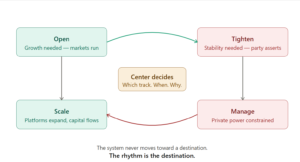
You can map the last move. You cannot reliably predict the next one. After a while, that stops being an intellectual problem and becomes a practical one for anyone allocating capital or building strategy around assumptions about rule stability.
Ant Group’s IPO was pulled in November 2020, hours before listing, after Jack Ma criticized regulators. Didi was pushed off Chinese app stores in July 2021, days after its New York IPO.
These were not arbitrary moves. They were situational — responses to specific conditions in a specific moment.
The situational quality is precisely what makes standard analysis unreliable.

What Neither Pure System Can Do
A purely market system cannot move in two directions at once. A purely planned system cannot let the edges run loose without unraveling the center.
This one does both — not cleanly, not without cost, but consistently enough that the doing of it has become the system’s most recognizable feature.
What looks like incoherence from outside is a specific kind of coherence from inside — coherence organized around keeping the center’s options open rather than producing predictable rules.
What Gets Tested
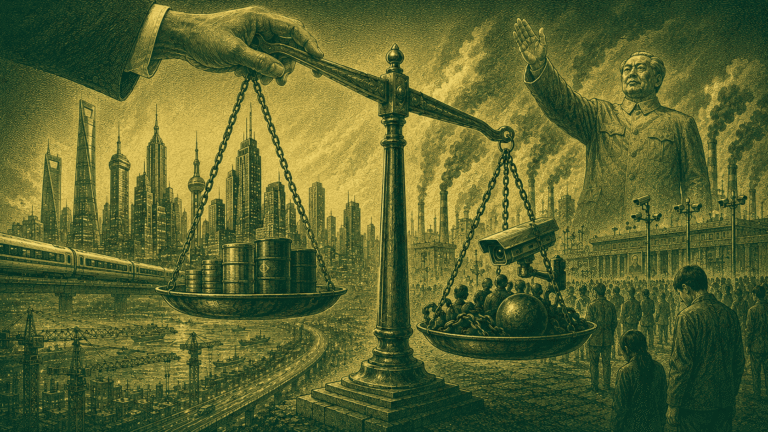
The tech crackdown of 2021 to 2023 asked the system to choose between the economic value generated by platform companies and the political risk posed by concentrations of private power large enough to operate independently.
The system chose the political track and paid the economic cost — roughly a trillion dollars in market capitalization across affected companies.
That choice is useful information.
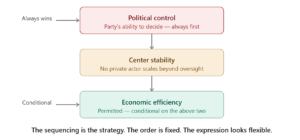
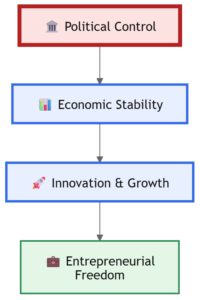
Economic priorities are not permanent losers. They are conditional on not threatening the first priority. The sequencing is the strategy. The order is fixed even when the expression looks flexible.
Demographic decline is compressing the labor force simultaneously. The transition to consumption-led growth requires the middle class to spend rather than save, which requires trusting that savings are secure, which requires resolving the property sector, which brings both conditions back into the same frame.
Whether the rhythm can hold through both simultaneously is the only question about this system that still has an uncertain answer.
What This Changes
The categories capitalism and socialism are not wrong descriptions. They are descriptions built for systems that choose between the two. This system didn’t choose.
The refusal to choose is the design.
“Aligning with national strategy” is not a startup’s marketing language. It is the operating condition under which private enterprise is permitted to exist. The alignment is not voluntary. The language makes it sound voluntary.
Forecasting this system by mapping its last move produces unreliable results. The only reliable forecast is about priority order: political control before economic efficiency, every time the two directly conflict.
The label slides off because the thing underneath keeps moving.
That movement is not a transition phase. It is not the system searching for a final form.
It is the system. The movement is the point.
Whether the rhythm can hold when two contradictory demands arrive at the same moment with no room to sequence between them — that is the only question still open.
Everything else has already been answered. The answers just don’t fit the categories we arrived at.