The Architecture Is Gone
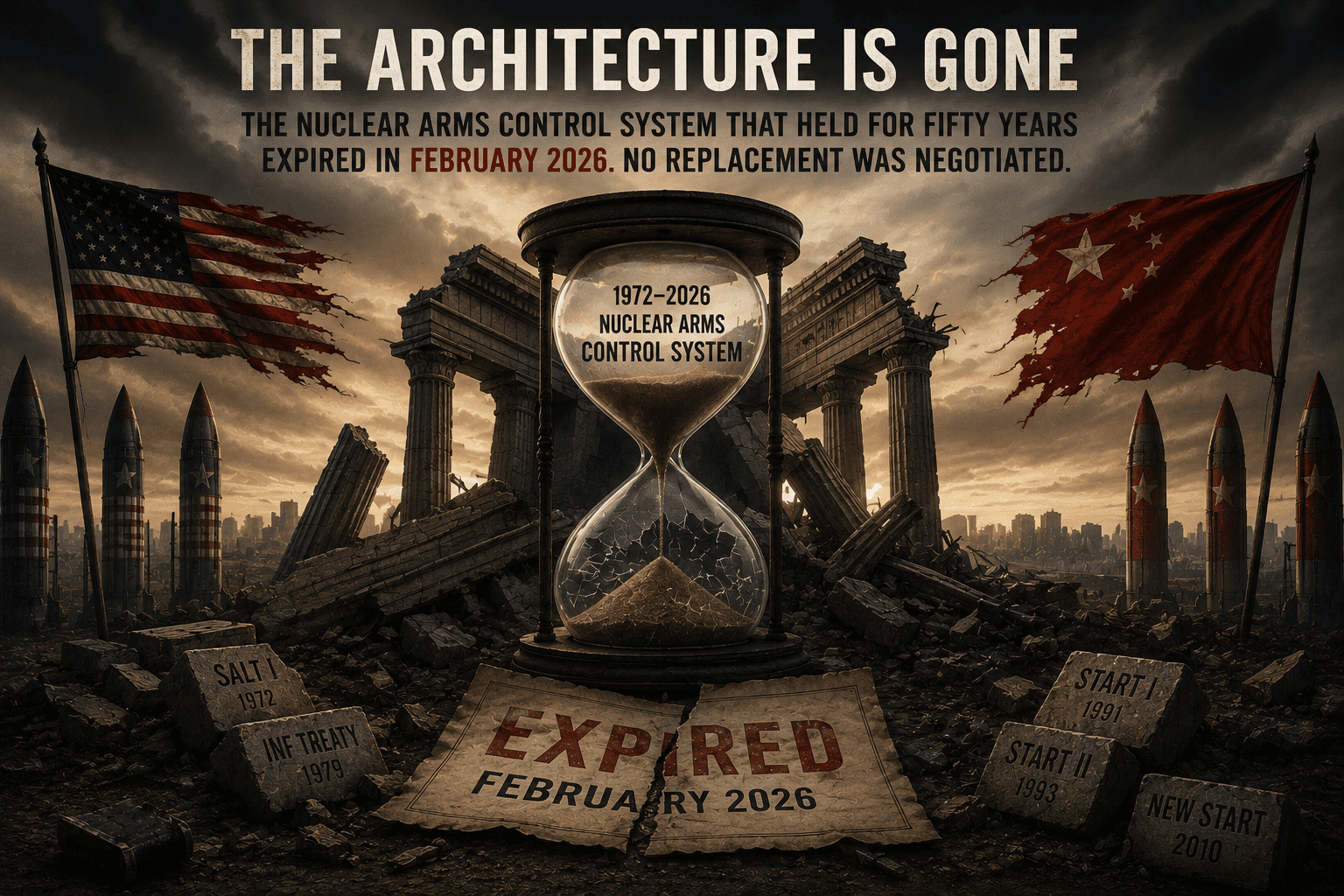
The Architecture Is Gone
The nuclear arms control system that held for fifty years expired in February 2026. No replacement was negotiated.
Not weakened. Not amended. Expired.
The United States and Russia — holding approximately 88% of the world’s nuclear warheads — now operate with no legally binding constraints for the first time since 1972.
This is not a projection. It is a description of what has already happened.
The comfortable answer to how a world war begins is a single event. A gunshot. A border crossed. A declaration read aloud.
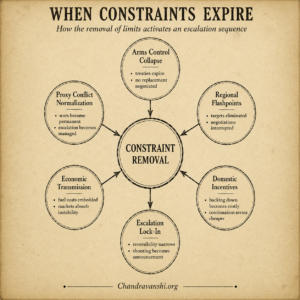
The accurate answer is that the moment is almost always administrative.
By the time it arrives, the war has already been won and lost a dozen times in treaty halls, naval shipyards, and proxy battlefields. The shooting is the announcement, not the cause.
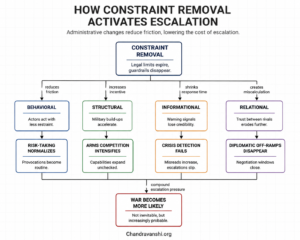
Both 1914 and 1939 followed the same sequence.
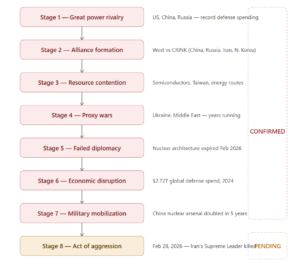
That is stages one through seven. Confirmed. Not predicted.
On February 28, 2026, the United States and Israel launched the largest military operation in the Middle East since 2003.
Iran’s Supreme Leader was killed during ongoing peace negotiations.
Whether that becomes stage eight depends on what happens in the next several weeks.
The reader who followed this sequence has done something real.
But following it is a specific act with a specific shape. It positions the reader above the sequence — watching a process unfold rather than living inside one.
The sequence does not actually offer that position.
Fuel costs are already embedded in the price of every physical product moved by road.
The bond market is carrying pressure from Gulf state reactions. The nuclear constraint architecture is gone.
The cascade runs on the stated interests and capabilities of the parties involved. Not on speculation.
The gap between what the reader understands intellectually and how they are actually living is already a gap.
Not a future risk. A present condition.
Their mortgage is the same. Their supply chain exposure is the same. Their assumptions about institutional stability are the same.
There is a specific identity the framework serves. The informed one.
The person who can hold the ten-stage sequence without reaching for reassurance. This identity is maintained by continued engagement with the material.
It does not require any change in how the informed person is actually positioned within the situation.
Every world war had a reversible moment. A point before stage eight, where de-escalation was still available.
In both cases, the window was not taken.
Not because leaders wanted war. Because the domestic political cost of backing down had been made higher than the perceived cost of continuing.
Stage nine has not set in. The superpowers are not directly engaged. China has not moved on Taiwan.
That gap is the only reason the situation remains technically reversible.
The framework says the point of no return has not been crossed. History says the point of no return rarely announces itself clearly in advance.
The reader who finishes this and opens the next tab already knows which of those two things they are living as though is true.