You Have Everything You Need to Start. That Is Why You Haven’t.
The research loop feels like progress. It is producing a different kind of failure.
The preparation loop feels like progress. It is producing a different kind of failure.
Three browser tabs. None of them is open to anything you have actually built.
The first is a course — highly rated, fourteen hours long, the instructor has a calm voice and a clean setup. You have watched forty minutes of it across three separate days. The second is a Reddit thread, someone asking how to become a data analyst with no experience, forty-seven replies, read most of them twice. The third is a LinkedIn post — a person describes going from call center work to a six-figure data role in three years. You have read it carefully enough to know which city they are in.
You have not written a query. You have not opened a database. You have not made a thing that could fail.
This is what preparation looks like from the outside. From the inside, it feels like work.
There is a belief running underneath all of this, and it sounds responsible when named: starting without enough knowledge is how people fail. The person who jumps in uninformed wastes months going the wrong direction. The person who researches first builds correctly from the start.
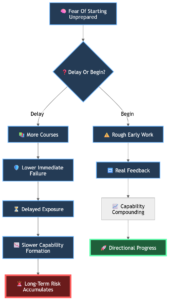
This belief is doing something specific right now. It is converting the gap between where you are and where you want to be into a reason not to close it yet.
The gap is real. The knowledge needed is real. But the belief that the gap must be closed before beginning — that part is not protecting you from failure. It is producing a different kind of failure, the kind that does not announce itself.
The person in that LinkedIn post did not start when they were ready. They started when they were approximately where you are now: aware of the gap, uncertain about the path, holding a browser tab instead of an output. The readiness they have now was produced by starting before they had it. That sequence does not run the other direction.
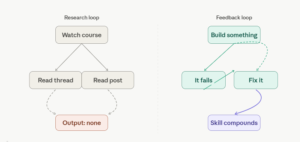
What you are doing with the fourteen-hour course and the Reddit thread is researching the distance. That is not the same thing as covering it.
Think about what those three years actually contained for that person. Not the highlights in the post. The actual composition of the time. Queries that failed and had to be fixed the next morning. Concepts explained badly by one resource and finally understood through a different one. Months inside work that felt below the destination, done because that was what was available.
The distance between where they were in year one and where they needed to be — that distance did not get solved by research. It got traversed by traversing it.
You already know the difference. That is not the same as changing anything yet.

The self-image this behavior serves is the careful one. The one who does not make rash decisions. The one who is serious about this, not just excited. Methodical is a real quality. It produces real value in the right conditions.
What it is doing right now is providing cover for not starting.
There is a question the careful approach will never answer: which specific course, which exact SQL dialect, which platform, which learning path is genuinely optimal for someone with your specific background entering this specific market at this specific moment. The answer does not exist in a form clean enough to satisfy the research loop. Every answer produces adjacent questions. The thread has forty-seven replies because forty-seven people had forty-seven different experiences, and none of them is you.
The loop is not moving toward a starting point. The loop is the activity that replaces the starting point.
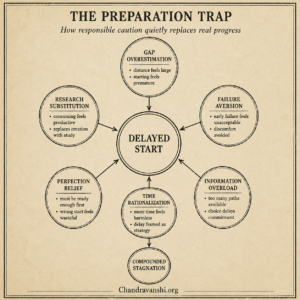
Here is the internal argument that has probably appeared already: starting too early means building on an incomplete foundation, and skills learned in the wrong order take twice as long to unlearn and relearn correctly.
But the window where it is acceptable to know very little and build something rough — where the stakes of failure are low enough that failure is just information — that window is not permanently open. It closes with time. Not dramatically. Quietly. The person willing to hire someone with a rough but honest portfolio at twenty-five is doing different math than the person considering the same candidate at thirty-two.
Both of these things are true. The argument does not resolve. It just sits there, inside the next tab you open
The person in that LinkedIn post has three years of feedback loops behind them. Some of it was painful. Some of it was slow. All of it is now compounded into a capability that looks, from the outside, like it might have arrived through talent or luck or a particularly good course recommendation.
It did not. It arrived through the accumulation of failed queries and fixed ones. Through writing something bad, seeing why it was bad, and writing something slightly less bad next.
The gap between where you are and where that person is — it is not fourteen hours wide. It is three years of feedback loops. The only way to shorten it is to enter it.
You decided that starting without full preparation is reckless. Somewhere in that decision, you stopped noticing what staying in preparation is costing. It felt like the careful approach.
That is not the same as it being the low-risk one.