Why Avoiding Losses Matters More Than Maximizing Returns
How Risk, Compounding, and Judgment Shape Long-Term Investment Survival
Most investors optimise for gain.
They search for opportunities, compare potential returns, and measure success by what they earn.
This approach misses the structural asymmetry that determines long-term survival:
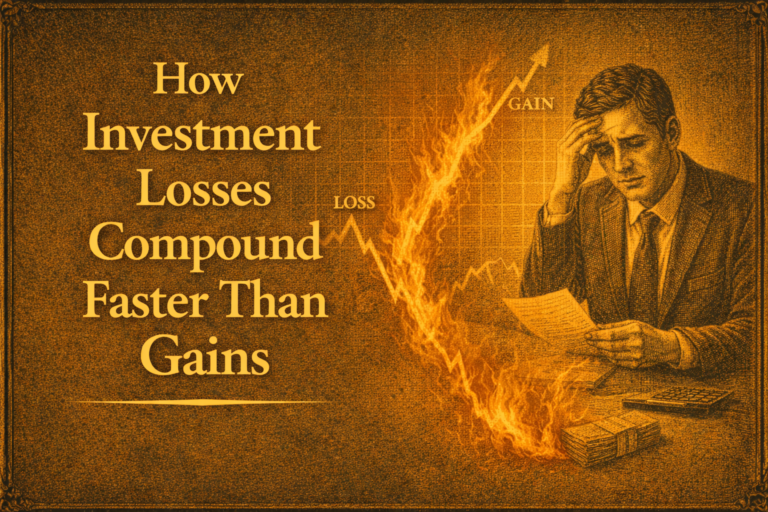
Losses destroy capital faster than gains rebuild it.
A 50% loss requires a 100% gain to recover.
This is not motivation or psychology.
It is mathematics.
The shape of compounding makes downside protection more valuable than upside capture, yet investor behaviour consistently reverses this priority.
This guide examines:
- Why mathematical asymmetry makes loss avoidance structurally superior to gain seeking
- How compounding amplifies small differences in downside exposure over time
- The psychological mechanisms that push intelligent investors toward excessive risk
- When loss avoidance becomes counterproductive and creates new dangers
- What changes when avoiding losses becomes the primary investment framework
Understanding this changes how you evaluate opportunities, not just which ones you select.
The Mathematical Foundation of Loss Asymmetry
Investment returns do not operate symmetrically.
A 20% gain followed by a 20% loss does not return capital to its starting point.
It leaves you below where you began.
Start with $100,000:
- Gain 20% → $120,000
- Lose 20% → $96,000
The percentage changes were identical.
The outcome was not.
This asymmetry accelerates as losses deepen:
| Loss | Required Gain to Recover |
|---|---|
| 10% | 11% |
| 20% | 25% |
| 30% | 43% |
| 40% | 67% |
| 50% | 100% |
Each additional percentage point of loss requires disproportionately larger recovery gains.
That changes the entire structure of investing.
The question stops being:
“How much upside can I capture?”
And becomes:
“How much downside can I survive without permanently impairing compounding?”
How Compounding Reveals the Pattern
Compounding does not simply multiply returns.
It multiplies the consequences of volatility.
Compare two investors over ten years:
- Investor A earns 12% annually with occasional 25% drawdowns
- Investor B earns 9% annually with maximum 10% drawdowns
Most analysis focuses on the 3% return difference.
The more important variable is the drawdown profile.
When Investor A suffers a deep decline, future gains compound from a smaller capital base.
Recovery absorbs years of future returns.
Investor B compounds more slowly but from a more stable foundation.
Over sufficiently long periods, stability frequently outperforms higher but more volatile returns.
The pattern becomes stronger over decades.
A portfolio avoiding major drawdowns often finishes ahead of a portfolio with higher average returns but repeated 40-50% collapses.
Why Volatility Costs More Than Math Suggests
Standard volatility metrics treat upside and downside movement symmetrically.
Real-world investing does not.
A portfolio swinging between +30% and -30% may show mathematically similar volatility to one fluctuating between +15% and -15%.
But the behavioural and structural consequences differ enormously.
Large drawdowns trigger:
- Margin calls
- Forced liquidation
- Panic selling
- Conviction collapse
The damage is not purely numerical.
It becomes psychological.
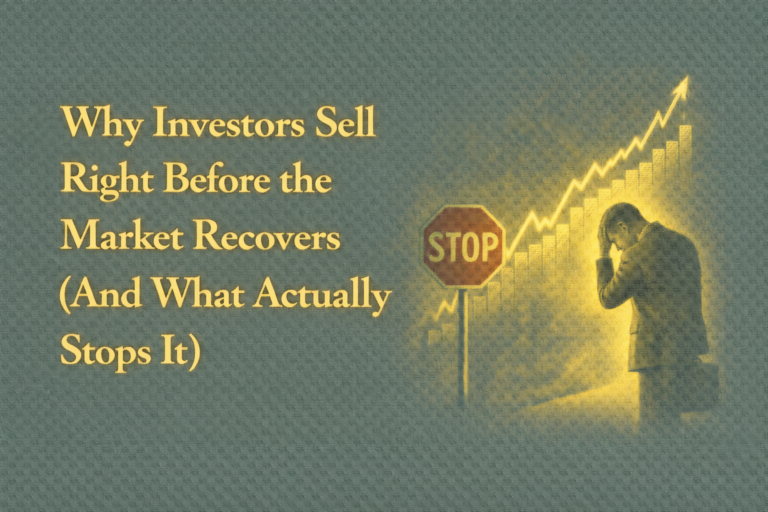
Most investors who believe they can tolerate a 50% decline discover during the decline that they cannot.
They exit near bottoms, converting temporary losses into permanent destruction.
Volatility therefore creates hidden costs:
- Reduced future compounding base
- Behavioural errors
- Liquidity stress
- Forced timing mistakes
How Loss Avoidance Works in Practice
Loss avoidance does not eliminate risk.
It structures risk so that ordinary mistakes and market volatility do not permanently destroy capital.
Position Sizing as Primary Defense
The most effective risk management happens before investment selection.
Position size determines the maximum damage if you are completely wrong.
A 5% position going to zero damages capital differently than a 30% position doing the same.
Certainty does not eliminate risk.
Even excellent analysis can fail.
Position sizing creates survivability.
When no single position can destroy the portfolio:
- Mistakes remain recoverable
- Emotional pressure reduces
- Compounding survives
The trade-off is obvious.
Smaller positions reduce upside from correct decisions.
But they also prevent catastrophic damage from incorrect ones.
Diversification Under a Loss Framework
Concentration maximises returns when you are right.
Diversification minimises destruction when you are wrong.
Loss-focused investing favours survivability over maximised conviction.
This does not mean owning hundreds of positions.
It means ensuring no single thesis failure creates unrecoverable damage.
Most investors cannot reliably identify which positions carry hidden catastrophic risk.
Diversification accepts that limitation instead of denying it.
Systematic Exits and Stop Losses
Predetermined exit rules prevent small losses from becoming existential ones.
When positions fall beyond acceptable thresholds, exits preserve capital regardless of emotional attachment or conviction.
This creates frustration because some stopped positions recover later.
But the framework evaluates aggregate outcomes, not isolated cases.
The purpose of stop systems is not maximising every trade.
It is preventing rare catastrophic outcomes from overwhelming years of disciplined compounding.
Stops also interrupt psychological drift:
- -10% feels manageable
- -20% starts feeling temporary
- -40% becomes emotionally paralysing
Without predefined exits, investors continuously redefine acceptable loss thresholds downward.
Quality as Downside Protection
Not all investments carry equal downside risk.
Businesses with:
- Strong balance sheets
- Stable cash flow
- Durable competitive advantages
- Low leverage
Typically suffer less permanent impairment during crises.
High-quality companies often appear expensive during stable periods.
That limits upside potential.
But during stress, quality preserves optionality better than fragile businesses bought purely because they appeared cheap.
Where Loss Avoidance Encounters Limits
Opportunity Cost Accumulation
Extreme caution creates invisible costs.
Cash sitting idle during recoveries earns nothing.
Positions exited too early miss future upside.
Opportunities rejected due to uncertainty may eventually outperform.
The problem is psychological:
Investors feel avoided losses directly.
They rarely feel missed returns with equal intensity.
This creates the illusion that caution is free.
It is not.
False Security Through Stability
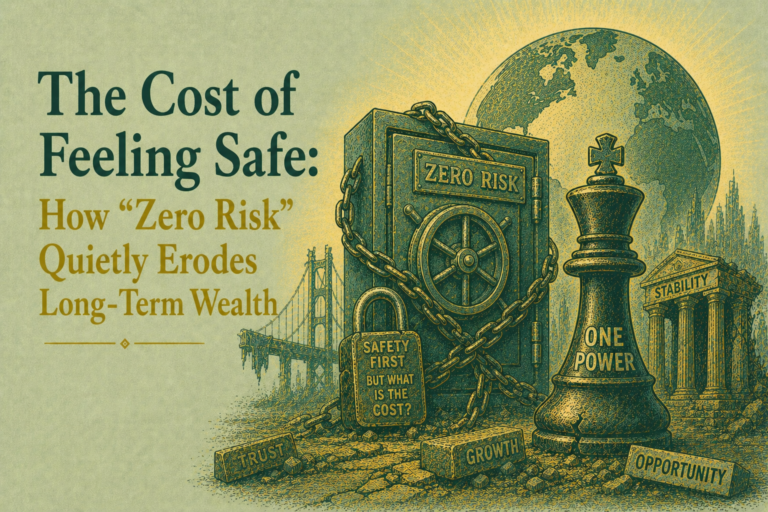
A portfolio generating low volatility but inadequate long-term returns still destroys capital after inflation and taxes.
Stable mediocrity can feel safe while quietly failing its actual purpose.
Loss avoidance must preserve:
- Capital survivability
- Future purchasing power
- Long-term compounding capacity
Avoiding volatility alone is insufficient.
Exit Paralysis
Once investors become heavily loss-focused, every decline triggers anxiety about whether further losses are coming.
This can produce excessive trading:
- Small losses get locked in repeatedly
- Recoveries occur after exits
- Cumulative friction compounds
The solution is not abandoning discipline.
It is accepting that no framework prevents all regret.
Some stopped positions will recover.
The framework exists to prevent ruin, not optimise every individual outcome.
Conviction Collapse During Panics
Loss-focused investors often handle ordinary volatility well but fail during extreme declines.
A 10-15% correction feels manageable.
A 35-50% collapse creates existential emotional pressure.
At precisely the moment long-term opportunity improves most, fear overwhelms process.
Investors who spent years protecting against downside frequently abandon the framework near market bottoms.
What Changes When Loss Avoidance Becomes Primary
Position Evaluation Reverses
Traditional investing asks:
“How much can this make?”
Loss-focused investing asks:
“How much can this lose, and can the portfolio survive it?”
This changes opportunity selection entirely.
High-upside positions with catastrophic downside become unattractive.
Moderate-return opportunities with limited downside become valuable.
Patience Replaces Constant Activity
Most trading activity creates more opportunity for error than value creation.
Loss-focused investors trade less frequently because unnecessary activity introduces:
- Timing mistakes
- Emotional reactions
- Tax friction
- Compounding interruptions
Patience becomes strategic.
Waiting for asymmetrically favourable opportunities often protects capital better than constant optimisation attempts.
Simplicity Becomes Protective
Complexity creates additional failure points.
Leverage, derivatives, tactical allocation systems, and complex hedging structures all introduce hidden interactions that may fail under stress.
Simple ownership of durable businesses creates more transparent risk.
The simplicity is not intellectual laziness.
It is recognition that many investment blowups emerge from complexity investors believed they fully understood.
Time Horizon Extends Naturally
Short-term price movement becomes less important under a long-term compounding framework.
A 10% decline over a quarter feels catastrophic only when evaluated over short windows.
Over multi-year periods, those fluctuations become normal variation.
Extending time horizon reduces the pressure to react emotionally to noise.
Common Misunderstandings About Loss Avoidance
“Loss Avoidance Means Avoiding Risk Entirely”
No investing approach eliminates risk.
Loss avoidance structures risk so that ordinary mistakes remain survivable.
Loss-focused investors still:
- Own equities
- Experience volatility
- Make directional bets
The difference lies in exposure structure and survivability.
“This Only Works During Bear Markets”
Loss avoidance often underperforms during prolonged bull markets because aggressive positioning captures more upside.
Its strength appears across full cycles.
Avoiding severe drawdowns preserves future compounding power in ways that become visible only over long horizons.
“Correct Entry Timing Solves the Problem”
Buying cheaply helps.
It does not eliminate downside.
Even excellent businesses purchased at reasonable prices can decline sharply.
Position sizing and exit discipline matter more than perfect timing.
“Loss Avoidance Requires Constant Monitoring”
Over-monitoring often damages results by encouraging emotional reaction to ordinary volatility.
Loss-focused frameworks generally work better with:
- Periodic review
- Clear exit criteria
- Predefined position limits
Rather than constant daily intervention.
Interpreting Loss Avoidance as a Framework
What to Watch For
Portfolios showing no meaningful drawdowns for many years may indicate:
- Excellent discipline
- Excessive conservatism
- Favourable market conditions mistaken for skill
The distinction matters because luck eventually reverses.
When to Question the Framework
If loss avoidance produces stable but inflation-adjusted capital decline over many years, caution has likely become counterproductive.
Protection matters only if capital still compounds meaningfully over time.
How This Reframes Risk
Traditional investing defines risk as volatility.
Loss-focused investing defines risk as:
Permanent impairment of capital.
That changes what deserves attention.
Temporary price movement matters less.
Business quality, survivability, and balance-sheet strength matter more.
Frequently Asked Questions
How do you avoid losses without missing opportunities?
You do not.
Missing opportunities is part of the trade-off.
The framework assumes avoided catastrophic losses outweigh missed upside over full market cycles.
What is the difference between loss avoidance and excessive conservatism?
Loss avoidance still participates in productive assets while structuring risk carefully.
Excessive conservatism avoids meaningful exposure entirely and often guarantees inadequate long-term returns.
Can loss-focused investing still outperform indexes?
Possibly.
But the objective is usually smoother compounding with reduced drawdown severity rather than maximum benchmark outperformance.
How do you decide whether to hold or exit a declining position?
Evaluate:
- Business deterioration
- Balance-sheet changes
- Competitive weakness
- Position size relative to total capital
Price decline alone is not always sufficient reason to exit.
Does inflation change the framework?
Yes.
Capital preserved nominally but destroyed in purchasing power still represents real loss.
Loss-focused investing must exceed inflation over long periods to remain effective.
What is a reasonable position size?
For many investors:
- 5-10% maximum position size provides survivability
- 2-3% works better for speculative ideas
- Positions above 15% significantly increase portfolio fragility
Related Reading
- The Most Important Thing by Howard Marks — Defensive investing and capital preservation
- Margin of Safety by Seth Klarman — Downside protection as the central investment principle
- Fortune’s Formula by William Poundstone — Position sizing and the Kelly Criterion
- Quality Investing by Lawrence Cunningham et al. — Business quality and downside reduction
- Your Complete Guide to Factor-Based Investing by Andrew Berkin and Larry Swedroe — Low-volatility and quality factor frameworks
Final Perspective
Loss avoidance is not about eliminating all declines.
It is about structuring an investment process so that normal mistakes, volatility, and occasional catastrophic events do not permanently impair capital’s ability to compound.
The mathematics are unavoidable:
Losses destroy compounding faster than equivalent gains rebuild it.
A 50% decline requiring 100% recovery changes the logic of long-term investing entirely.
Most investors understand this intellectually while behaving as though upside matters more than survivability.
The conflict exists because psychology values opportunity emotionally while underestimating structural fragility.
Loss-focused investing reverses that emphasis.
The primary question becomes:
“How much downside can this portfolio absorb while preserving future compounding?”
The framework carries costs.
It underperforms during speculative manias.
It feels overly cautious during extended bull markets.
Those are not flaws.
They are the premium paid for avoiding the kinds of destruction that permanently reset long-term compounding.