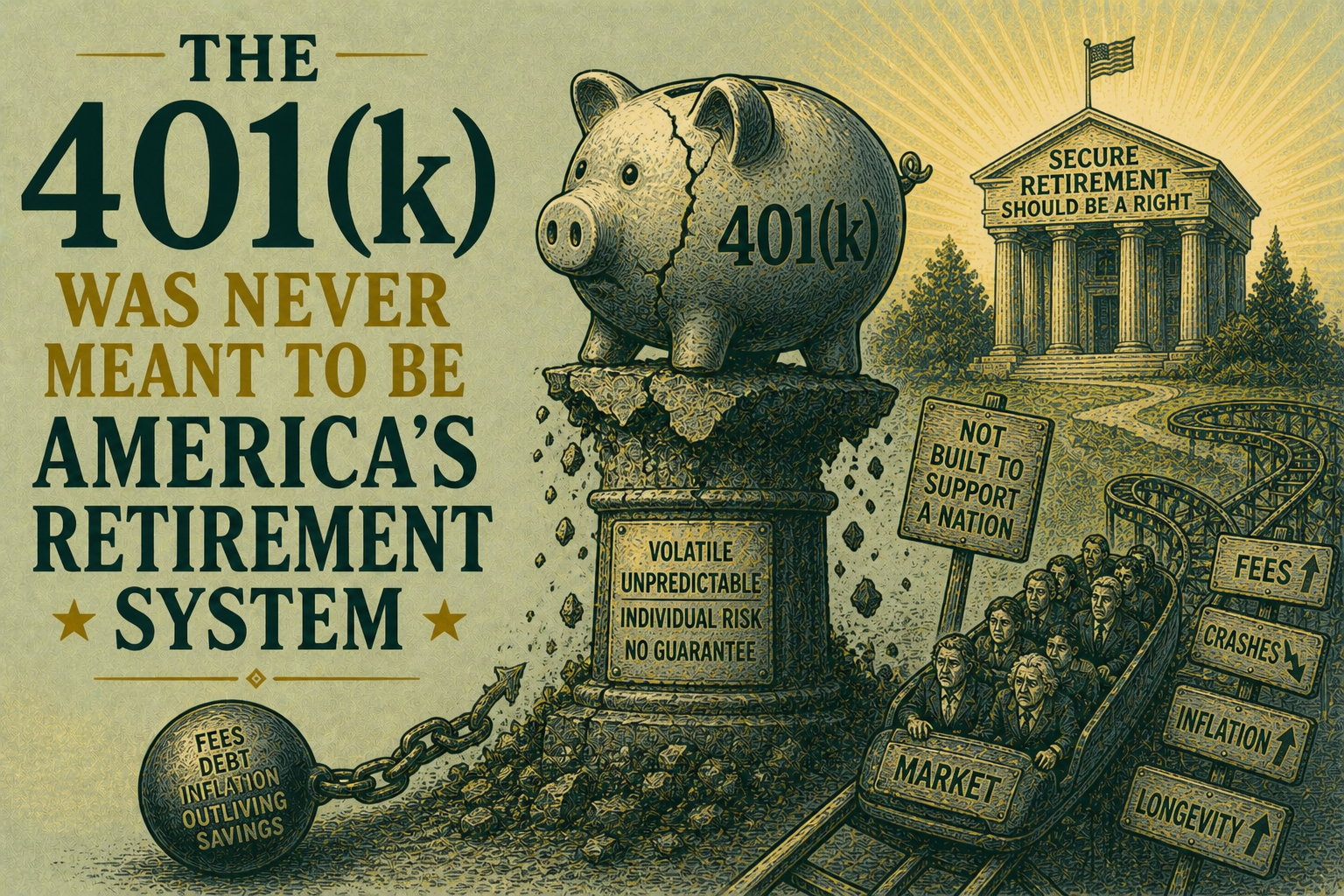
THE 401(k) WAS NEVER MEANT TO BE AMERICA’S RETIREMENT SYSTEM
Why the 401(k) Was Never Designed to Be a Retirement Plan
Most workers treat the 401(k) as a retirement plan. It isn’t — not by design. It’s a tax deferral mechanism that accidentally became the foundation of retirement for 60 million Americans.
Understanding what it actually is changes how you use it, what you expect from it, and what risks you’re carrying that you may not have priced in.
The 401(k) Didn’t Start With a Retirement Problem
The 401(k) doesn’t start with a retirement problem. It starts with a tax problem.
In 1978, Congress passed the Revenue Act. The legislation ran to hundreds of pages. Buried in it was a short section, labelled 401(k), that allowed certain employees to defer taxes on a portion of their compensation.
The clause was narrow. Its target was executives looking for a legal way to push income into lower-tax years.
No retirement policy was debated.
No replacement for the pension system was proposed.
A tax rule was passed.
That’s all.
What the 401(k) Actually Is
A 401(k) is a tax-deferral vehicle.
- Contributions go in pre-tax
- Growth compounds without annual tax drag
- Withdrawals in retirement are taxed as ordinary income
The structure creates a meaningful long-term advantage.
But the mechanism is deferral, not retirement design.
The confusion is understandable. The account is called a retirement account. Employers frame it as a retirement benefit. The financial industry markets it as a retirement solution.
None of that changes what the underlying structure is or what it was built to do.
How a Tax Clause Became a Retirement System
In 1980, a benefits consultant named Ted Benna studied the 401(k) provision and noticed something the original drafters hadn’t emphasised:
The language wasn’t restricted to executives.
Ordinary employees could defer salary into a tax-advantaged account, too.
Benna helped design one of the first broad employee 401(k) plans. The IRS provisionally approved the structure in 1981.
Corporate America paid close attention.
Not because the 401(k) was a better retirement tool than the pension, but because it transferred financial risk in one specific direction:
Away from the employer.
A defined-benefit pension required the company to guarantee retirement income regardless of how the underlying investments performed. If markets fell, the employer absorbed the gap.
The 401(k) changed the structure completely.
- Employees contribute their own money
- Returns depend on market performance
- The employer’s obligation is limited to the match, not the outcome
The guarantee disappeared.
So did the long-term financial liability for the company.
The risk moved to the worker.
Between 1983 and 2016, the share of private-sector workers participating only in defined-benefit plans fell from 62% to 17%.
The shift didn’t require a national debate.
It happened quietly, company by company, over four decades.
What the Numbers Actually Produce
The median 401(k) balance for Americans approaching retirement, workers between 55 and 64, sits around $185,000.
Apply the 4% withdrawal guideline, and that produces roughly $7,400 per year.
That’s not retirement income.
That’s a supplement.
Social Security averages about $1,907 per month.
Together, the picture becomes more complete.
But only under specific conditions:
- Maximum Social Security benefits
- No debt
- No major healthcare costs
The 4% rule itself carries an important condition.
It assumes a 30-year retirement horizon and historical returns that included unusually strong bond performance.
Where the System Breaks
Late Entry
A worker starting at 45 does not just lose contributions.
They lose decades of compounding on every dollar.
This gap cannot be fully recovered.
Sequence-of-Returns Risk
Two investors with identical balances can experience completely different retirements depending on market conditions at the start.
Early withdrawals during a downturn permanently reduce capital.
A pension absorbs this risk.
A 401(k) does not.
Fee Drag
Expense ratios range from 0.5% to 1.5%.
On a $200,000 balance over 20 years, the difference between a 0.05% index fund and a 1% active fund can exceed $45,000.
Not as visible fees, but as growth that never happens.
The Structural Limit to Understanding
The 401(k) works under specific conditions:
- Early participation
- Consistent contributions
- Low-cost funds
- No early withdrawals
- Stable market environment at retirement
Each condition is reasonable.
Together, they describe a minority.
The system works best for those with:
- Stable careers
- Higher incomes
- Financial literacy
It works worst for those with interruptions, lower wages, or limited access to matching.
The structure does not compensate for these gaps.
It compounds them.
Where This Breaks
- The 4% rule was built on historical conditions that may not repeat. Applying it mechanically introduces uncertainty.
- Sequence-of-returns risk is not a timing issue. It is structural.
- Employer matching encourages minimum contribution. It does not encourage optimization.
- Catch-up contributions help. They do not replace lost time.
What Most Workers Miss
- The 401(k) became dominant not because it was better, but because it shifted risk
- The account balance is not income
- Fee differences compound significantly over time
- The highest risk period is near retirement, not early in the career
The system looks stable.
The outcomes are not guaranteed.
Frequently Asked Questions
What is a 401(k)?
A tax-deferred savings account offered by employers. Contributions reduce taxable income, grow tax-free, and withdrawals are taxed later.
How does it work mechanically?
A percentage of salary is contributed pre-tax, invested in available funds, and compounds over time. Withdrawals are taxed. Required distributions begin at age 73.
How much is enough?
Common benchmarks suggest 10–12x salary by retirement. These are guidelines, not guarantees.
401(k) vs pension?
A pension guarantees income.
A 401(k) guarantees nothing about outcomes.
Risk shifts from employer to worker.
When does it fail?
Late starts, early withdrawals, high fees, job changes, or poor market timing near retirement.
These are not rare cases.
They are common outcomes.
Does the 4% rule still work?
It is a guideline. Newer estimates suggest closer to 3.3%–3.5% may be safer.
It is useful for planning.
Not for certainty.
The Mechanism Worth Holding Onto
A short clause in a 1978 tax law became the retirement infrastructure for 60 million Americans.
Not because it guaranteed retirement.
Because it transferred risk.
The account is real.
The tax advantage is real.
The compounding is real.
What is not real is the assumption that contributing automatically produces a retirement.
The deferral works.
The retirement requires more than that.