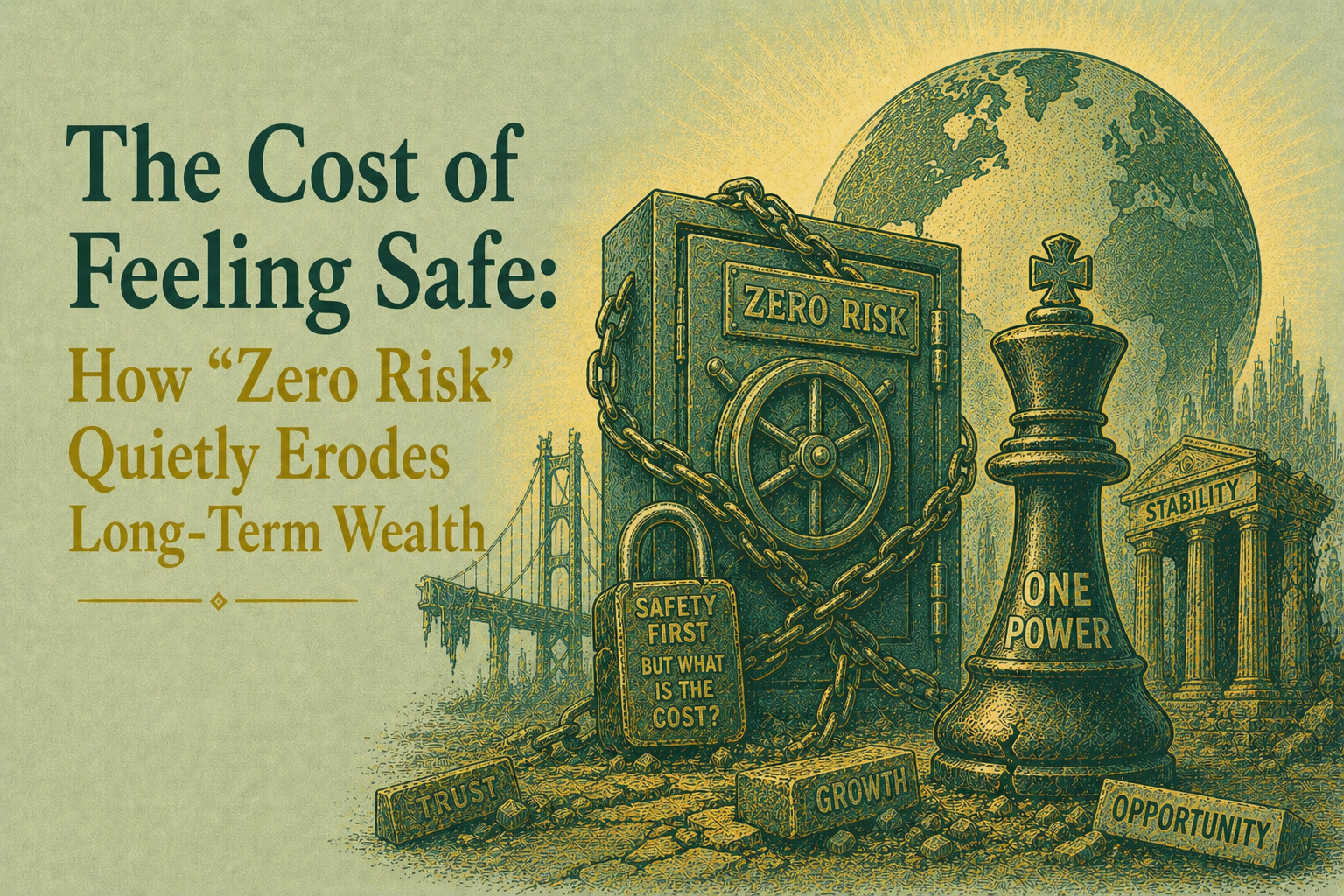
The Cost of Feeling Safe: How “Zero Risk” Quietly Erodes Long-Term Wealth
Why Moving Money to Fixed Deposits During Market Falls Feels Safe — and Quietly Costs More Over Time
The Comfort That Comes With a Number Not Falling
Moving money out of a falling market and into a fixed deposit feels like control. The decline stops. The balance stabilises. The anxiety fades.
That instinct is not flawed. It is built on lived experience.
“At least this won’t go down anymore.”
For decades, that sentence held real financial logic in India. Fixed deposits once delivered returns meaningfully above inflation. Stability was not just emotional. It was mathematical.
Today, the emotional logic still holds.
The math does not.
What looks like protection often hides a second outcome that does not show up anywhere. No message. No alert. No statement. Yet it compounds quietly, and in most cases, it outweighs the visible loss you tried to avoid.
Two Losses, Only One You Can See
When markets fall, the loss is immediate and measurable.
A portfolio drops from ₹1.4 lakh to ₹1.18 lakh.
The screen confirms it. The number hurts. Action follows.
Money moves into an FD. The fall stops.
That is the visible loss. It is real, and it is recorded.
But there is another number that never appears.
What would that ₹1.18 lakh have become if it stayed invested through the cycle?
Across recent market recoveries, similar investments have grown to nearly ₹2.1 lakh over a few years.
So the actual comparison is not ₹1.4 lakh vs ₹1.18 lakh.
It is ₹2.1 lakh vs whatever the FD delivers.
The first loss feels painful.
The second loss feels like nothing.
Because it produces no signal.
Why Your Mind Chooses the Smaller Loss
This is not about intelligence or financial literacy. It is about how humans process information.
A falling number creates pressure. It demands a response.
A missed gain does not exist as an event. It has no emotional weight unless you calculate it deliberately.
Pain that is visible always wins over loss that is invisible.
So decisions optimise for what can be seen.
The FD solves the immediate problem.
It removes volatility. It restores certainty.
But it replaces a temporary decline with a permanent gap in long-term outcomes.
The Math Has Quietly Changed
There was a time when this behaviour worked.
In earlier decades, fixed deposits in India offered 10 to 13 per cent returns. Inflation was lower. Post-tax returns still left room for real growth.
That environment no longer exists.
Today:
- FD rates: around 6 to 7 per cent
- Inflation: around 5 to 6 per cent
- Post-tax return for many investors: close to zero or negative in real terms
The number grows.
The value behind the number does not.
This is not a flaw in the FD itself. It is a mismatch between the tool and the job it is being asked to do.
Where Fixed Deposits Actually Work
The FD is a precise instrument. It works well in specific situations.
Use it where certainty matters more than growth:
- Money needed within 1 to 3 years
- Known expenses like education fees or down payments
- Capital that cannot afford any short-term fluctuation
In these cases, the FD delivers exactly what is required.
Predictability is the goal, not growth.
Where It Quietly Fails
Problems begin when the same tool is applied to money with a long horizon.
If funds are not needed for 7, 10, or 15 years, the objective changes.
Now the question is not safety over months.
It is growth over decades.
Using an FD here does not reduce risk.
It shifts risk from visible volatility to invisible erosion.
You avoid short-term discomfort by accepting long-term underperformance.
The Compounding Gap Most People Never Calculate
Consider a simple comparison.
₹10 lakh invested for 20 years:
- At around 6.5 per cent (FD): grows to roughly ₹24 lakh post-tax
- At around 12 per cent (long-term equity average): grows to about ₹96 lakh
The difference is not marginal.
It is over ₹70 lakh.
No notification ever tells you this gap exists.
It only becomes visible at the end, when there is no time left to recover it.
Why This Pattern Repeats So Often
The behaviour is reinforced socially, not just individually.
Messages about “safe returns” circulate constantly. Stories of loss travel faster than stories of recovery.
Nobody forwards a message saying they stayed invested and quietly compounded wealth.
So the shared belief system emphasises protection from visible loss, not awareness of invisible loss.
The result is consistent:
- Decisions feel responsible in the moment
- Outcomes fall short over long horizons
A More Accurate Way to Decide
Before choosing any instrument, one question matters more than all others:
“When is this money actually needed?”
Not when it would feel better to have it guaranteed.
When will it actually be used?
Then match accordingly:
- Immediate access → liquid funds or savings
- Short-term goals → fixed deposits
- Long-term goals → growth-oriented investments
This separation does not eliminate risk.
It places each type of risk where it belongs.
What Changes Once You See Both Numbers
Nothing dramatic needs to happen.
No complex strategy. No constant tracking.
Just one shift:
Start evaluating decisions based on both outcomes, not just the one you can see.
The visible loss will always demand attention.
The invisible loss will never announce itself.
But over time, it is the invisible one that shapes financial reality.
Conclusion
The appeal of “zero risk” is powerful because it removes discomfort immediately. That is its strength.
Its cost lies elsewhere.
Not in what it shows you, but in what it quietly prevents from happening.
Once you begin to account for both numbers, the decision changes. Not because the FD is wrong, but because it is no longer being asked to do a job it was never built for.
Frequently Asked Questions
Is a guaranteed return always safer?
For short-term needs, yes. For long-term goals, not necessarily. A guaranteed return below inflation reduces real wealth over time.
What if markets fall right after investing?
That risk exists. Over long periods, recovery has historically followed declines. The larger risk is exiting during the fall and missing that recovery.
Can I split between FD and equity?
Yes. This is often the most practical approach. The key is aligning each portion with its time horizon.
Did earlier generations succeed with FDs?
They did, because interest rates were significantly higher relative to inflation. The environment has changed, even if the habit has not.