Decoded: Howard Marks on Nikhil Kamath Podcast | The Investor the Media Didn’t Build
Why Forecasting Keeps Failing and What Actually Separates Great Investors
In a wide-ranging conversation on the Nikhil Kamath Podcast, Howard Marks explains why forecasting is overrated, why market cycles never disappear, and why emotional discipline matters more than intelligence in investing.
Prediction Is Not a Strategy
Most investment frameworks are built on an assumption that doesn’t hold. Fix the assumption and everything downstream has to change.
Every serious investor knows the future is uncertain. Most still organize their portfolios around a single predicted future. The mismatch between what people say they believe and how they actually position is where the losses accumulate.
Why Prediction Keeps Failing
Markets are not mechanical systems that return to equilibrium when disturbed. They are feedback systems driven by human interpretation. The same piece of economic data, read through different emotional states, produces entirely different market outcomes. That’s not a bug in how markets work. That’s what markets are.
The forecasting problem runs deeper than the fact that outcomes are uncertain. It’s that investors systematically overestimate how predictable outcomes are in the first place. The failure isn’t random. It’s directional.
When growth is accelerating, optimism overshoots what the data justifies. When growth is contracting, pessimism overshoots in the other direction. Markets don’t fluctuate randomly around a rational mean. They fluctuate around a psychological mean that is itself moving.
A forecast that is right about direction and wrong about magnitude will still produce a bad outcome.
The investor who correctly predicted the 2008 housing correction but positioned 18 months early suffered the same redemption pressure as the investor who predicted nothing. Being right eventually is not the same as being right in a way that you can survive.
The correct response to forecasting unreliability isn’t better forecasting. It’s a different objective.
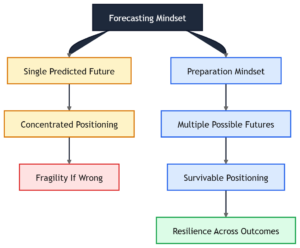
Howard Marks draws the distinction precisely: the goal is not to predict one future. The goal is to prepare for multiple futures.
Not the same thing.
Building a Positioning Approach Around Uncertainty
Preparing for multiple futures requires a different risk framing than conventional investing. Under prediction logic, risk is the probability your forecast is wrong. Under preparation logic, risk is the set of outcomes you cannot survive.
This reframing changes what good portfolio construction looks like. Under prediction logic, the optimal portfolio is the one maximally positioned for the most likely outcome. Under preparation logic, the optimal portfolio is one that produces an acceptable result across a range of outcomes, including the ones you didn’t forecast.
Diversification is often explained as risk reduction. The deeper explanation is that diversification exists because certainty about future outcomes is unavailable. If any investor had certainty, diversification would be pure cost.
The fact that every serious investor diversifies is evidence that, at some level, everyone already knows prediction is unreliable.
The behaviour just hasn’t caught up with the reasoning.
Preparing instead of predicting also changes how you evaluate managers. A manager with an exceptional 18-month record in a specific macro environment is not evidence of forecasting ability. It may be evidence of a concentrated bet that happened to pay off.
The question worth asking is: what happens to this portfolio in the scenarios that weren’t the base case?
How Cycles Form — and Why They Don’t Stop
The standard objection to cycle-based investing is that with more information, more computing power, and better communication, cycles should dampen. This hasn’t happened. Understanding why requires looking at where cycles actually originate.
Cycles are not created by information gaps. They are created by the way humans interpret and act on information when their financial wellbeing is at stake.
When growth is good, risk tolerance rises. Rising risk tolerance expands credit. Expanded credit funds more activity, which makes growth look better, which raises risk tolerance further.
The system feeds itself.
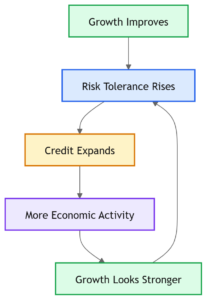
This is not a coordination failure. It is not a problem of irrational actors. It is the logical result of individually rational behavior aggregating into collectively destabilizing outcomes.
No single participant’s decision is wrong in isolation. The pattern that emerges from millions of individually defensible decisions is a cycle.
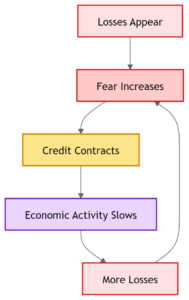
The correction phase follows the same internal logic. Losses create fear. Fear reduces credit availability. Reduced credit constrains activity. Constrained activity produces more losses, which creates more fear.
The mechanism runs in reverse.
Technology changes the speed at which these cycles operate. It does not change the human reflexes that drive them.
Markets in 2024 can overshoot and correct faster than markets in 1924 did. The overshooting and correcting still happens.
Information abundance does not eliminate cycles because cycles are not caused by information shortage.
Why Active Management Collapsed
Active management did not fail because passive investing is structurally superior. It failed, in large part, because most active managers were not genuinely superior, and the fee structure made mediocre active performance consistently worse than an index.
But the full explanation requires one more layer. The institutional conditions surrounding active managers systematically discouraged genuine skill deployment.
Benchmarking against an index created career risk for deviation. A manager who moved significantly underweight equities in early 2007, when valuations were extended, would have underperformed the benchmark for several quarters before being right.
In an institutional setting, those several quarters may be enough to lose the mandate.
Quarterly reporting requirements reinforced this. Long-term positioning became structurally difficult to hold when performance was evaluated on short intervals.
The result was managers who nominally had conviction but practically clustered around benchmark weightings to manage career exposure.
This is not cowardice. It is rational response to the incentive system they operated inside.
The incentive system was incompatible with the behavior required for genuine active outperformance.
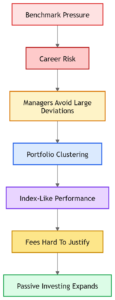
Passive investing expanded because those structural conditions made the average active manager reliably worse than an index after fees.
In extended bull markets, particularly those supported by central bank liquidity that compressed return dispersion across assets, the structural advantage of passive compounded.
The implication is not that passive is permanently superior. It is that passive benefited from conditions that may not hold indefinitely.
Return dispersion is not a constant. In volatile, high-dispersion environments, genuine active skill becomes more valuable.
Where AI Enters the Equation
AI performs best in environments where historical data is dense, rules stay stable, feedback loops are fast, and success can be measured cleanly.
Financial markets satisfy one of those four conditions adequately. They have plenty of historical data.
They routinely violate the other three.
- Rules change when regulators change them
- Crisis forces policy response
- Participants adapt once a pattern becomes visible
Feedback loops in markets are not fast. The consequences of a positioning decision made in January may not be clear until the following year’s earnings cycle.
There is a more specific problem. AI extrapolates from historical patterns. Financial markets are reflexive.
Participant behavior changes the market, and changed markets change participant behavior.
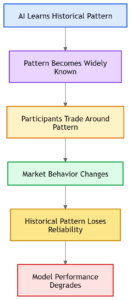
The pattern AI identifies becomes the pattern participants know to trade around, which means the pattern changes.
The performance degrades not because the AI is wrong about the past, but because the past is no longer the relevant reference.
The more defensible claim is that AI will displace a specific type of investor first: the one whose edge comes from processing publicly available information faster and more completely than competitors.
That edge has been narrowing for years and AI compresses it further.
What AI does not displace is the investor whose edge comes from genuinely different interpretation of available information, willingness to hold positions through periods of discomfort, and ability to identify possibilities with no historical precedent.
Average analytical skill gets automated. Exceptional judgment becomes more valuable.
Why Emotional Control Is Structural, Not Motivational
Crashes create the most compelling opportunities in investing. Most investors cannot act on them.
Understanding the gap between visible opportunity and accessible opportunity is more useful than urging emotional resilience.
When prices fall sharply, several forces converge to make rational action nearly impossible.
- Investors using leverage are forced to liquidate
- Institutional managers facing redemptions must raise cash
- Career incentives reward visible caution
- Recent losses distort probability assessment
Each of these is a structural constraint, not a failure of courage.
The implication for how to build a portfolio before a crisis: position size matters.
The emotional stability required during the crash is created by the structural decisions made before it.
You cannot produce the capacity for rational action in a crash by trying harder in the moment.
What Actually Separates Superior Investors
The distinctive investors are not better at prediction. They are better at three things that don’t require prediction to work.
The first is second-level thinking.
First-level thinking asks: is this investment good or bad?
Second-level thinking asks: what does everyone else think, and is there a gap between consensus opinion and probable reality?
An investment that looks excellent can be a bad trade if the excellent view is already priced in.
An investment that looks distressed can be the best trade available if the distress is already priced in more severely than reality warrants.
The relevant question is never just the quality of the asset. It is the relationship between quality and price, and between price and what the consensus believes.
The second is accurate self-knowledge about capacity for discomfort.
Many investors hold a theoretical commitment to buying when others are selling. Almost none of them have accurately mapped how much drawdown they can sustain before their stated conviction changes.
The investors who act effectively during downturns are not people with more courage. They are people who, before the downturn, genuinely understood what they could tolerate and built their positioning accordingly.
The third is comfort with a specific form of uncertainty.
There is a class of investment opportunity that cannot be explained by reference to a historical pattern.
High-yield debt in the late 1980s.
Distressed assets after the 2008 crisis.
These opportunities had no established precedent, no institutional approval, and no peer group providing cover.
The capacity to act under genuine uncertainty, and to be right more often than wrong when doing so, is not a skill AI can replicate from historical data.
What Happens to Investing From Here
Three things are probably true simultaneously.
- Average analytical skill will be further automated
- Return dispersion will rise as the macro environment becomes more volatile
- The structural advantages that made passive investing dominant in the post-2008 period will become less reliable
In that environment, the investors who hold structural edges are the ones who have built the capacity to act when others cannot, who think at a level of specificity that price discovery has not yet reached, and who can sit with genuine uncertainty long enough for the thesis to resolve.
The future of investing is probably not about who has the best information.
It is about who can do something useful with information under conditions that most participants find cognitively and emotionally intolerable.
That edge is not built by forecasting better.
It is built by understanding cycles well enough to know where you are in one, sizing positions to survive the scenarios you didn’t forecast, and accepting that the best opportunities will look, in the moment they appear, like the worst ones.
References
Primary Source
- Howard Marks: AI, Debt vs Equity & The Next 40 Years Of Investing | Nikhil Kamath | People by WTF
https://www.youtube.com/watch?v=O368Uk_b5f8
Optional Supporting Reading
- Howard Marks Memo Archive (Oaktree Capital)
https://www.oaktreecapital.com/insights/memos - The Most Important Thing by Howard Marks
https://www.oaktreecapital.com/insights/books/the-most-important-thing - Howard Marks Memo: The Illusion of Knowledge
https://www.oaktreecapital.com/insights/memos/the-illusion-of-knowledge - Howard Marks Memo: Is It a Bubble?
https://www.oaktreecapital.com/insights/memos/is-it-a-bubble