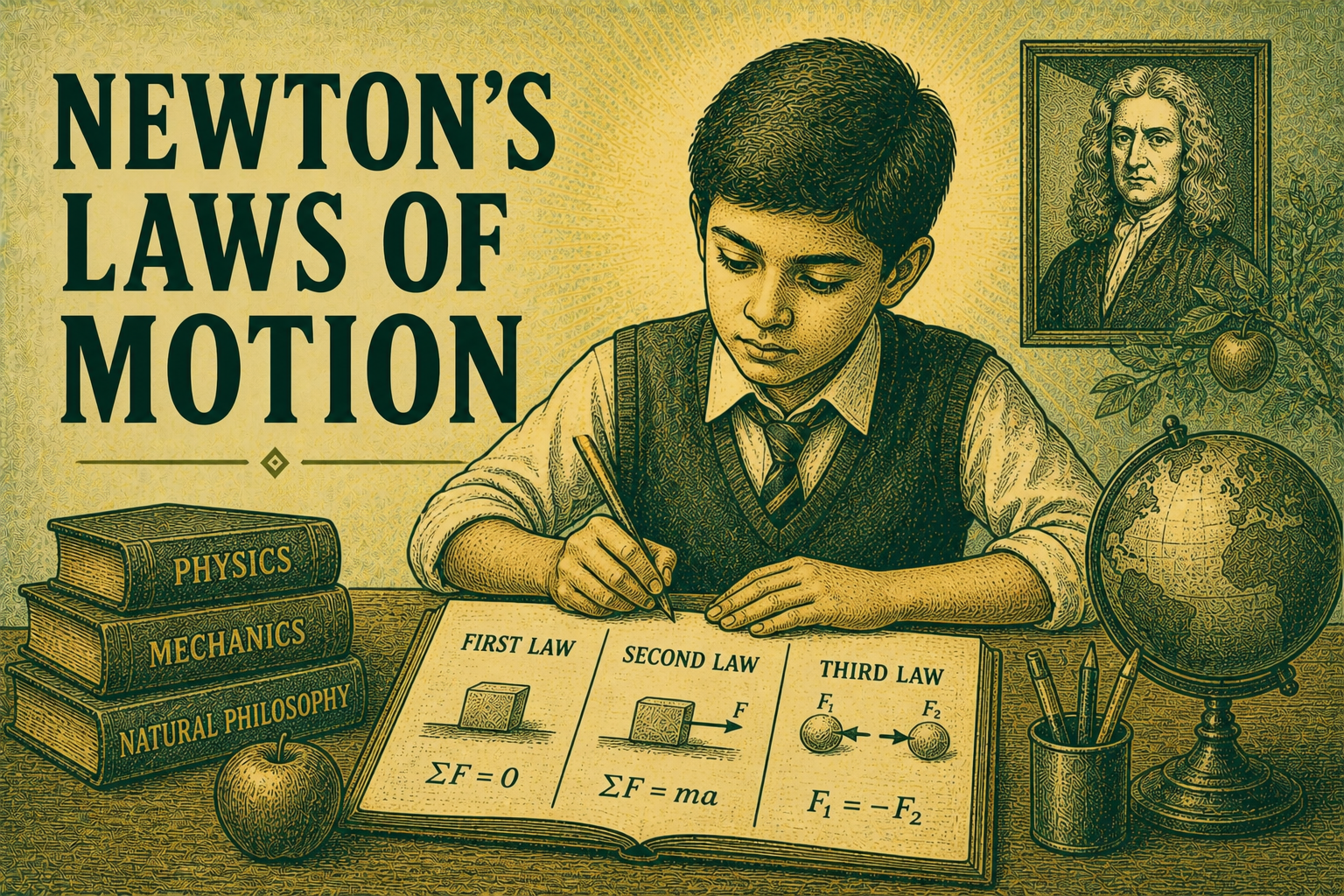
Newton’s Laws Made Simple: From Inertia to F = ma for Class 9
Force equals mass times acceleration. But mass represents resistance to change. Learn what inertia really means before applying F = ma.
By Navya Sharma | Class 9 Science | CBSE
Have You Ever Wondered Why You Jerk Forward When a Bus Stops Suddenly?
In this article, you will learn:
- What inertia actually is — and why it is not just a word to memorise but a physical reality you feel every day
- What Newton’s three laws actually say — in plain language, before the formulas appear
- What F = ma means in terms of real objects, not just symbols
- What CBSE Class 9 expects you to write — and the specific errors most students make in numericals
By the end, you will understand that Newton’s laws are not three separate rules. There are three observations about the same truth — that objects resist change, and force is what overcomes that resistance.
Section 1: The Story
Ramesh bhaiya drives a tempo in Patna.
Every morning, he carries vegetables from the wholesale market to the local bazaar. His tempo is loaded heavy — sacks of onions, potatoes, and tomatoes piled up behind him.
One morning, a cycle cuts in front of him suddenly. Ramesh bhaiya slams the brakes.
The tempo stops.
The sacks do not.
Three sacks of onions slide forward and crash into the back of his seat. He feels the impact through the seat. The tempo is standing still — but the onions kept moving, as if the brakes meant nothing to them.
Ramesh bhaiya mutters something under his breath and restacks the sacks.
The onions were not being disobedient. They were obeying a law. A law so fundamental that it took the most famous physicist in history to put it into words. That law has a name.
Section 2: What the Onions Were Actually Doing
Think about what happened in Ramesh bhaiya’s tempo.
Before the brakes — everything was moving. The tempo, Ramesh bhaiya, the sacks, the onions. All of them, together, at the same speed, in the same direction.
The brakes applied a force to the tempo’s wheels. The wheels stopped. The tempo stopped. Ramesh bhaiya stopped — because the seat and belt pushed against him.
But nothing pushed against the onions. No force reached them in time. So they continued doing exactly what they had been doing one second earlier — moving forward.
This is the key idea. Objects do not stop on their own. Objects do not start on their own. Objects do not change direction on their own. Every change in motion — every single one — requires a force to cause it.
Without a force, an object keeps doing whatever it was already doing. If it was still — it stays still. If it was moving — it keeps moving. Same speed. Same direction. Until something pushes or pulls it.
The onions had no force acting on them when the brakes hit. So they kept moving. Straight into Ramesh bhaiya’s seat.
This is not a special case. This is how every object in the universe behaves, always.
Section 3: The Name
Newton gave this tendency a name.
He called it inertia — from the Latin word meaning laziness or inactivity. Not because objects are lazy, but because they resist change. They will not start, stop, or turn unless something forces them to.
Inertia is the tendency of an object to resist any change in its state of motion. An object at rest resists being moved. An object in motion resists being stopped or redirected. The greater the mass of an object, the greater its inertia.
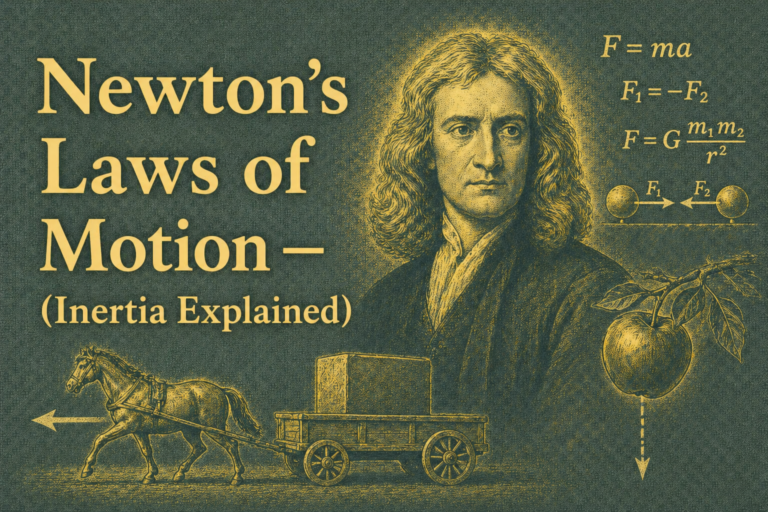
Newton described this in his First Law of Motion:
An object remains in its state of rest or uniform motion in a straight line unless acted upon by an external unbalanced force.
The onions demonstrated Newton’s First Law. They remained in motion because no external force acted on them in time. The tempo’s brakes were an external force — but they acted on the wheels, not on the onions.
Ramesh bhaiya’s seat received that force. The onions did not. So the onions obeyed Newton — perfectly.
Section 4: How Newton’s Three Laws Work — Step by Step
Step 1 — The First Law (Inertia): Every object resists change. At rest — it stays at rest. In motion — it stays in motion, same speed, same direction. Only an unbalanced external force changes this. The bus passenger jerks forward when the bus brakes because the passenger’s body was moving and nothing stopped it immediately when the bus stopped. The seat belt is the external force. Without it — the passenger continues forward. (That is why seat belts exist. They apply the stopping force gradually, across the chest, instead of suddenly, against the windscreen.)
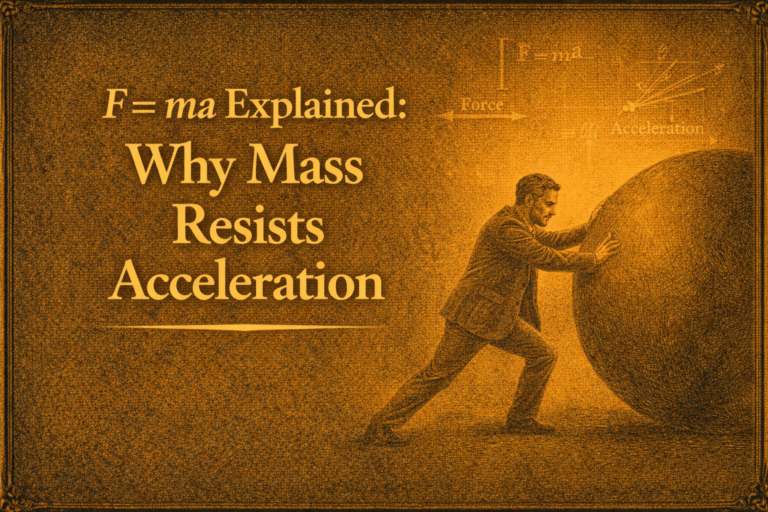
Step 2 — The Second Law (F = ma): When a force acts on an object, it causes acceleration — a change in speed or direction. The amount of acceleration depends on two things: how large the force is, and how much mass the object has. A large force on a small mass produces a large acceleration. The same force on a large mass produces less acceleration. Newton wrote this as:
F = m × a
Where:
- F = Force (measured in Newtons, N)
- m = Mass (measured in kilograms, kg)
- a = Acceleration (measured in metres per second squared, m/s²)
This means: one Newton of force is exactly the amount of force needed to accelerate one kilogram of mass by one metre per second every second.
Step 3 — The Second Law in Ramesh bhaiya’s tempo: Ramesh bhaiya’s onion sacks weighed 30 kg combined. When they slid forward and hit his seat, they were moving at roughly 10 m/s before braking. The force they delivered to his seat was real, measurable, and directly connected to their mass and acceleration. Heavier sacks — more force on impact. Same sacks, faster speed — more force on impact. F = ma is not an abstract formula. It is exactly what Ramesh bhaiya felt through his seat.
Step 4 — The Third Law (Action-Reaction): Every force has an equal and opposite reaction force. When the onion sacks pushed forward into Ramesh bhaiya’s seat — the seat pushed back on the sacks with exactly the same force in the opposite direction. When you push against a wall — the wall pushes back against your hand with exactly the same force. When a rocket expels gas downward — the gas pushes the rocket upward with equal force. Action and reaction forces are always equal in size, opposite in direction, and act on different objects.
Step 5 — Why the Third Law does not cancel out: Many students ask: if action and reaction are equal and opposite, why does anything move? The answer is that action and reaction act on different objects. When the sacks push the seat — the seat pushes back on the sacks. These forces act on different objects. They do not cancel. Cancellation only happens when two forces act on the same object.
Section 5: F = ma — Don’t Panic
The formula looks like three letters. It is three letters. But you already know what each one means — because Ramesh bhaiya’s tempo showed you.
F = m × a
The formula is just this: how hard you push = how heavy the thing is × how fast it speeds up.
Worked Example 1 — Basic: A cricket ball of mass 0.15 kg is bowled and accelerates at 200 m/s². What force did the bowler apply?
F = m × a
F = 0.15 × 200
F = 30 N
The bowler applied 30 Newtons of force. (For reference — a Newton is roughly the weight of a medium-sized apple pressing down on your palm. 30 N is a real, physical push.)
Worked Example 2 — Finding acceleration: Ramesh bhaiya pushes his unloaded tempo (mass 500 kg) with a force of 1000 N. What acceleration does it experience?
Rearrange F = ma to find a:
a = F ÷ m
a = 1000 ÷ 500
a = 2 m/s²
The tempo accelerates at 2 metres per second every second. (Now load it with 200 kg of vegetables — mass becomes 700 kg — same force gives only 1.43 m/s². More mass, less acceleration. Ramesh bhaiya knows this. He just calls it: ” The tempo feels heavy today.)
Worked Example 3 — Finding mass: A force of 50 N produces an acceleration of 5 m/s² in an object. What is the mass of the object?
m = F ÷ a
m = 50 ÷ 5
m = 10 kg
The only three versions of the formula you need: F = ma, a = F÷m, m = F÷a. Every numerical in this chapter uses one of these three. Identify what is given, identify what is missing, pick the right version. That is the entire method.
Section 6: Real-World Examples
Example 1 — The Seat Belt A seat belt exists because of Newton’s First Law. In a collision, the car stops suddenly. The passenger’s body — following inertia — continues forward at the car’s original speed. The seat belt is the external force that stops the passenger’s forward motion gradually. Without it, the passenger’s inertia carries them into the windscreen at full speed. The belt does not violate Newton’s First Law — it applies it correctly, by providing the external force that changes the passenger’s state of motion.
Example 2 — The Rocket A rocket works entirely on Newton’s Third Law. Hot gases are expelled downward at high speed. By the Third Law, the gases push the rocket upward with equal and opposite force. There is no ground to push against. No air to push against. The rocket works in the vacuum of space because the Third Law requires no medium — only two objects exerting equal and opposite forces on each other. (This is also why a balloon flies across the room when you release it without tying the end — air rushes out one way, balloon goes the other.)
Example 3 — Remember Ramesh bhaiya’s Onions When he restacks the sacks and drives more carefully, he places them against the front wall of the cargo area — so that if the brakes are applied hard, the wall provides the external force to stop the sacks instead of his seat. He has never read Newton. But every careful driver in India applies Newton’s First Law every time they think about where to secure a load.
Section 7: Common Mistakes
Many students think: A moving object naturally slows down on its own. But actually: Objects slow down because of friction and air resistance — these are forces. Remove all forces, and an object in motion continues forever at the same speed. Newton’s First Law describes a world without friction. On Earth, friction is always present — but it is a force, not the natural tendency of objects. The natural tendency is to keep moving unchanged.
Many students think: F = ma means force causes speed. But actually: Force causes acceleration — a change in speed or direction. A constant force produces constant acceleration, not constant speed. If you want constant speed, you need zero net force. A car driving at constant speed on a highway has its engine force exactly balanced by friction and air resistance — the net force is zero, so acceleration is zero, so speed stays constant.
Many students think: Action and reaction forces cancel each other out. But actually: They act on different objects. The sacks push the seat — the seat pushes the sacks back. Two different objects. Forces on different objects never cancel. Cancellation only applies to forces on the same object. This is the most common conceptual error in this chapter — and the most common source of lost marks in CBSE exams.
Section 8: The ELIS Ladder
Level 1 — Class 6 Version (already done above)
Objects resist change — this is inertia. Force is needed to start, stop, or redirect any object. More mass means more resistance to change. Every push has an equal push back in the opposite direction. These three ideas are Newton’s three laws.
Level 2 — Class 9 CBSE Version
Newton’s Three Laws — exact CBSE wording:
First Law: An object remains in its state of rest or of uniform motion in a straight line unless acted upon by an external unbalanced force.
Second Law: The rate of change of momentum of an object is proportional to the applied force and takes place in the direction of the force. (At Class 9 level, this simplifies to F = ma when mass is constant.)
Third Law: For every action, there is an equal and opposite reaction.
Momentum — CBSE introduces this here: Momentum (p) = mass × velocity
p = m × v
Units: kg·m/s
Newton’s Second Law in its fuller form:
F = Δp ÷ Δt
Force equals the rate of change of momentum. When mass is constant, this becomes F = ma. CBSE Class 9 tests both forms.
Conservation of Momentum: When no external force acts on a system of objects, total momentum before an event equals total momentum after. A gun recoils when fired — the bullet gains forward momentum, and the gun gains equal backward momentum. Total momentum of the system remains zero. This is Newton’s Third Law expressed in terms of momentum.
Standard CBSE numerical pattern:
- Given: mass, acceleration → Find: force (F = ma)
- Given: force, mass → Find: acceleration (a = F/m)
- Given: force, acceleration → Find: mass (m = F/a)
- Given: mass, velocity → Find: momentum (p = mv)
- Given: momentum change, time → Find: force (F = Δp/Δt)
Level 3 — Advanced / Class 11-12
Newton’s laws are extraordinarily accurate for everyday speeds and masses — but they are approximations of a deeper reality.
At very high speeds — approaching the speed of light — Newton’s Second Law breaks down. Mass is not constant; it increases with velocity. Einstein’s Special Relativity replaces F = ma with equations that account for relativistic mass. A particle accelerated in the Large Hadron Collider at CERN cannot be described by F = ma alone.
At very small scales — electrons, photons, quarks — Newton’s laws fail entirely. Quantum mechanics replaces classical mechanics. Particles do not have defined positions and momenta simultaneously (Heisenberg’s Uncertainty Principle). The concept of a force acting on a particle to produce a predictable trajectory dissolves.
Newton’s First Law also requires the concept of an inertial reference frame — a frame of reference that is not itself accelerating. The law only holds in inertial frames. Inside Ramesh bhaiya’s accelerating tempo, the onions appear to slide backwards without any visible force — a pseudo-force appears. This is why objects in a turning car seem to be pushed outward — there is no actual outward force. The car is turning inward. The passenger’s inertia resists that turn. The apparent outward force is an artefact of being in a non-inertial frame.
Einstein eventually replaced Newton’s framework entirely with General Relativity — where gravity is not a force at all but a curvature of spacetime. Newton’s laws emerge from General Relativity as a special case valid at low speeds and weak gravitational fields.
What this article does not cover: Rotational dynamics and torque, angular momentum, gravitational law derivation, fluid mechanics, or relativistic and quantum mechanical treatments of motion.
Section 9: Simplification Loop
In 5 sentences: Newton’s First Law says objects resist change — they stay still or keep moving in a straight line at constant speed unless a force acts on them, and this resistance is called inertia. Newton’s Second Law says that when a force acts, it produces acceleration proportional to the force and inversely proportional to the mass — expressed as F = ma. Newton’s Third Law says every force is paired with an equal and opposite force acting on a different object — action and reaction are always equal, always opposite, always on different objects. Together, the three laws describe how every object with mass behaves when forces are absent, when forces act, and when two objects interact. These laws governed every moving object on Earth from the beginning of time — Newton did not invent them, he discovered and described them precisely enough that we could calculate with them.
In 3 sentences: Objects resist change in motion — this is inertia, and it is Newton’s First Law. Force produces acceleration in proportion to mass — F = ma — and this is Newton’s Second Law. Every force has an equal and opposite reaction force acting on a different object — Newton’s Third Law — which is why rockets fly, guns recoil, and onion sacks hit tempo seats.
In 1 sentence: Objects resist change, force overcomes that resistance in proportion to mass, and every force produces an equal and opposite force on a different object — these three observations are Newton’s Laws of Motion.
Practice Questions
- State Newton’s First Law of Motion. Give two examples from daily life that demonstrate inertia.
- A force of 200 N acts on an object of mass 40 kg. Calculate the acceleration produced. If the same force acts on an object of mass 80 kg, what is the new acceleration? What does this tell you about the relationship between mass and acceleration?
- Explain why a passenger in a bus jerks forward when the bus brakes suddenly. Which law of motion explains this? What device in a car is designed specifically to manage this effect?
- A gun of mass 3 kg fires a bullet of mass 0.03 kg. The bullet leaves the barrel at 300 m/s. Calculate the recoil velocity of the gun. Which law of motion explains this?
- State Newton’s Third Law. Why do action and reaction forces not cancel each other out? Explain with one example.
Frequently Asked Questions
Q: If every action has an equal reaction, why does a heavy truck moving at the same speed as a bicycle cause more damage in a collision? Because damage depends on momentum and force over time — not just force alone. The truck has far greater mass, therefore far greater momentum (p = mv). When it collides, the force required to stop it — and the force it exerts — is much larger. Newton’s Third Law says the forces are equal and opposite between the two vehicles. But the bicycle has far less mass, so the same force produces far greater acceleration — and far greater damage — to the bicycle than to the truck.
Q: Does Newton’s First Law mean objects in space travel forever? Yes — in the absence of any force, an object in space continues at constant velocity indefinitely. The Voyager 1 spacecraft, launched in 1977, is still travelling through interstellar space with no engine power — it has been coasting on its initial velocity for over four decades. Gravitational forces from distant stars are now so weak that they produce negligible acceleration. Newton’s First Law applies directly.
Q: What is the difference between mass and weight? Mass is the amount of matter in an object — it does not change regardless of location. Weight is the gravitational force acting on that mass — it changes depending on the gravitational field strength. On the Moon, your mass is identical to your mass on Earth. Your weight on the Moon is approximately one-sixth your weight on Earth because the Moon’s gravitational field is weaker. F = ma connects them: Weight = mass × gravitational acceleration (W = mg).
Q: Is friction a violation of Newton’s First Law? No. Newton’s First Law says objects maintain their motion unless acted upon by an external force. Friction is an external force. It acts on moving objects and decelerates them. The law is not violated — it is demonstrated. The law describes what happens without forces. Friction is a force. The law predicts that friction will cause deceleration — and it does, exactly as predicted.
Q: Can Newton’s Third Law explain how we walk? Exactly. When you walk, your foot pushes backwards against the ground. By Newton’s Third Law, the ground pushes forward on your foot with equal force. That forward force from the ground is what propels you. Without friction between foot and ground — as on ice — your foot cannot push effectively backwards, the ground cannot push you forward, and you cannot walk. Walking is entirely a Third Law phenomenon.
Related Articles
- Gravitation — Universal Law of Gravity — How Newton extended the same laws of motion to explain why planets orbit the sun and why objects fall to Earth
- Work, Energy and Power — How force acting over distance produces work, and how energy transfers connect directly to Newton’s Second Law
- Motion — Distance, Velocity and Acceleration — The kinematics foundation that Newton’s laws build upon — uniform motion, speed-time graphs, and equations of motion
This article follows the CBSE Class 9 Science syllabus (Chapter 9 — Force and Laws of Motion). All physics content is consistent with NCERT Class 9 Science. Numerical examples use standard SI units throughout. The Voyager 1 reference is accurate as of the knowledge available at the time of writing.