India Sector Analysis: Lithium-Ion Battery Industry
Table of Contents
- What This Article Actually Answers
- The Belief That Is Costing Investors Money
- The Thesis
- How the Sector Works: Value Chain and Economic Engine
- Where the Model Breaks: Unit Economics Under Pressure
- Four-Lens Analysis
- Who Controls a Constraint: Company Positioning
- Risks With Signals, Not Just Names
- What Analysts Consistently Miss
- What You Should Do Next
- Honest Limits of This Analysis
- Frequently Asked Questions
- Synthesis: What These Changes
What This Article Actually Answers
India’s lithium-ion battery sector is growing. Battery demand tripled in import volume over roughly six years (IEA, 2024).
The government has committed significant capital through the PLI-ACC scheme, targeting 50 GWh of domestic manufacturing capacity (Ministry of Heavy Industries). Multiple large Indian conglomerates have announced gigafactory investments.
None of that tells you where investor returns actually come from.
This article answers one specific question:
In India’s battery sector, which positions in the value chain generate durable returns, and which generate revenue without margin?
The answer is not intuitive, and most coverage gets it wrong in a direction that affects how capital is allocated.
The sector is real. The opportunity is real. The returns will be uneven in ways that a capacity-focused reading of the sector completely misses.
If you arrived here trying to understand whether India’s battery sector is investable, the answer is: it depends entirely on which part of the chain you are evaluating.
The Belief That Is Costing Investors Money
The investment narrative around India’s battery sector treats it as a manufacturing story.
The logic runs: India has strong EV demand, the government is backing domestic production, large companies are investing, therefore the sector will deliver returns proportional to the capacity being built.
That belief survives because it is comfortable and partially true. There is a real demand curve. There is genuine policy commitment. The scale numbers are large.
Abandoning the narrative means accepting something harder:
India is entering a sector where the critical competitive positions were established by China over 20 years, and building from behind is structurally expensive.
The sharper lens:
Battery manufacturing without chemistry control is the final assembly. Final assembly in a commodity component industry does not produce the margins or competitive moats that current valuations on Indian battery companies imply.
China does not just manufacture batteries at scale. It controls the processing capacity for lithium, cobalt, and graphite — the three materials that determine input costs for the entire global industry.
China holds approximately 97% of global LFP cathode production, the dominant chemistry for EVs and stationary storage (IEA, 2024). Indian assemblers and manufacturers operate inside a cost ceiling they did not set and cannot unilaterally change.
This is not a geopolitical point. It is an earnings point. And it has direct consequences for which Indian companies can generate durable returns and which will grow revenue while fighting for margin.
The Thesis
India’s lithium-ion battery sector will expand significantly in capacity over the next three years but deliver uneven returns across the value chain.
Value capture concentrates upstream in chemistry and raw materials — cathode, anode, and electrolyte production — where India remains weak.
Downstream manufacturers will see revenue growth as EV adoption accelerates. Margin growth is a separate, harder question that capacity announcements do not answer.
This thesis breaks under one specific condition: if domestic players achieve cost-competitive scale in cathode, anode, and electrolyte chemistry before global battery overcapacity compresses margins industry-wide.
The probability of that outcome within the next three years is low, given the current gap between Indian chemistry capability and Chinese cost benchmarks.
The cost of misjudging that timeline is permanent capital impairment in capital-heavy manufacturing plants that were built ahead of chemistry readiness.
What would prove this wrong: if a major Indian cathode or anode producer demonstrates per-unit costs within 15% of Chinese equivalents at meaningful scale within 24 months, the timeline risk recedes, and the construction thesis becomes more defensible.
How the Sector Works: Value Chain and Economic Engine
The value chain
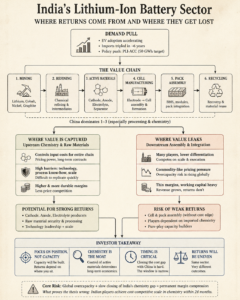
A lithium-ion battery moves through six stages from raw material to end use: mining, refining, active material production, cell manufacturing, pack assembly, and recycling.
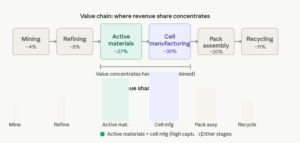
Where margin concentrates: cell manufacturing holds roughly 30% of total chain revenue. Active materials — cathode, anode, and electrolyte — hold roughly 27% combined (IEA, 2024).
Everything below that, meaning pack assembly and system integration, competes primarily on logistics, volume, and customer relationships.
Chemistry does not determine outcomes at the bottom of the chain. Scale and execution do — and those are far easier to replicate.
One distinction that most sector coverage collapses: cell manufacturing and active material production are not equally positioned in early phases of a market.
Cell manufacturing captures value only at scale and with sustained high utilisation.
Active material production captures value through chemistry control regardless of scale in the early phases of building a position.
A company building LFP cathode capability with backward integration toward lithium refining is in a structurally different risk-return position than a company building a gigafactory to assemble cells from imported materials.
Both are in India’s battery sector. Only one controls a constraint.

The economic engine
Three variables determine earnings outcomes in this sector. Understanding which one is moving and in which direction tells you more about near-term returns than any capacity announcement.
Chemistry adoption rates determine input demand. LFP now accounts for roughly half of global EV batteries, up from approximately 43% in 2020 (IEA, 2024).
LFP runs 20-30% cheaper than NMC, the competing chemistry, and dominates stationary energy storage globally. India’s industrial strategy is aligned toward LFP.
China holds a near-monopoly position in LFP cathode production. If that chemistry continues gaining share, the companies building LFP positions have demand visibility.
If battery chemistry shifts again — toward solid-state or sodium-ion — existing investments face obsolescence risk before capital is recovered.
Capacity utilisation in cell manufacturing is the most operationally critical variable. The fixed-cost base in a gigafactory is large and largely unavoidable once built.
Below approximately 70% utilization, most cell manufacturing plants operate at economic fragility regardless of revenue growth.
Early-stage operations in India, running at lower utilisation rates while domestic EV demand builds, carry this exposure directly. Revenue lines will grow. Margins will not follow automatically.
Raw material sourcing security sets the earnings floor for the entire chain. For companies without backward integration into lithium refining or domestic graphite processing, the floor is set by China’s export decisions, not their own procurement strategy.
In 2023, China imposed export controls on graphite — a primary anode input. India’s domestic processing base was insufficient to absorb even a partial restriction.
India’s global position
India is currently a large and growing consumer of battery cells, almost entirely served by imports.
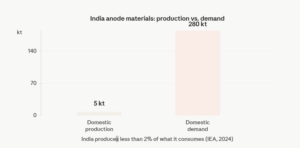
It is an emerging producer of battery chemicals at an early stage, a negligible producer of anode materials (roughly 5 kilotonnes against domestic demand approaching 280 kilotonnes per IEA data), and a nascent cell manufacturer with most announced gigafactory capacity still pre-operational as of 2025-26 (Ministry of Heavy Industries).
The policy aspiration — 50 GWh of domestic cell manufacturing under PLI-ACC — describes where India wants to be. The operational reality describes where it is.
The gap between those two numbers is where the investment risk lives.
The policy spine
The PLI-ACC scheme is the primary government instrument. It incentivises capital deployment into cell manufacturing through production-linked financial support.
What it incentivises: building gigafactories.
What it does not address: chemistry competitiveness, raw material sourcing security, or operating margin protection once the incentive period adjusts.
The gap between PLI intent and ground reality: the scheme de-risks capex for companies. It does not de-risk the investment for investors who buy equity at multiples that already price execution success.
Where the Model Breaks: Unit Economics Under Pressure
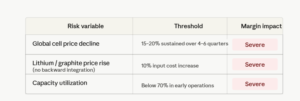
This is a cost structure where small pricing changes produce disproportionate earnings impact. Not a stable margin sector. A leveraged one.
The revenue model across the battery chain is straightforward: companies earn on the spread between input cost and output price.
In chemistry-controlled segments like cathode and electrolyte production, that spread includes a technology premium — the cost of replicating the chemistry is high, so competitors cannot simply undercut on volume.
In assembly-oriented segments, the spread is determined by procurement efficiency and utilisation rates, with no technology premium protecting it.
The cost structure in cell manufacturing is heavily fixed. Equipment, facility, and financing costs do not vary with volume below a certain threshold.
Variable costs — primarily cell materials — are sourced at prices set in global markets. China dominates. This means the downside in a demand shortfall or price compression environment is steep and fast.
Sensitivity analysis worth holding:
A 10-15% fall in global cell prices — entirely plausible as Chinese, Southeast Asian, and now European battery capacity expands simultaneously — compresses margins immediately for fixed-cost-heavy Indian manufacturers.
There is no buffer. The PLI offsets part of the capex. It does not replace the margin.
A 10% rise in lithium carbonate or graphite prices hits companies without backward integration before any procurement adjustment is possible.
Given that India imports the majority of both, this is not a tail risk. It is the base condition.
Sub-70% capacity utilization, which is realistic in the early years of operation for most new entrants, makes cell plants economically fragile regardless of what the revenue line shows.
A sustained 15-20% decline in global battery cell prices over four to six consecutive quarters is the signal that overcapacity has crossed from cyclical to structural.
At that point, the investment thesis for cell manufacturers changes category — from growth with execution risk to value trap with chemistry dependency.
Investors using capacity announcements to assess this sector will be the last to register that the category has changed.
Capital efficiency in this sector has not been tested on an Indian scale because the relevant plants have not yet reached full operation.
Return on capital employed and return on invested capital over a five-year trend — the standard quality checks — are not yet calculable for most Indian players. This is a genuine limit, addressed directly in the honest limits section below.
The central question is not whether the sector is growing. Growth is not in dispute. The question is whether that growth is creating value or consuming it. The answer differs by position in the chain.
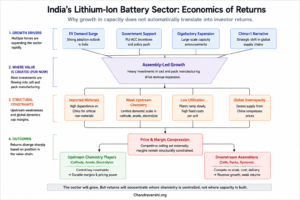
Four-Lens Analysis
Policy lens
The PLI-ACC scheme targets 50 GWh of domestic cell manufacturing through production-linked incentives.
The non-obvious finding: the scheme’s incentive structure rewards capacity creation, not chemistry quality or cost competitiveness against Chinese benchmarks.
A plant that builds and operates at whatever efficiency level still captures the incentive.
This creates a risk that Indian cell manufacturing capacity is built to PLI specifications without building chemistry capability that survives post-incentive economics.
Weak enforcement of domestic content requirements — which are part of the PLI structure — could further reduce the competitive development pressure on Indian manufacturers.
A company sourcing imported cathode materials for a PLI-incentivised cell plant is not building an integrated battery supply chain. It is assembled with a government subsidy. The distinction matters for how post-incentive margins will look.
Supply chain lens
India is import-dependent at every critical upstream node. Lithium: no meaningful domestic reserves, dependent on imports from Australia and South America, processed largely in China.
Cobalt: imported, with China controlling most processing capacity from Congolese mining operations.
Graphite: imported, subject to China’s 2023 export controls. This is not a supply chain with one point of vulnerability. It has three, and all three run through the same processing geography.
The non-obvious finding: a company doing final assembly with imported cathode and anode materials is structurally different from a company that has built domestic chemistry processing capacity.
Both describe themselves as being in India’s battery sector. Only one is building supply chain resilience. Investors evaluating Indian battery companies without this distinction are comparing non-equivalent businesses.
Global trends lens
Global battery manufacturing capacity is expanding at a rate that will significantly exceed near-term demand.
Chinese manufacturers are adding capacity aggressively, South Korean producers are expanding in Southeast Asia and Europe, and Western governments are subsidising domestic buildouts.
The aggregate effect: global cell prices are likely to face downward pressure for multiple years.
For India, this creates a specific timing problem. Indian gigafactories are being built while global prices are high enough to support the investment case.
By the time they reach full operation, the global price environment may have shifted materially.
Companies entering the market at that point, without chemistry differentiation, will face a structurally harder competitive environment than the one that justified the original investment.
The non-obvious finding: India’s China+1 export opportunity — which is real, based on genuine Western demand for non-Chinese battery supply — requires cost-competitive chemistry, not just available capacity.
A gigafactory offering cells at prices above Chinese benchmarks does not capture the China+1 market. It sits empty while analysts point to the order of magnitude of the opportunity.
Financial and valuation lens
Current valuations on the Indian battery sector embed significant execution assumptions.
Companies with announced gigafactory plans are trading at multiples that price successful ramp to full utilisation, cost competitiveness with imported alternatives, and margin stability in a global environment of declining cell prices.
None of those assumptions has yet been verified by operating data.
The non-obvious finding: PLI incentives are partially captured in current multiples.
Investors buying Indian battery companies today are paying for the PLI benefit at least partially upfront, before it is earned through production. This reduces the margin of safety on the downside without improving the upside.
Upstream chemistry players — cathode, anode material, electrolyte producers — are trading at narrower multiples despite holding structurally better positions.
If the value chain analysis is correct, the market has the relative valuation approximately backwards.
Who Controls a Constraint: Company Positioning
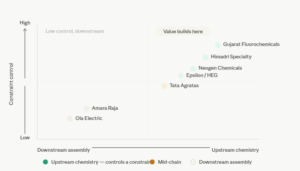
The correct filter for this sector is not who is building capacity. It is the entity that controls a constraint in the value chain that others cannot easily replicate or bypass.
The obvious plays
Ola Electric, Tata’s Agratas, and Amara Raja are the names most investors encounter first. These are the cell manufacturing buildouts. They will generate revenue as domestic EV adoption grows.
The non-obvious point about these names: high-multiple stocks in a long-cycle sector require close examination of when margins arrive relative to when the stock moved. For these companies, the revenue timeline is reasonably visible. The margin timeline is not.
The overlooked positions
Himadri Speciality Chemicals and Gujarat Fluorochemicals are building LFP cathode capacity and electrolyte chemical positions, respectively, with moves toward backward integration into lithium refining and fluorochemical precursors.
These names sit at actual constraints in the value chain.
The reason they receive less attention: they are speciality chemical companies that have expanded into battery materials, not pure-play battery stories. The market categorises them differently, which creates a valuation gap relative to their strategic position.
Neogen Chemicals is building LiPF6 electrolyte salt production. Domestic LiPF6 capacity is genuinely scarce in India. A company that controls this input holds something real in the near term.
Epsilon Advanced Materials and HEG Ltd are building anode material positions. India produces roughly 5 kilotonnes of anode materials against domestic demand approaching 280 kilotonnes (IEA, 2024).
The gap is large enough that early entrants with operating capacity have room before competitive pressure arrives.
The question for both: can they reach cost competitiveness with Chinese-sourced materials before the demand gap closes enough for importers to become the default again?
Indirect beneficiaries
The financing layer — banks and NBFCs lending to EV manufacturers and battery companies — captures the sector’s growth without the chemistry execution risk.
The logistics layer serving battery raw material imports benefits from volume growth regardless of which chemistry wins.
These are lower-multiple, lower-risk exposures to the same underlying demand curve.
If the sector works, value accrues to upstream chemical players first, cell manufacturers second, and pack assemblers last.
If it underdelivers, losses concentrate in capital-heavy manufacturing capacity built ahead of chemistry readiness. This sequencing is not speculative.
It is the resolution pattern from China’s own battery sector buildout between 2010 and 2020, where CATL and BYD survived because they controlled chemistry, while dozens of assemblers with no chemistry differentiation exited or were absorbed.
Risks With Signals, Not Just Names
Risk 1: Global overcapacity becomes structural
Probability: medium. Current trajectory has global battery supply reaching approximately double projected demand within five years.
A 30-40% supply excess collapses pricing power. At 2x, it becomes a margin reset across the industry.
Signal: a sustained 15-20% decline in global battery cell prices over four to six consecutive quarters.
Below that threshold, price moves are cyclical. Above it, the industry is repricing permanently. Track monthly Chinese export price data for battery cells as the leading indicator.
Reflected in Indian valuations: no. Current multiples assume margin stability.
Risk 2: Graphite and raw material export controls
Probability: medium. China demonstrated willingness to deploy export controls on graphite in 2023.
Escalation in EV trade policy between China and Western markets — which is an ongoing and active policy area — would logically extend such controls.
Signal: any new Chinese announcement on battery material export licensing requirements, particularly for processed graphite or lithium carbonate.
Watch the Chinese Ministry of Commerce announcements quarterly.
Impact: immediate and severe for Indian anode producers without a domestic graphite supply.
Reflected in current valuations: no.
Risk 3: Technology displacement by sodium-ion
Probability: low in the near term, high impact if realised. Sodium-ion batteries eliminate lithium from the chemistry entirely.
Reliance Industries acquired Faradion specifically to hold an option on this technology (IEA, 2024).
If sodium-ion achieves cost parity with LFP in stationary storage applications — which some manufacturers target within five to seven years — LFP investments made today face obsolescence before capital recovery.
Signal: a major stationary storage contract awarded to sodium-ion chemistry at below LFP cost benchmarks. Not there yet. Watch for it.
Reflected in current valuations: no. The optionality that Reliance’s Faradion acquisition represents is not widely modelled.
Risk 4: PLI execution risk
Probability: low to medium. Several PLI-ACC capacity targets require operational gigafactories by specific dates. Delay in meeting those targets affects incentive payment timing and the utilisation ramp assumptions embedded in current valuations.
Signal: Ministry of Heavy Industries PLI progress reports, which are published periodically. Any announcement of a timeline revision on major capacity commitments is the trigger.
Strongest counterargument: China+1 supply chain diversification is a genuine structural shift with policy backing in the US, EU, Japan, and South Korea.
If Western battery manufacturers commit to non-Chinese supply contracts with Indian producers at volumes that guarantee utilisation, the operating leverage in Indian gigafactories works in favour of investors. The execution requirement — cost-competitive chemistry at scale within three years — remains difficult.
But external demand validation would significantly reduce the risk of building capacity into a price-compressed environment.
What Analysts Consistently Miss
The PLI scheme is frequently cited as a risk mitigant. It mitigates capex risk for companies. It does not mitigate margin risk for investors. These are different variables, and the conflation is widespread.
The comparison between Indian and Chinese battery costs is almost always made at the cell manufacturing level, where the gap looks manageable.
The comparison is almost never made at the chemistry level, where the gap is much larger and more durable. Cell manufacturing costs can converge through scale and engineering. Chemistry costs converge only through years of R&D investment and raw material supply control.
Capacity announcements are treated as equivalent to operating capacity. The period between announcement and full utilisation is where the investment assumption is actually being tested, and that period is not tracked by most retail-facing coverage.
The sodium-ion option that Reliance holds through Faradion receives almost no analytical attention in Indian battery sector coverage. If that technology scales, it affects the entire lithium-dependent portion of the chain that is currently receiving the majority of investment attention.
What You Should Do Next
Watch these three indicators specifically:
LFP cathode capacity utilisation and per-unit cost at Himadri Speciality Chemicals and Gujarat Fluorochemicals, reported in quarterly earnings.
Not announced capacity. Operating output and cost relative to Chinese import benchmarks. That cost gap is the clearest signal of whether India is building a competitive position or an expensive substitute.
Global battery cell price movement is tracked monthly. A sustained 15-20% decline over four to six quarters is the signal that overcapacity has crossed from cyclical to structural, requiring reclassification of cell manufacturer investment theses.
Chinese export control policy announcements on battery materials, particularly processed graphite and lithium carbonate. Any expansion of the 2023 graphite controls is a direct and immediate negative for Indian anode producers without a domestic supply.
Question this consensus assumption: that PLI incentives reduce investment risk in Indian battery sector equities. They reduce project risk for the companies building capacity.
Investor risk — which is a function of chemistry competitiveness, raw material security, and margin durability — is unchanged by the scheme. Multiples that price PLI success without separately pricing these three variables are mispriced.
Avoid this exposure: battery pack assembly businesses trading at growth multiples. They carry margin compression risk from both directions — input costs set by a supply chain they do not control, and customer pricing pressure in an increasingly competitive EV market.
Value in this sector builds upstream and gets competed away at the assembly stage. Paying growth multiples for an assembly business is paying for the most contested part of the chain.
Honest Limits of This Analysis
This analysis applies to listed or near-listed companies with disclosed financial positions operating in the lithium-ion battery value chain.
It does not apply to pre-revenue startups dependent on order-of-intent conversion or companies without auditable production data.
Return on capital employed and ROIC data — the standard capital efficiency checks — cannot be calculated reliably for most Indian battery manufacturing entrants because the relevant plants have not yet completed a full operating cycle.
Where cited, ROCE expectations of 20-25% in new chemistry segments (Ministry of Heavy Industries) are projections, not reported outcomes. Treat them as directional, not factual.
The sodium-ion technology assessment is based on publicly available development timelines. Commercial scale deployment remains uncertain, and timeline estimates from manufacturers have historically been optimistic.
Frequently Asked Questions
What is India’s lithium-ion battery sector, and why does it matter for investors now?
India’s lithium-ion battery sector covers the full chain from chemical raw materials through cell manufacturing to battery pack assembly, serving primarily electric vehicle manufacturers and renewable energy storage projects.
It matters for investors now because domestic EV adoption is accelerating rapidly, government policy has committed significant incentives to build domestic manufacturing capacity, and several large Indian conglomerates have made substantial capital commitments. The investment case is real.
The question is not whether the sector will grow but which positions within it will generate returns proportional to the capital invested.
Battery imports tripled over roughly six years (IEA, 2024), indicating genuine demand expansion. Whether domestic producers capture that demand at acceptable margins depends on chemistry competitiveness and raw material access, not capacity alone.
What actually drives margins in a battery manufacturing business?
Three variables determine margin outcomes. Chemistry control — owning the ability to produce cathode, anode, or electrolyte materials at competitive cost — is the primary margin driver in upstream positions.
Capacity utilization is the primary margin driver in cell manufacturing, where fixed costs are high, and below approximately 70% utilization, the economics deteriorate rapidly.
Raw material sourcing security is the floor-setter for the entire chain, because input cost spikes that cannot be passed through compress margin directly and immediately.
Revenue growth in this sector does not automatically translate to margin growth. The two variables are decoupled in the early phases of building a battery manufacturing base, which is where India currently sits.
How does India’s battery sector compare to China’s in terms of investment risk?
China’s battery sector is a mature, vertically integrated ecosystem built over 20 years with state-directed investment in chemistry, processing, and manufacturing simultaneously.
India’s is an early-stage buildout concentrated primarily in cell manufacturing and pack assembly, with upstream chemistry at a nascent stage.
The comparison that matters for risk is not scale — China is obviously larger — but structural position. China controls approximately 97% of global LFP cathode production and dominates processing of all three primary battery raw materials (IEA, 2024).
Indian battery companies are building downstream of that control, which means their input costs are set externally. The risk is not that India fails to build a battery sector. It is that the sector gets built primarily in the segments that generate the least durable returns.
What would have to change for Indian battery companies to become genuinely competitive with Chinese producers?
Three things would need to happen within roughly three to five years.
Domestic cathode and anode material producers would need to demonstrate per-unit costs within approximately 15% of Chinese equivalents at meaningful production scale — not announced capacity but operating output.
Raw material sourcing would need to shift from import dependence toward either domestic processing capability or secured long-term offtake agreements from non-Chinese jurisdictions for lithium and graphite.
And capacity utilization at Indian cell plants would need to sustain above 70% consistently, which requires either faster-than-projected domestic EV adoption or successful capture of export market volume from Western manufacturers seeking non-Chinese supply. All three are possible.
None are likely within the current three-year investment horizon at an adequate scale to change the margin picture.
What is the biggest risk that is not reflected in current sector valuations?
The global overcapacity trajectory. If global battery supply reaches double projected demand — which multiple credible projections place within five years — the pricing environment for cell manufacturers resets structurally, not cyclically.
A sustained 15-20% decline in global cell prices over four to six quarters is the signal. Indian manufacturers without chemistry differentiation face margin compression in that scenario where the PLI incentive does not offset.
This risk is not reflected in current multiples on Indian battery manufacturing companies, which are priced for utilization ramp success in a stable or improving price environment.
The combination of overcapacity risk and operating leverage in fixed-cost-heavy plants is the most significant underpriced risk in this sector.
Which Indian companies are best positioned in the battery sector and why?
The better-positioned companies are those that control a constraint in the value chain rather than those with the largest announced capacity.
Gujarat Fluorochemicals and Himadri Specialty Chemicals are building LFP cathode and electrolyte chemical positions with moves toward backward integration — these sit at points in the chain where chemistry control generates a defensible margin.
Neogen Chemicals is building LiPF6 electrolyte salt production, which is genuinely scarce domestically. These are not the highest-profile names in standard battery sector coverage, which tends to focus on gigafactory announcements.
That coverage gap is part of what creates a valuation discrepancy worth examining. Cell manufacturers — Ola Electric, Tata Agratas, and Amara Raja — will generate significant revenue.
Whether that revenue translates to the margins implied by current valuations depends on factors outside their direct control.
Synthesis: What These Changes Mean
What most analyses of this sector miss:
The PLI scheme is analysed as a risk mitigant for investors.
It is a risk mitigant for companies. The two are different, and the conflation is the source of most valuation errors in this sector.
Chemistry competitiveness and cell manufacturing scale are treated as equivalent building blocks. They are not.
Chemistry creates a defensible margin. Scale creates revenue. In early-phase markets, the two are decoupled, and paying scale multiples for chemistry-dependent returns is a category error.
Global overcapacity risk is acknowledged in most sector coverage and then discounted without a trigger signal.
A 15-20% sustained decline in global cell prices is the threshold between cyclical and structural. That threshold is trackable in real time.
Announced capacity is consistently used as a proxy for operating capacity.
The period between announcement and full utilization is where the investment assumption is being tested. It is not being monitored.
India’s battery sector will be built in chemistry labs and supply agreements, not in gigafactory announcements.
Investors who track capacity headlines will see growth. Investors who track chemistry control will understand returns. Investors who confuse the two will fund infrastructure whose returns they will not capture.
The market is currently pricing both the same way. That is where this analysis lives.
Key Sources & References
These sources support the analysis of India’s lithium-ion battery sector, including import growth, PLI-ACC execution, value chain economics, LFP chemistry trends, upstream material constraints, company positioning, and global overcapacity risks.
Official Global Reports
- IEA Global EV Outlook 2024
https://www.iea.org/reports/global-ev-outlook-2024 - IEA: Trends in Electric Vehicle Batteries
https://www.iea.org/reports/global-ev-outlook-2024/trends-in-electric-vehicle-batteries - IEA: Global Supply Chains of EV Batteries
https://www.iea.org/reports/global-supply-chains-of-ev-batteries - IEA Global EV Outlook 2024 PDF
https://iea.blob.core.windows.net/assets/a9e3544b-0b12-4e15-b407-65f5c8ce1b5f/GlobalEVOutlook2024.pdf - IEA Global Critical Minerals Outlook 2025
https://www.iea.org/reports/global-critical-minerals-outlook-2025
India Battery Sector, PLI & Import Dependence
- Ministry of Heavy Industries: PLI-ACC Scheme
https://heavyindustries.gov.in/en/pli-scheme-national-programme-advanced-chemistry-cell-acc-battery-storage - PLI-ACC Official Portal
https://pliacc.in/ - PIB: PLI ACC Battery Status Update
https://www.pib.gov.in/PressReleasePage.aspx?PRID=2246037 - India Lithium-Ion Battery Market (Mordor Intelligence)
https://www.mordorintelligence.com/industry-reports/india-lithium-ion-battery-market - Lithium-Ion Battery Manufacturing Landscape in India (IEEFA PDF)
https://ieefa.org/sites/default/files/resources/Lithium-Ion-Battery-Manufacturing-Landscape-in-India_January-2022.pdf - How Can India Indigenise Li-Ion Battery Manufacturing? (CEEW)
https://www.ceew.in/publications/how-can-india-indigenise-li-ion-battery-manufacturing - India’s Battery Supply Chain (Fastmarkets)
https://www.fastmarkets.com/insights/indias-battery-supply-chain-building-a-sustainable-future/ - Unlocking Supply Chains for Localising EV Battery Production
https://www.iisd.org/system/files/2024-11/electric-vehicle-battery-production-india.pdf
Cathode, Anode & Electrolyte Material Players
- Himadri Speciality Chemical LFP Cathode Expansion
https://www.fortuneindia.com/enterprise/himadri-speciality-chemical-enters-lfp-cathode-material-space/120963 - Gujarat Fluorochemicals IFC Project Disclosure
https://disclosures.ifc.org/project-detail/ESRS/49732/gfcl-ev-products - Neogen Chemicals LiPF6 Expansion & Morita JV
https://www.mercomindia.com/neogen-and-morita-form-jv-to-develop-li-ion-battery-business - Epsilon Advanced Materials
https://www.epsilonam.com/ - EV-Ready India: Localising Anode Manufacturing (Ola Electric)
https://olawebcdn.com/ola-institute/EV_Ready_India_Greeer_Tomorrow.pdf
Industry Research, Pricing & Overcapacity Signals
- Reuters: EV Battery Metals & Price Pressure Analysis
https://www.reuters.com/markets/commodities/electric-vehicles-prove-bumpy-ride-battery-metals-andy-home-2024-10-22/ - Benchmark Mineral Intelligence
https://www.benchmarkminerals.com/ - PV Magazine India: India’s PLI Battery Capacity Delays
https://www.pv-magazine-india.com/2026/01/22/indias-pli-scheme-achieves-just-2-8-of-targeted-50-gwh-battery-manufacturing-capacity-so-far/ - ICRA Battery Manufacturing Sector Analysis
https://www.icra.in/Research/ViewResearchReport/over-150-gwh-of-li-ion-battery-cell-capacity-committed-to-be-operational-by-2030/6205
Suggested Reader Note
Data and industry references sourced from the International Energy Agency (IEA), Ministry of Heavy Industries (India), PIB releases, IEEFA, CEEW, IFC disclosures, Reuters, PV Magazine India, Fastmarkets, ICRA, and company filings. Claims related to LFP market share, cathode dominance, anode demand gaps, and battery value-chain economics are primarily based on IEA Global EV Outlook and EV battery supply chain reports.