Why Women Don’t Speak Up in Meetings (And Why It Has Nothing to Do With Confidence)
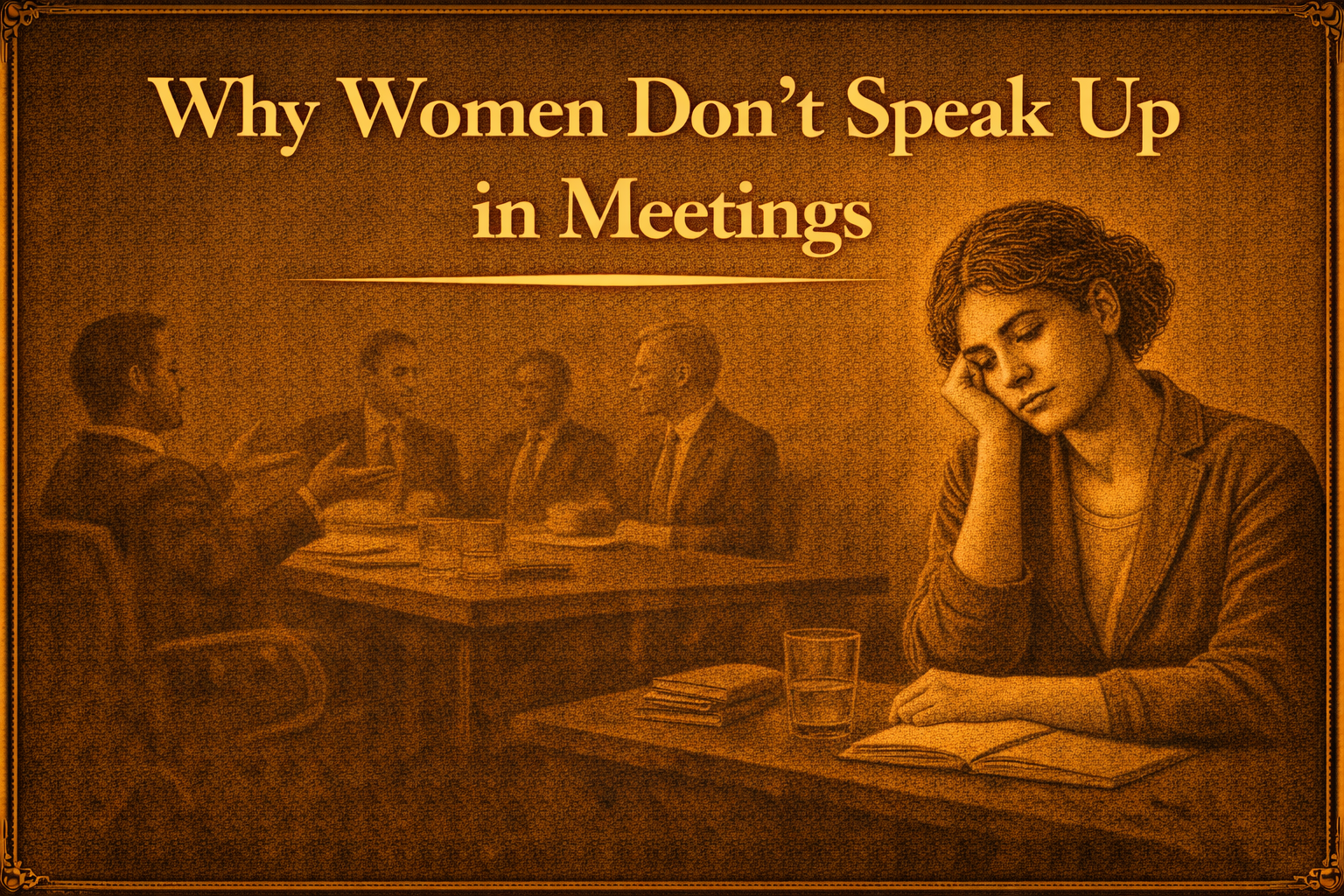
Why Women Don’t Speak Up in Meetings (And Why It Has Nothing to Do With Confidence)
The silence isn’t hesitation. It’s a calculation — one that gets faster and more automatic every time it runs.
Women leave meetings having said less than they knew.
This happens across industries, seniority levels, and team sizes. It happens in rooms where women are the majority. It happens to women who speak confidently everywhere else.
And the most common explanation — that women lack confidence — gets the mechanism exactly backwards.
The silence isn’t a confidence gap.
It’s a calculation.
A fast, private, highly rational assessment of whether speaking is worth the specific cost it will carry in this room, with these people, right now.
That calculation has been running long enough in most women that it no longer feels like a decision.
It feels like nothing.
And that’s precisely why it keeps producing the same result.
What the Silence Actually Costs
Before getting to how the calculation works, it’s worth being precise about what it costs — because the cost isn’t just individual.
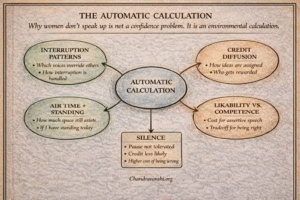
When a woman runs the four-second calculation and tips toward silence, what disappears is not just one point in one meeting.
It’s:
- input that could have shifted direction
- a problem caught earlier
- a correction that never happened
Multiply that across:
- every meeting
- every team
- every year
The cost doesn’t appear anywhere.
It exists only in what didn’t happen.
Which makes it easy to ignore.
How the Calculation Actually Works
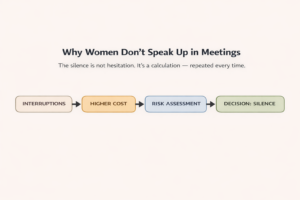
The calculation runs in approximately four seconds.
It processes:
- How much air is already in use
- whether the room is open or already committed
- whether the interruption will be tolerated
- whether the room will pause or ignore
And then the harder variable:
whether the person has enough standing in this room, on this day, to spend it on this point.
Standing is not the same as seniority.
A woman can be senior and still be read as interrupting.
She can be an expert and still carry a higher cost for being wrong.
If that variable comes back uncertain:
The calculation tips toward silence.
The point is filed.
The window closes.
The meeting continues.
As if nothing happened.
Why It Isn’t a Confidence Problem
The confidence explanation sounds logical.
But it breaks at a key point.
Women who stay quiet often know their point is good.
The decision is not:
“I’m not sure about this.”
It is:
“I’m not sure this room will handle this well.”
There is no doubt.
That is risk assessment.
And that assessment is based on real patterns:
- Higher interruption rates
- lower credit attribution
- penalties for assertive speech
The calculation is not irrational.
It is accurate.
How the Calculation Gets Faster
It doesn’t slow down with experience.
It speeds up.
- First interruption → registered
- First credit loss → remembered
- first pattern → recognised
Over time:
- The answer arrives faster
- The decision feels automatic
- The silence feels like a default
Faster means quieter.
And eventually:
It stops feeling like a decision at all.
What Actually Produces This Pattern
This is not just individual behaviour.
It is trained by the environment.
1. Interruption patterns
Men interrupt women more often — even when women are senior.
That experience changes how the next room is read.
2. Credit diffusion
Ideas from women are more likely to be reassigned.
This shapes future participation.
3. Likability vs competence tradeoff
Assertive women are evaluated differently.
Same behaviour.
Different outcome.
The calculation reflects these conditions.
What This Means for Organisations
Telling women to “speak up more” does not fix this.
Because:
The calculation is correct.
If the environment stays the same:
The behaviour will too.
What actually helps:
- structured meeting formats
- explicit credit attribution
- evaluation criteria without bias
These are not difficult.
But they require a change from those who benefit from the current system.
That is the real barrier.
The Gap That Doesn’t Appear in the Minutes
The silence in the room is not empty.
It is full of:
- fast decisions
- private calculations
- accumulated experience
The woman with the minimised window is not lacking confidence.
She is responding to a system that trained her to calculate.
That calculation will continue.
Until the conditions change.
Not until she does.