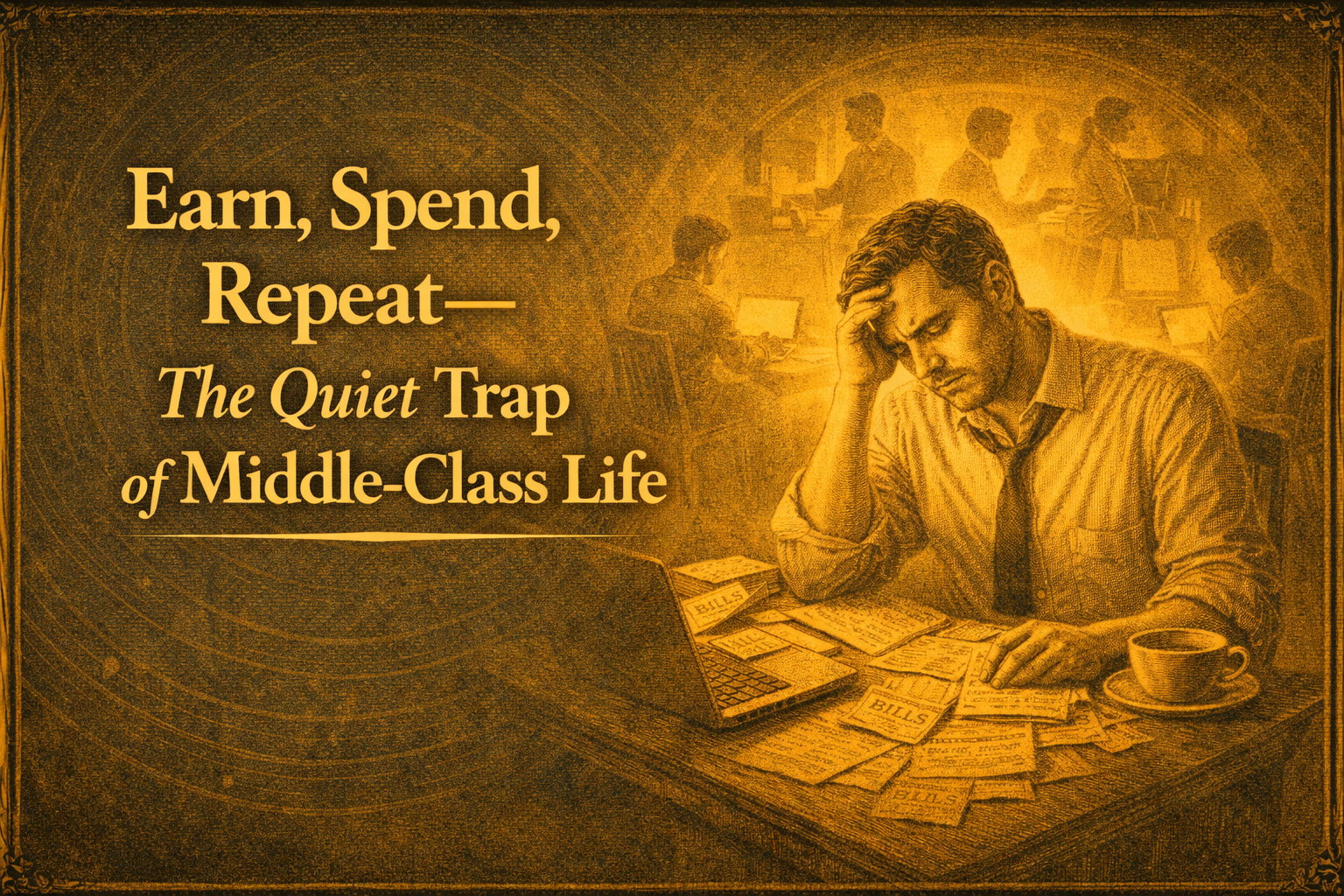
Earn, Spend, Repeat—The Quiet Trap Of Middle-Class Life
What If Stability Isn’t Security, But Something Harder To Escape?
The Middle-Class Loop No One Admits Living In
You earn more every year.
So why does it still feel like nothing really changes?
Not because people are careless.
Not because they failed to budget properly.
The deeper problem is structural:
income and obligation usually grow together.
The salary rises.
The monthly commitments rise with it.
The numbers become larger.
The breathing room stays almost identical.
This is the middle-class loop.
The Opening Position
The salary arrives, and the obligations are already waiting.
- Rent or EMI
- School fees
- Insurance premium
- Electricity bill
- Internet recharge
- Parents’ medicine
- SIP contribution
None of these feel irresponsible.
Most were added slowly across years.
A better school because the child deserved it.
A bigger flat because the family expanded.
A vehicle because commuting became impossible otherwise.
Every decision made sense individually.
Together, they created a system where most income arrives pre-allocated.
This is not poverty.
It is something more psychologically exhausting:
a permanent narrow gap between earnings and obligations.
What The Loop Actually Is
The loop has three moving parts.
1. Income Growth
A raise happens.
A promotion comes through.
A better opportunity appears.
For a short moment, relief appears.
Then the system adjusts.
2. Obligation Expansion
The additional income gets converted into infrastructure upgrades.
- A slightly better apartment
- A better school
- Improved health insurance
- A car upgrade
- New EMIs
This is usually framed as “lifestyle inflation.”
But most middle-class expansion is not reckless luxury spending.
It is aspirational infrastructure.
People are not buying yachts.
They are buying protection, positioning, and stability.
3. The Gap Remains Narrow
After the salary increase and the lifestyle adjustment settle, something strange happens:
The stress level barely changes.
The household is now operating at a higher numerical level with almost the same emotional pressure.
The loop reproduces itself.
Why Obligations Expand So Quickly
Because middle-class life is not built only on consumption.
It is built on signalling and protection.
In urban India:
- The area you live in signals status
- The school your child attends signals class position
- The car signals professional success
- The phone signals relevance
These signals are not entirely vanity.
They affect:
- Professional perception
- Marriage prospects
- Social belonging
- Network access
- Family expectations
That is why many “upgrades” feel mandatory once income crosses certain levels.
The pressure is structural, not purely psychological.
The Real Emotion Inside The Loop
Most people think the middle class is driven by ambition.
Partly true.
But the stronger force is fear.
Not fear of failing to rise.
Fear of falling backward.
That fear shapes almost every major decision:
- Take the safer job
- Delay the risky idea
- Keep the emergency fund untouched
- Stay where income feels predictable
The loop changes ambition itself.
Dreams become conditional.
“We’ll do it later.”
“We’ll travel next year.”
“Once the EMI reduces.”
Later becomes a recurring financial season that never fully arrives.
The EMI Contract Nobody Talks About Honestly
EMIs are not just monthly payments.
They are future income commitments signed in advance.
A home loan taken at 32 shapes the financial structure of 52.
A car EMI shapes career flexibility.
A personal loan shapes risk tolerance.
This is why EMI culture matters psychologically:
It converts future uncertainty into present stability.
You get the apartment now.
The lifestyle now.
The vehicle now.
In return, future income becomes partially owned before it arrives.
The loop tightens.
Why “Managing” Is Exhausting
Middle-class households survive through management.
“We’ll manage.”
“It’s manageable.”
“We’re managing.”
These phrases sound calm.
But underneath them is constant calculation:
- School fees this month
- Insurance renewal next month
- Parents’ medical expense
- Unexpected repair
- Annual travel decision
Managing requires discipline.
Real discipline.
But it also consumes mental bandwidth continuously.
That is why many households earning objectively “good salaries” still feel emotionally fragile.
The problem is not income scarcity alone.
It is obligation density.
Why Earning More Often Changes Less Than Expected
Most people inside the loop believe:
“If income rises enough, everything will finally feel stable.”
Then income rises.
And the system expands around it.
The larger flat arrives.
The larger school fee arrives with it.
The upgraded lifestyle creates upgraded maintenance costs.
The household becomes richer numerically while remaining psychologically tight.
This is not personal failure.
It is the loop functioning correctly.
Where The Loop Can Actually Be Interrupted
The loop rarely breaks through income growth alone.
It weakens when obligation growth slows.
That requires decisions most systems quietly discourage:
- Keeping the same flat longer
- Driving the car beyond the “upgrade” stage
- Avoiding unnecessary EMI expansion
- Treating income spikes as debt reduction opportunities instead of lifestyle triggers
These decisions have social costs.
People notice downward signalling immediately.
That is why escaping the loop is not only financial.
It is psychological and social.
The Hidden Timeline Most People Eventually Discover
For many households, the loop loosens only after:
- The home loan ends
- The children complete education
- Peak earning years arrive
Usually this happens in the late forties or fifties.
At that point, income continues while obligation growth slows.
The gap finally widens.
But many people arrive there exhausted from decades of continuous management.
Frequently Asked Questions
Why does my salary disappear so quickly even when I earn well?
Because most income gets consumed by fixed obligations before discretionary spending begins.
The issue is often not overspending.
It is the density of recurring commitments.
Is lifestyle inflation always bad?
Not entirely.
Some upgrades genuinely improve quality of life, safety, health, and opportunity.
The problem begins when every income increase automatically converts into permanent monthly obligations.
Why do EMIs create psychological pressure?
Because EMIs pre-commit future income.
They reduce flexibility before future conditions are known.
That creates a persistent fear of income disruption.
Does financial security ever fully arrive?
For many households, security feels delayed because obligations scale upward with income.
The emotional feeling of “arrival” often comes much later than expected.
Can the loop be escaped completely?
Completely?
Rarely.
But it can be weakened through lower fixed obligations, reduced debt dependency, and resisting automatic lifestyle expansion.
The One Thing Worth Remembering
The middle-class loop is not evidence that people are irresponsible.
It is what happens when:
- Income growth
- Aspirational infrastructure
- EMI culture
- Social positioning
- Fear of falling backward
all move together at the same time.
Understanding this matters because it changes the direction of blame.
The problem is not always that people are running too slowly.
Sometimes the treadmill itself is designed to match their speed.