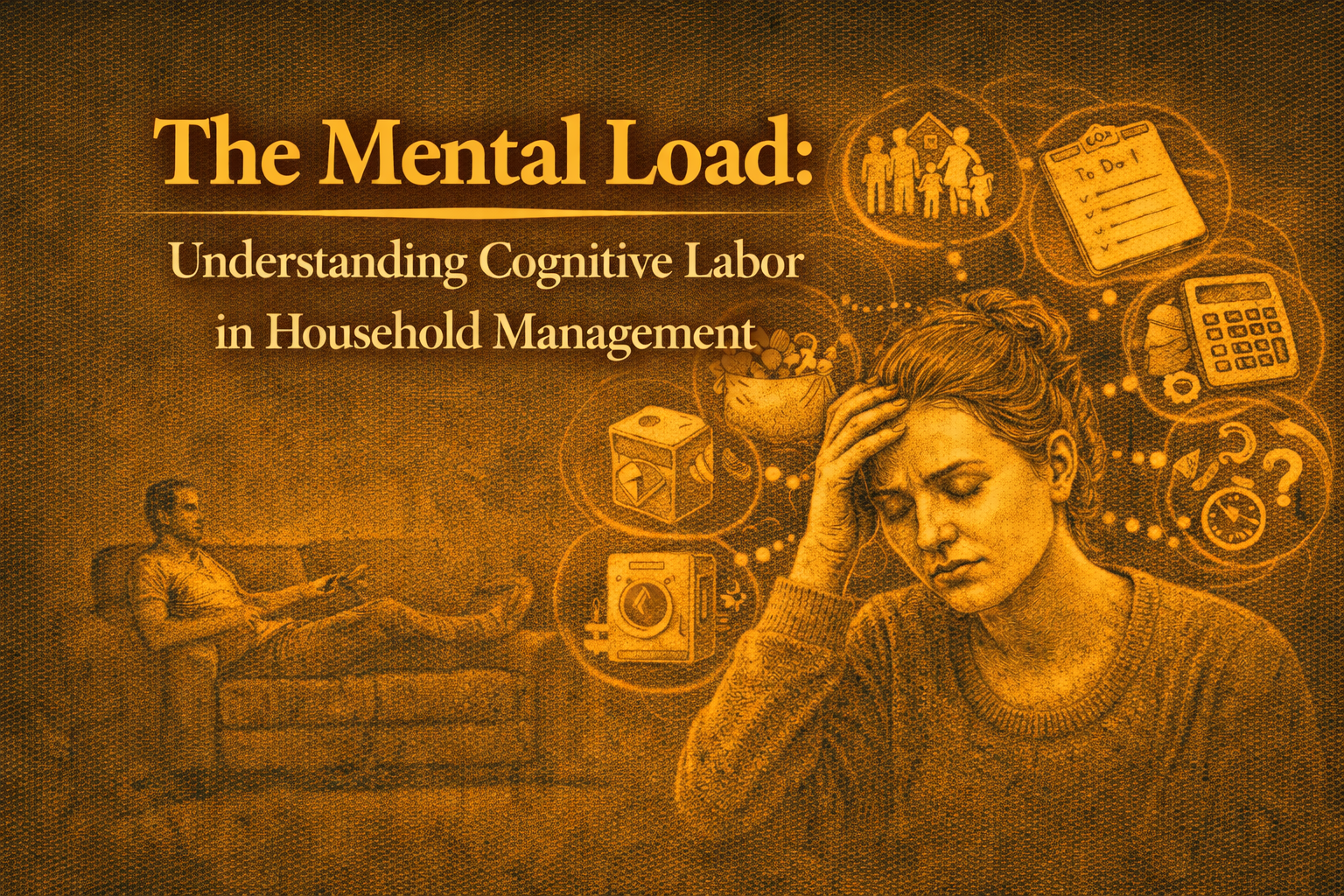
The Mental Load: Understanding Cognitive Labor in Household Management
Why “Just Tell Me What to Do” Doesn’t Solve the Problem
The mental load is the invisible cognitive work of managing a household. It is not the tasks themselves, but the constant tracking, anticipating, planning, and remembering that makes those tasks possible.
It is the difference between doing the dishes and knowing the dishes need doing, buying more soap before it runs out, and noticing the dish rack is cracked and needs replacing.
It matters because it never fully stops.
Unlike physical chores, the mental load continues running quietly in the background of everything else you do.
This article covers:
- What the mental load actually is and what it is not
- Why “just ask me” is a structural misunderstanding rather than a solution
- How the mental load operates as a system instead of a list of chores
- What research shows about its distribution and consequences
- Why it appears differently across class, race, and relationship structures
- What women are most commonly told that gets the problem wrong
- What would actually need to change
I tracked this dynamic in my own household across seven years, two careers, and two children.
Here is what that experience revealed.
What the Mental Load Actually Means
The mental load is the cognitive and emotional work of household management: the planning, anticipating, organising, and remembering that runs underneath visible domestic labour.
It is not the act of cooking dinner.
It is knowing:
- what is already in the fridge
- what needs to be used before it expires
- whether your child has a food sensitivity affecting tonight’s meal
- whether tomorrow requires a packed lunch
This distinction matters because cognitive labour is invisible by design.
When dinner appears on the table, the visible outcome hides the forty smaller decisions that produced it.
Women often confuse the mental load with household chores themselves. The two overlap, but they are not identical.
A partner may help with laundry while one person still tracks:
- when laundry needs doing
- which items require special care
- whether detergent is running low
- when supplies need replacing
The labour may appear shared.
The management often is not.
The mental load also differs from emotional labour.
Emotional labour involves managing other people’s feelings.
The mental load involves managing systems and logistics.
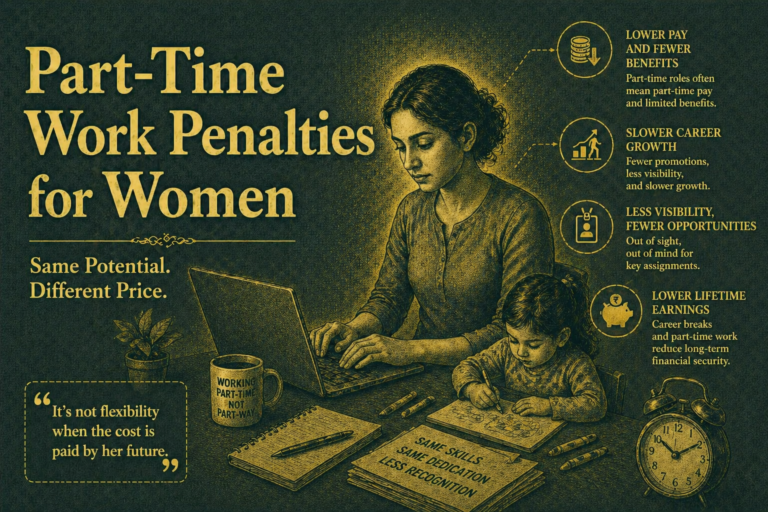
Many women describe feeling exhausted after “doing nothing all day.” Often, the exhaustion comes from carrying both forms of labour simultaneously.
The term gained mainstream attention in 2017 after French cartoonist Emma published You Should’ve Asked, illustrating how women frequently function as household managers while partners function as helpers.
The comic spread rapidly not because it introduced a new reality, but because it finally gave language to an old one.
What Seven Years of Tracking Taught Me
My husband is, by most standards, an involved partner.
He cooks several nights a week, handles car maintenance, manages finances, and is deeply engaged with our children.
We divided responsibilities intentionally when we moved in together.
We revisited those divisions after each child.
We use shared calendars and shared grocery systems.
And despite all of that, I still carried approximately 80% of the mental load.
I know because I tracked it.
For six months across two separate years, I logged every instance of cognitive household management:
- every task anticipated
- every system monitored
- every transition tracked
- every appointment remembered before it appeared on a calendar
The numbers were not close.
I made roughly 340 to 380 household management decisions each month.
My husband made approximately 60 to 80.
Most of his decisions stayed inside domains he fully owned:
- cars
- finances
- outdoor maintenance
In nearly every other category, I remained the primary cognitive manager:
- children’s medical needs
- school systems
- social planning
- food management
- family scheduling
- gift obligations
- clothing systems
He was not absent.
He was responsive, willing, and helpful.
But the asking remained mine.
The monitoring remained mine.
The anticipation remained mine.
That distinction changed how I understood the problem entirely.
How the Mental Load Actually Works
The Anticipation Layer
The mental load is not a collection of isolated tasks.
It is a management system.
Understanding that difference explains why “just tell me what to do” misses the problem so precisely.
Most household tasks become visible only after someone has already performed anticipation work.
“We’re out of milk” is a visible problem.
Knowing you will run out by Thursday before Thursday arrives is anticipation.
That anticipation exists because someone is already tracking:
- consumption patterns
- family schedules
- grocery timing
For the person carrying the mental load, this monitoring runs continuously in the background.
For the partner not carrying it, problems often become visible only after they already exist.
One person runs prevention systems.
The other runs response systems.
Both may be caring and engaged.
Only one is managing.
The Tracking System
Households operate through overlapping systems:
- food supply
- school calendars
- medical appointments
- social obligations
- clothing cycles
- financial schedules
- maintenance timelines
Someone must continuously hold those systems in working memory.
Knowing:
- the dentist appointment is in three weeks
- the school form is due Friday
- the birthday invitation still requires a gift
- one library book is missing
Tracking does not always require action.
It requires uninterrupted awareness.
Sociologist Arlie Hochschild described this as the “second shift”:
- thinking about dinner during meetings
- messaging the paediatrician during lunch breaks
- confirming childcare during commutes
The mental load does not end when paid work begins.
The Delegation Problem
This is the mechanism “just tell me what to do” fails to understand.
When a partner says this, they are offering execution.
They are not offering management.
The person carrying the mental load must still:
- monitor the system
- identify the problem
- decide action is needed
- delegate the task
- follow up if necessary
Delegation does not reduce the management burden.
It often adds communication and monitoring work to it.
Research by Allison Daminger divided household cognitive labour into four stages:
- anticipation
- identification
- decision
- monitoring
Women disproportionately performed the first and fourth stages, which are also the most continuous and invisible.
Men often entered the process later, after the most cognitively expensive work had already been completed.
The Standard Problem
Household systems require standards.
Someone defines:
- what “clean enough” means
- when a doctor should be called
- how much preparation social obligations require
These standards are learned, monitored, and enforced.
When one person carries the mental load, that person also carries the standards.
The conflict this creates is predictable.
The person managing the system experiences incomplete execution as inadequate.
The executing partner experiences correction as criticism.
Both reactions make sense.
Neither resolves the structural imbalance underneath them.
The Bottom Line on the Mental Load
The mental load is the invisible management system underneath household life.
It remains disproportionately concentrated in women across:
- income levels
- relationship structures
- employment categories
- stated household values
The problem is not simply a lack of communication.
It is a mismatch between execution and ownership.
“Just tell me what to do” is usually a sincere offer.
But it offers help with execution while leaving anticipation, tracking, decision-making, and monitoring in the same hands.
That is why many couples who believe labour is shared still experience deep inequality in cognitive exhaustion.
What changes the mental load is not occasional help.
It is full ownership transfer.
Not task-sharing.
Not reminders.
Not assistance.
Complete responsibility for an entire system:
- anticipating
- tracking
- deciding
- executing
- monitoring
That transfer is possible.
But it is slower, more uncomfortable, and more structurally demanding than most people expect.
About the Author
Mrs Chandravanshi (Deepa Chandravanshi) writes about marriage, motherhood, workplace structures, and the invisible negotiations women make inside domestic and professional systems.