Why the Soviet Economy Grew Fast, Then Stopped Growing at All
Why the Soviet Economy Looked Strong Before It Collapsed
Western economists watching the Soviet Union in 1932 saw something that genuinely unsettled them. The United States was burning surplus corn because prices had fallen below harvest costs. A quarter of American workers had no job. Meanwhile, Soviet newspapers reported zero unemployment, and steel mills the size of small cities were going up across the Urals.
Some of those economists quietly conceded that the command economy might represent a superior model.
They were wrong. But understanding precisely why — and why it took sixty years for the error to become undeniable — requires understanding how the Soviet economy actually functioned. What it was genuinely capable of. What it structurally could not do. And why the people running it were unable to fix the things they knew were broken.
This is not primarily a story about ideology.
It is a story about information, incentives, and who benefits from keeping both broken.
Why Russia Was So Far Behind Before Any of This Began
The Soviet economy did not emerge from nowhere. It emerged from one of the most extractive economic arrangements in the industrialised world.
To understand why Russia was economically backward by 1900, the comparison needs to begin in the fourteenth century. When the Black Death swept across Europe between 1346 and 1353 — killing roughly half the population — it produced different outcomes in the west and east.
In western Europe, the sudden scarcity of peasant labour gave surviving workers bargaining power they had never had. Lords competed for labourers. Unpaid work requirements fell. Wages rose. Over generations, this compounded into expanded rights, property protections, and eventually the institutional foundations that made the Industrial Revolution possible.
In Eastern Europe, the same labour scarcity produced the opposite response. Eastern lords controlled larger territories, faced less organised peasant populations, and responded to the Black Death by intensifying control rather than relaxing it. They seized more land, tightened restrictions on movement, and extracted more rather than less. When western demand for eastern agricultural products grew in the sixteenth century, it gave eastern lords additional reason to squeeze harder.
The gap between east and west — in freedom, in institutional development, in economic capacity — widened across the following four centuries.
Russia in 1850 occupied one-seventh of the earth’s landmass and had an economy smaller than Belgium’s. Serfdom was not abolished until 1861, and its replacement kept most of the underlying oppressions intact. The tsar and the nobility actively resisted industrialisation because they correctly understood that it would produce a middle class capable of challenging their authority. Russia had one railway line before 1853. It was built more only after a military defeat demonstrated that the absence of rail was a strategic vulnerability.
By 1917, the population was starving, the army had collapsed, and the political structure dissolved. The Bolsheviks — small, highly organised, ideologically coherent — filled the vacuum.
What the Command Economy Actually Did
The Soviet command economy that crystallised under Stalin in 1928 was not a variation on market economics. It replaced the price system with administrative allocation.
In a market economy, prices perform an information function. A rising price signals scarcity, drawing producers toward it and away from things that are abundant and cheap. No central authority needs to know what is scarce — the price communicates it, and producers respond automatically. This information processing happens continuously, across billions of transactions, without any coordinating intelligence directing it.
The Soviet system eliminated this entirely. Every input and every output — from the tonnage of steel produced in Magnitogorsk to the price of bread in a Leningrad grocery — was determined by a planning bureaucracy working from political targets rather than price signals. The Five-Year Plan set output goals. Government ministries broke those into sector allocations. Factory directors received their input quotas and output targets and were legally required to meet them.
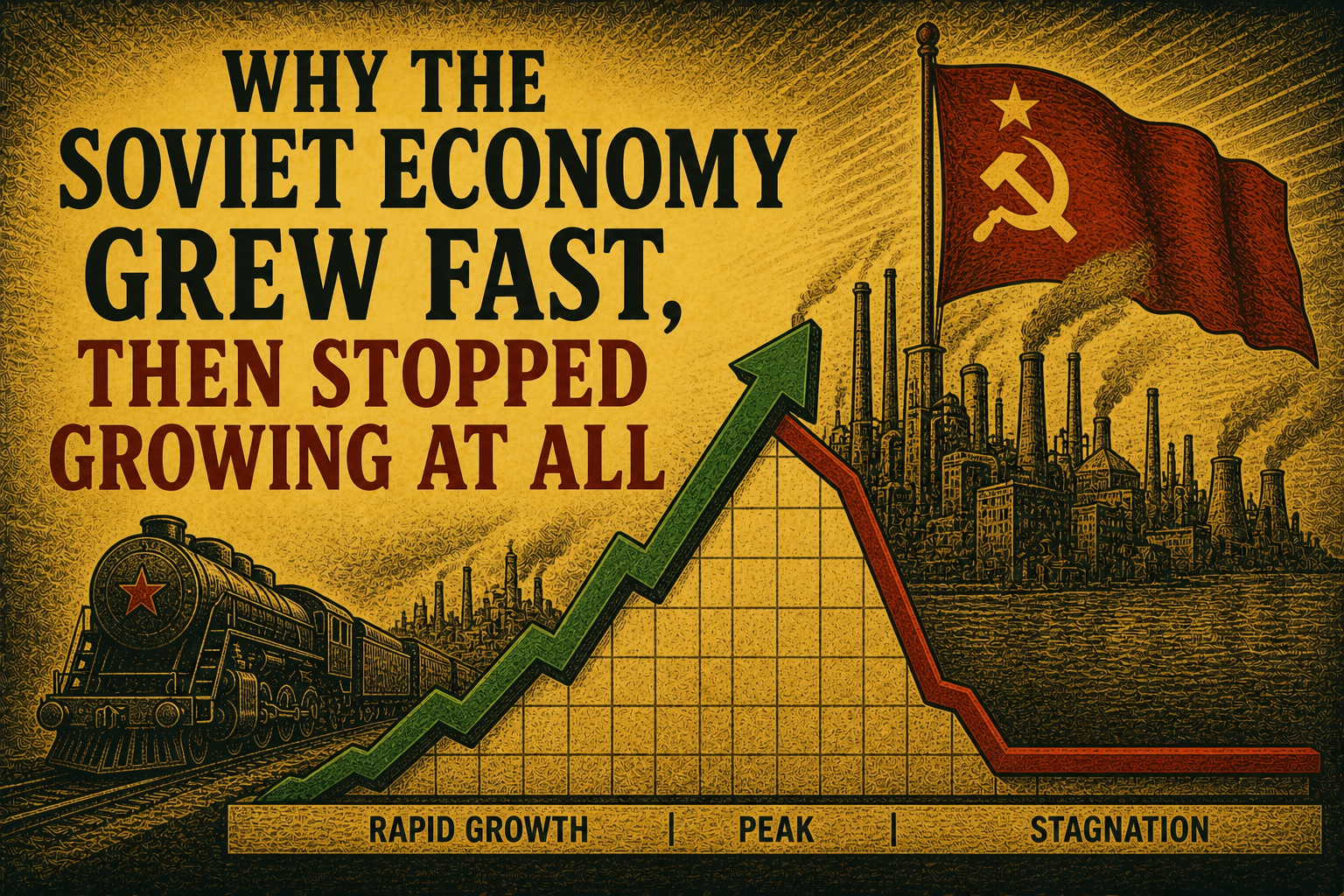
The early results were real. Between 1928 and 1940, the Soviet economy grew at approximately 5.8% annually — faster than any Western economy during the same period, most of which were contracting or stagnant.
This growth was achieved by a mechanism that required no sophisticated management: move people from low-productivity activities to high-productivity ones. In 1928, roughly 85% of the Soviet population worked in subsistence agriculture using methods largely unchanged from medieval times. Moving those workers — through collectivisation and industrialization campaigns — into steel mills, construction sites, and manufacturing plants produced enormous productivity gains simply by changing what people were doing, regardless of how efficiently they were doing it.
This distinction is the key to everything that follows. Soviet growth was extensive rather than intensive. Extensive growth means adding more inputs — more workers, more raw materials, more factories — to produce more output. Intensive growth means producing more output from the same inputs through improved efficiency, better technology, or innovation. The Soviet system could do the first on an enormous scale. It was structurally incapable of the second.
The Incentive Trap Factory Directors Couldn’t Escape
The failure of incentives in the Soviet system ran deeper than the surface observation that workers were paid the same regardless of effort.
Factory directors — enterprise managers — faced a specific and perverse set of incentives created by the planning process itself. Their compensation depended on meeting output targets. Bonuses came from exceeding them. This sounds like it should have produced effort. It produced the opposite.
When a manager exceeded his target significantly one year, planners interpreted this as evidence that the previous target had been set too low. The following year’s target was raised accordingly. A manager who worked hard and exceeded his quota this year was effectively punishing himself with a harder quota next year.
The rational response was to produce at or just above the target — enough to collect the bonus, not enough to trigger a revision. If the target was unreachable, the rational response was to produce as little as possible and argue for a lower target the following year. Either way, a genuine productive effort was irrational from the manager’s perspective.
Input hoarding followed the same logic. Managers who could demonstrate shortages during the planning negotiation phase received more inputs — workers, materials, equipment — than they strictly needed. Extra inputs provided a buffer against supply chain failures, which were constant in a system trying to coordinate production across an entire economy from a single centre. Soviet factories routinely employed twice the workforce of comparable Western facilities, not because the work required it, but because managers had no incentive to run lean and every reason to run overstaffed.
The absence of prices had one further consequence that is less often discussed: the planning apparatus had no reliable way to know which enterprises were efficient and which were wasteful. In a market economy, a company that consistently requires more inputs than competitors to produce the same output loses business and capital to more efficient rivals. In the Soviet system, the inefficient factory received the same allocation as the efficient one — or more, if its managers were skilled at negotiating with planners. Inefficiency was not penalised and therefore persisted indefinitely.
Why Planning an Entire Economy Is Informationally Impossible
The Austrian economist Friedrich Hayek articulated the theoretical reason for Soviet failure before the Soviet economy had fully developed.
The knowledge required to efficiently allocate resources across an industrialized economy cannot be centralized.
Prices in a market encode the dispersed knowledge of millions of producers and consumers — what they value, what they have, what they need, what substitutes exist. This knowledge is fragmented across the entire economy and changes continuously. No planning bureau can collect it, process it, and translate it into correct allocation decisions in real time. The attempt to do so produces errors that compound across every production cycle.
Soviet planners confronted this practically from the beginning. By the 1960s, the Soviet economy encompassed millions of distinct products. Gosplan, the central planning agency, employed tens of thousands of people attempting to set production targets for all of them. The informational demands of the task exceeded the capacity of any human institution — before computers existed that could have helped, and even after.
Economists within the Soviet system recognised this. Some proposed using market prices as information inputs while maintaining state ownership. The proposals went nowhere. The political conditions that would have allowed experimentation never existed — because the people who would have had to authorise the experiment were the people who benefited most from the existing arrangement.
Why the System Could Not Reform Itself
This is the part that the standard account of Soviet collapse gets wrong by understatement.
The Soviet economy did not fail because it was communist.
It failed because it was extractive.
Because the people controlling it had no interest in the changes that would have made it work better.
The parallel with pre-revolutionary Russia is exact: the tsars resisted industrialisation because it threatened their power. The Soviet elite resisted institutional reform — genuine property rights, managerial autonomy, market price signals, political decentralisation — because those reforms would have distributed decision-making away from the centre and reduced the elite’s control.
The revolution of 1917 replaced one extractive arrangement with another. It changed who sat at the top of the extraction.
It did not change the underlying dynamic.
What the Soviet Economy Actually Teaches
The standard lesson is that central planning does not work.
This is accurate but incomplete.
The more precise reading is that the Soviet command economy was well-designed for one specific task — mobilizing massive resources toward a few clearly defined industrial targets under emergency conditions — and poorly designed for everything else.
The industrialisation of the 1930s, the wartime production that ultimately defeated the German invasion, and the early space program were genuine achievements produced by a system optimised for concentrated resource mobilisation.
The system was not irrational.
It was rational for the wrong phase of economic development.