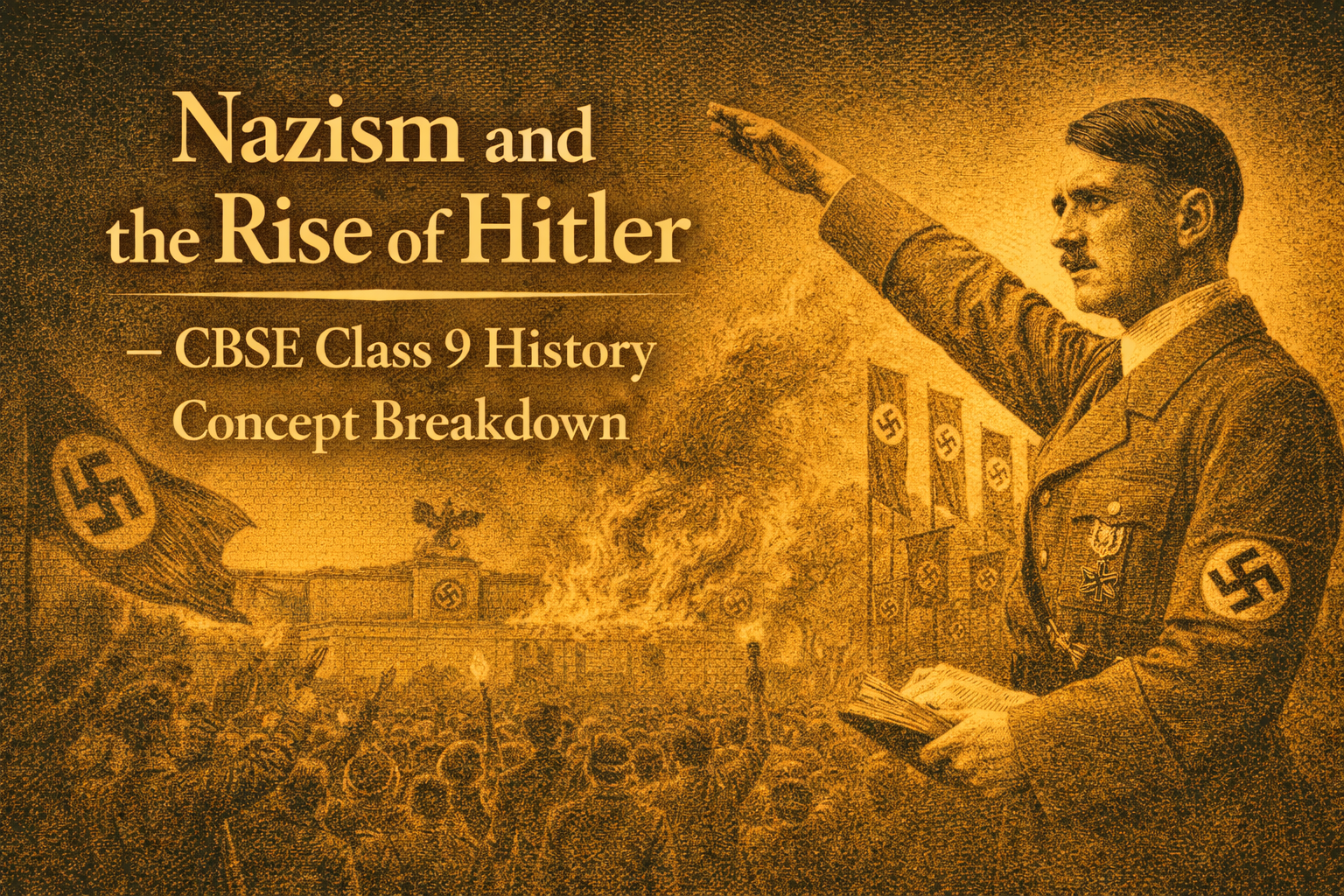
Nazism and the Rise of Hitler — CBSE Class 9 History Concept Breakdown
How Economic Collapse, Fear, and Identity Crisis Shaped Extremism
By Navya Chandravanshi | Class 9 History | CBSE
Economic collapse, fear, and identity crisis shaped extremism.
Class 9 History requires understanding the conditions — not just memorising events.
Have You Ever Wondered How an Entire Country Followed One Man Into Destruction?
In this article, you will learn:
- What conditions allowed Hitler and the Nazi Party to rise to power
- How ordinary Germans became supporters of an extremist regime
- What propaganda, fear, and economic collapse actually did to a society
- What CBSE Class 9 expects you to write in your exam — and what most students miss
By the end, you will understand that Nazism was not an accident.
It was a process.
And understanding that process is exactly what your examiner is looking for.
A Story from a Broken Economy
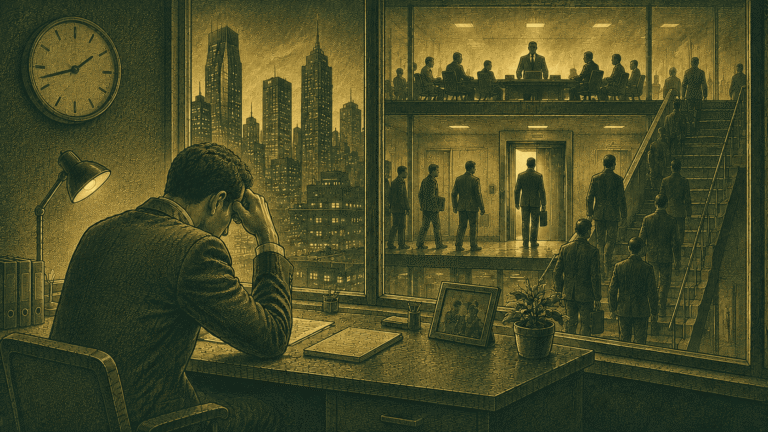
Arjun’s father lost his job at the mill in 1931.
Not because he was lazy.
Not because he made a mistake.
The mill simply closed.
Then the shop down the road closed.
Then three more families on their street lost their income in the same month.
Arjun watched his father — a proud, hardworking man — sit silently at the table with no money, no work, and no explanation for why this had happened.
Then one evening, a man came to their neighbourhood.
He spoke loudly.
He had answers.
Simple ones.
He said:
Your suffering is not your fault.
Someone else caused this.
Follow me, and I will fix it.
Arjun’s father, who had never cared much about politics, started listening.
That man had a name:
Adolf Hitler.
And millions of families like Arjun’s were listening at the same time.
Why People Were Ready to Listen
Think about what Arjun’s father was experiencing:
- Unemployment
- Humiliation
- Fear
- Loss of identity
Now multiply that across Germany.
By the early 1930s:
- Millions were unemployed
- Businesses were collapsing
- Middle-class savings disappeared
- People had lost trust in democracy
Germany had also recently lost World War I.
The Treaty of Versailles forced Germany to:
- Accept blame for the war
- Pay heavy reparations
- Reduce military strength
- Give up territory
Many Germans felt humiliated.
When societies experience fear, economic collapse, and loss of national pride together, people often stop looking for complex explanations.
They begin looking for certainty.
Hitler offered certainty.
What Was Nazism?
Nazism came from the German word:
Nationalsozialismus — National Socialism.
The Nazi Party was officially called:
National Socialist German Workers’ Party (NSDAP)
Its leader was Adolf Hitler.
Nazism was a totalitarian and ultranationalist ideology built around:
- Extreme nationalism
- Antisemitism
- Hatred of communism
- The idea of one supreme leader — the Führer
- Total control over society
Nazism blamed specific groups for Germany’s suffering and promised national rebirth through obedience and racial purity.
How Hitler Rose to Power — Step by Step
1. Germany Lost World War I (1918)
Germany surrendered in 1918.
But many Germans believed the army had not truly been defeated in battle.
This created the “stab-in-the-back myth.”
Many people falsely believed Germany had been betrayed internally by politicians and minorities.
This myth later became a powerful Nazi propaganda tool.
2. The Treaty of Versailles (1919)
The treaty imposed harsh conditions on Germany:
- War guilt clause
- Huge reparations
- Territorial losses
- Military restrictions
Many Germans saw the treaty as humiliating and unfair.
Hitler repeatedly used this anger in speeches.
3. The Weak Weimar Republic
Germany’s democratic government after World War I was called the Weimar Republic.
But it faced serious problems:
- Political instability
- Violence from extremist groups
- Economic crises
- Low public trust
Many Germans blamed democracy itself for the country’s weakness.
4. The Great Depression (1929)
The global economic crash devastated Germany.
By 1932:
- Over 60 lakh people were unemployed
- Banks collapsed
- Factories shut down
- Middle-class families lost savings
Fear spread rapidly across society.
Economic desperation made extremist promises more attractive.
5. Hitler’s Message
Hitler offered:
- National pride
- Strong leadership
- Simple explanations
- Clear enemies to blame
He blamed:
- Jews
- Communists
- The Weimar government
His speeches were emotional, repetitive, and designed to create certainty during chaos.
The Nazi Party vote grew rapidly:
- 1928 — 2.6%
- 1932 — 37%
6. Hitler Becomes Chancellor (1933)
In January 1933, President Paul von Hindenburg appointed Hitler as Chancellor.
Many conservative politicians believed they could control him.
They failed.
After the Reichstag Fire, Hitler used emergency powers to suspend civil liberties.
Within months, democracy collapsed from inside the political system itself.
Important Terms Every CBSE Student Should Know
Weimar Republic
Germany’s democratic government from 1919 to 1933.
It struggled because of:
- Economic instability
- Political violence
- Lack of public trust
Hyperinflation
A situation where prices rise extremely fast and money loses value.
In Germany during 1923:
- Bread prices became enormous
- People carried money in wheelbarrows
- Savings became worthless
Propaganda
Information designed to influence beliefs and emotions.
The Nazis used:
- Radio
- Posters
- Films
- Mass rallies
Joseph Goebbels led Nazi propaganda.
The goal was repetition and emotional control.
Gestapo
The secret police of Nazi Germany.
People feared the Gestapo because:
- Arrests could happen secretly
- Criticism became dangerous
- Fear spread through society
Concentration Camps
Places where political prisoners, Jews, Roma people, disabled people, and others were imprisoned.
Many faced:
- Forced labour
- Starvation
- Violence
- Mass murder
These camps became central to the Holocaust.
Enabling Act (1933)
A law that allowed Hitler to rule without parliamentary approval.
This effectively ended German democracy.
Historical Examples
The 1932 Election
The Nazi Party became the largest political party in Germany.
Democracy weakened gradually through crisis and fear.
The Night of the Long Knives (1934)
Hitler ordered the killing of rivals inside his own movement.
This showed:
- Absolute loyalty was expected
- Violence had become normalised
- No opposition was safe
The Experience of Ordinary Families
Millions of German families experienced unemployment, insecurity, and humiliation during the Great Depression.
Extremist politics became attractive because democratic institutions seemed unable to solve the crisis.
Common Mistakes Students Make
Mistake 1 — “Hitler took power through a military coup”
Incorrect.
Hitler was appointed Chancellor legally.
Nazism destroyed democracy using democratic institutions themselves.
Mistake 2 — “Only poor or uneducated people supported Hitler”
Support came from many groups:
- Middle-class citizens
- Industrialists
- Professionals
- Educated Germans
Fear, nationalism, and propaganda affected all sections of society.
Mistake 3 — “The Holocaust happened suddenly”
The Holocaust developed gradually:
- 1935 — Nuremberg Laws
- 1938 — Kristallnacht
- 1941 onwards — systematic genocide
Years of propaganda prepared society for discrimination and violence.
Timeline Students Should Remember
- 1918 — Germany loses World War I
- 1919 — Treaty of Versailles and Weimar Republic
- 1923 — Hyperinflation crisis
- 1929 — Great Depression begins
- 1932 — Nazis become largest party
- 1933 — Hitler becomes Chancellor
- 1933 — Enabling Act
- 1935 — Nuremberg Laws
- 1938 — Kristallnacht
- 1939 — World War II begins
- 1941–45 — Holocaust
- 1945 — Germany surrenders
The Core Idea in Simple Words
Germany experienced:
- Military defeat
- Economic collapse
- Political instability
- National humiliation
The Weimar government failed to solve these crises.
Hitler offered certainty, identity, and someone to blame.
Millions supported him.
Once in power, he dismantled democracy and created a totalitarian state built on fear, propaganda, and racial persecution.
Conclusion
The rise of Nazism was not a sudden accident.
It was a process shaped by economic suffering, political weakness, propaganda, and fear.
History matters because these conditions are not unique to one country or one century.
When societies lose trust, when fear becomes stronger than critical thinking, and when simple answers replace careful reasoning — democracies become fragile.
That is the real lesson behind this chapter.
Practice Questions
- What were the main reasons for the rise of Hitler and the Nazi Party in Germany?
- How did the Treaty of Versailles contribute to the rise of Nazism?
- Explain the role of propaganda in strengthening Nazi rule.
- What was the Enabling Act of 1933, and why was it important?
- “Hitler came to power legally.” Explain.
Frequently Asked Questions
Why did ordinary Germans support Hitler?
Economic suffering, national humiliation, fear, and propaganda made Hitler’s promises attractive to millions.
What is the difference between Fascism and Nazism?
Fascism is a broader authoritarian ideology.
Nazism was a specific form of fascism centred on racial ideology and antisemitism.
Why did the Weimar Republic fail?
Because of economic crises, political instability, extremist violence, and weak public trust.
What were the Nuremberg Laws?
Laws passed in 1935 that removed Jewish citizenship rights and legalised racial discrimination.
Is the Holocaust the same as World War II?
No.
The Holocaust was a systematic genocide carried out by Nazi Germany during the war.
This article follows the CBSE Class 9 History syllabus:
India and the Contemporary World — I, Chapter 3
Based on NCERT concepts and established historical research.
About the Author
Navya Chandravanshi
I write about living systems — from constitutions to classrooms — focusing on how human behaviour, institutions, and pressure shape societies.