Caste vs. Race: A Structural Comparison
How Hierarchy Shapes Power, Inequality, and Identity Across Societies
Two Systems, One Function
Start with what both systems do before examining how they do it.
Caste and race are both technologies of stratification. They exist to solve a specific political problem: how to maintain the unequal distribution of land, labour, capital, and dignity across generations without requiring constant physical coercion. The solution, in both cases, is to make the hierarchy feel inevitable — to move it from the category of political arrangement into the category of natural fact.
Once that move is made, the system becomes self-enforcing. People police their own position and the positions of others. Violation of hierarchy triggers social sanction — shame, ostracism, violence — without requiring the state to intervene in every instance. The state intervenes at the edges. The centre holds itself.
This is the structural core that both systems share. Everything else — the specific markers used, the degree of rigidity, the official ideology, the response to reform — varies significantly between them.
Caste: The Architecture of Purity
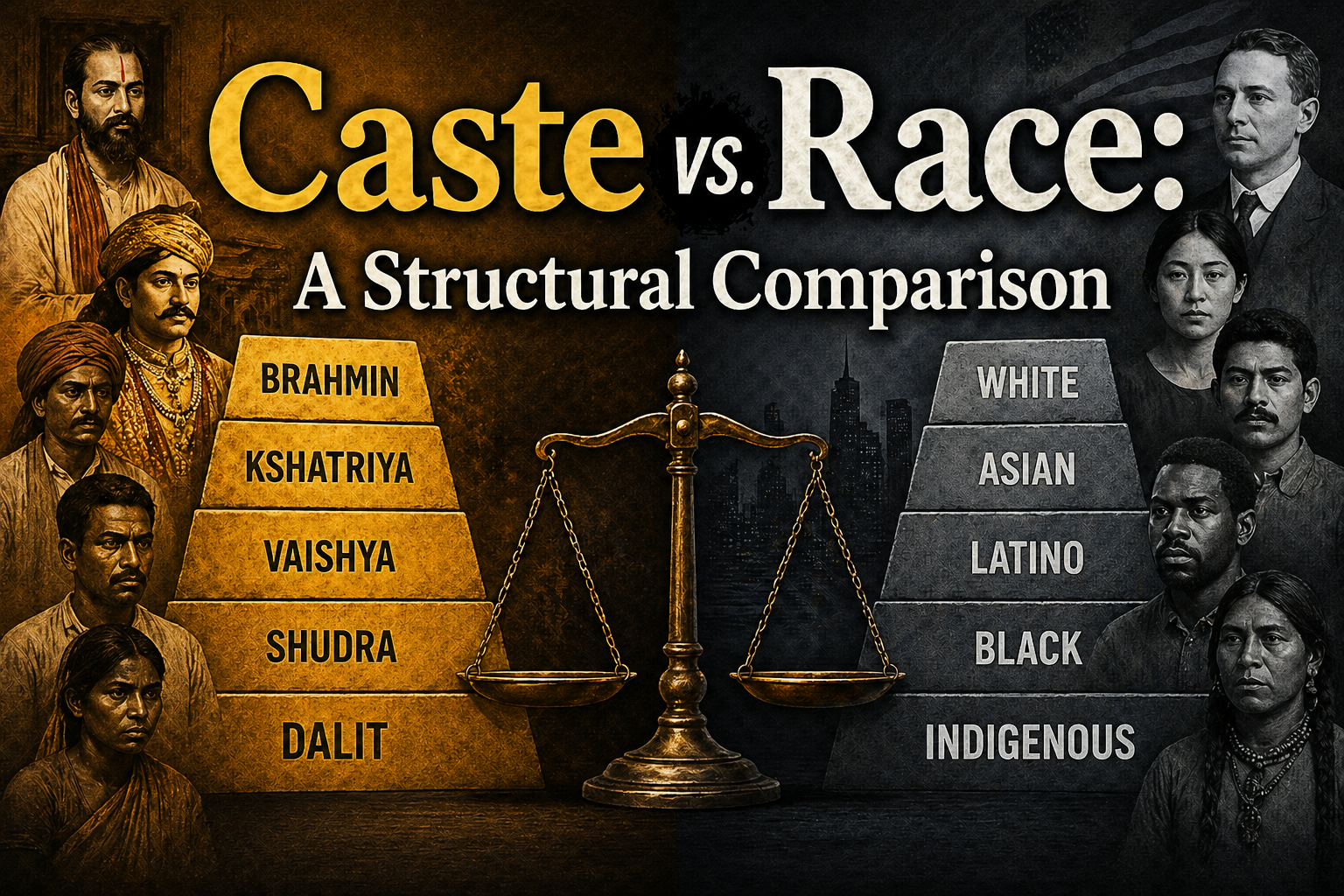
The caste system, in its South Asian form, is among the oldest functioning social hierarchies on earth. Its roots trace to the varna divisions in Vedic texts — Brahmin, Kshatriya, Vaishya, Shudra — and the later, more granular jati system of occupational and kinship-based sub-castes that now numbers in the thousands.
The organising principle is purity and pollution, not biology in the genetic sense. The hierarchy assigns ritual status based on proximity to pure versus polluting substances and occupations. Brahmin priests at the apex; Dalit communities — those outside the four-varna system, formerly called Untouchables — at the base, assigned work involving death, bodily waste, leather, and sanitation.
Several features make this architecture distinct:
Endogamy as Enforcement
Caste reproduces itself through marriage restrictions. You are born into a jati, and marriage outside it is socially prohibited and, historically, legally prohibited as well. This keeps caste identity stable across generations without requiring a visible physical marker. A person cannot be identified as Dalit from appearance alone in most cases. The system runs on genealogy, name, village of origin, and occupation — not visual inspection.
Occupation as Inheritance
Jati determined not just social status but economic function. Specific communities held hereditary rights — and hereditary obligations — to specific occupations. A family of leather workers produced leather workers across generations not purely by choice but because the system foreclosed alternatives: land ownership, education, access to markets, and physical safety were all conditioned on maintaining occupational position.
Religious Legitimation
The system was embedded in a cosmological explanation. The Purusha Sukta hymn in the Rigveda presented the four varnas as emanating from the body of the cosmic person — Brahmins from the mouth, Kshatriyas from the arms, Vaishyas from the thighs, Shudras from the feet. Suffering one’s caste position was reframed as karma — the consequence of actions in a previous life, requiring acceptance in this one as the path toward better rebirth.
This is not incidental theology.
It is a load-bearing ideology.
It converts the political question of why one group dominates another into a spiritual question about individual souls working out their cosmic debt. The oppressed person is not a victim of a structure. They are participants in a divine accounting system.
B.R. Ambedkar identified this mechanism with precision. He argued that the caste system could not be reformed from within Hinduism as practised, because the religious framework was not separate from the hierarchy — it was the hierarchy’s primary justification. His 1936 text Annihilation of Caste remains the most systematic structural critique of the system in its own terms.
Race: The Architecture of Biology
The racial hierarchy that structured the Atlantic world from the sixteenth century onward was built on a different ideological foundation: inherited biological difference. The claim was not that some souls had accumulated bad karma. The claim was that some bodies were fundamentally inferior — intellectually, morally, and physically — and that this inferiority was transmitted through blood.
This was not ancient cosmology.
It was modern science, or what passed for it.
Racial classification systems emerged as formal intellectual projects in the seventeenth and eighteenth centuries, developed by European naturalists who applied Linnaean taxonomy — the same system used to classify plants and animals — to human populations. Carolus Linnaeus, Johann Friedrich Blumenbach, and later Samuel Morton and Josiah Nott produced hierarchies that ranked human groups, placed Europeans at the apex of civilisation, and presented these rankings as empirical observations rather than political arguments.
The timing was not coincidental.
The transatlantic slave trade required an ideological infrastructure. Enslaving people requires believing — or at a minimum publicly asserting — that the people being enslaved are not fully persons. Racial science provided that infrastructure on an institutional scale. It moved slavery from a pragmatic economic arrangement into an expression of natural order.
Several features of the racial system are structurally distinct from caste:
Visibility as a Mechanism
Race, in the American context, operated primarily through visual identification. Skin colour, hair texture, and facial features — these became the surface markers the system used to assign position. This created a different enforcement architecture from caste. A person could be identified and categorised by a stranger on the street, without genealogical knowledge. The hierarchy was written on the body in a way that caste typically is not.
The One-Drop Rule
American racial classification developed the hypodescent principle: any documented African ancestry, regardless of degree, assigned a person to the subordinate category. This served economic function — it prevented the children of enslaved women and white men from claiming free status — and it reveals the system’s underlying logic. Race in America was not about accurately describing ancestry. It was about maximising the population legally available for exploitation.
Legal Construction
American race was built through law in ways that caste was not, at least not in the same period. Slave codes defined who could be enslaved. Black codes after emancipation defined what freedmen could and could not do. Jim Crow laws segregated public space, transportation, education, and housing. The legal apparatus was explicit, detailed, and enforced by state violence.
This legal explicitness created a specific vulnerability that caste did not share in the same form: the laws could, in principle, be repealed. And they were — formally, through the Civil Rights Act of 1964, the Voting Rights Act of 1965, and related legislation.
What the repeal of the laws did not do, and this is the critical point, was to repeal the material consequences of three centuries of accumulated disadvantage. Wealth is intergenerational. Residential segregation, once established through legal means, persists through market mechanisms after the legal mandate is removed. Educational inequality, built on property tax funding of schools, continues without any explicitly racial law to sustain it. The legal architecture came down. The economic architecture it had constructed stayed.
Where the Two Systems Touch — and Where They Don’t
Isabel Wilkerson’s 2020 book Caste: The Origins of Our Discontents argued that race in America is best understood as a caste system — that the United States, India, and Nazi Germany represent three distinct versions of the same underlying structure. The comparison generated significant discussion and some serious analytical pushback.
The pushback from scholars, including Suraj Yengde and others, centered on a specific point: the comparison, while illuminating in some respects, risks flattening the particular features of each system in ways that misguide intervention.
The substantive disagreements worth examining:
Rigidity
Caste in India is, by most measures, more rigid than racial hierarchy in the United States. Social mobility across caste lines is constrained by endogamy in ways that racial hierarchy in America is not. A Black American can, under current law and in many current circumstances, marry a white American without social sanction from the state. A Dalit marrying outside their jati still faces community violence in many parts of India — not historical violence, but contemporary violence. The mechanisms that enforce caste boundaries have remained more intact across the reform era than the mechanisms that enforced racial hierarchy in America.
Visibility and Anonymity
Because caste is not visually legible to strangers in the way race is, a Dalit person in an urban environment can, in some contexts, pass — conceal caste identity and operate in spaces that would otherwise be closed. This possibility does not eliminate discrimination; it creates a different texture of discrimination, one organised around disclosure and concealment rather than immediate visual categorisation. The experience of carrying a stigmatised identity that is invisible until revealed has different psychological and strategic dimensions from carrying an identity that is immediately apparent.
The Role of Diaspora
Racial hierarchy in America was built in the specific context of Atlantic slavery and its aftermath. It is, in origin, a system for managing a captive labour population brought from one continent to another. Caste hierarchy in South Asia is organised around land, village, and occupation in a context of continuous habitation. When South Asian immigrants arrive in Western countries, they frequently bring caste practice with them — discrimination against Dalit people by higher-caste South Asians has been documented in the United States, United Kingdom, and Canada. This exportability shows that caste operates through community enforcement mechanisms that do not require a state apparatus to function.
Ideological Flexibility
American racial ideology has shown a greater capacity for surface revision than caste ideology. Explicit biological racism — the claim that Black people are genetically inferior — is no longer a defensible public position in mainstream American discourse. The hierarchy it produced has persisted, but the stated justification has shifted. Caste’s religious justification has proven more durable in its original form. Ambedkar’s critique — that the ideology and the hierarchy are structurally inseparable — has been more consistently validated by caste’s resistance to reform than by race’s.
What Reservation and Affirmative Action Reveal
Both India and the United States developed formal remediation policies for their respective hierarchies. The comparison between them is analytically useful precisely because the differences are instructive.
India’s reservation system, embedded in the Constitution of 1950 primarily through Ambedkar’s influence, set aside percentages of government jobs, legislative seats, and educational institution places for Scheduled Castes, Scheduled Tribes, and later Other Backward Classes. The targets were specific, the percentages were explicit, and the constitutional mandate was direct.
Ambedkar fought for this not because he believed it was sufficient but because he believed nothing else had any possibility of producing material change against a hierarchy that controlled land, education, and employment through community enforcement rather than individual preference. The reservation system was not designed to change minds. It was designed to change access — to create a class of educated, economically independent Dalit people who could then exert pressure on the system from within institutions rather than from outside them.
The results have been mixed in the way that forced redistribution of opportunity is always mixed. A Dalit middle and professional class exists today that did not exist in 1950. The material conditions of the majority of Dalit people — rural, landless, engaged in the same occupations their grandparents held — have changed far less. The reservation system reached the institutions. It did not reach the village economy, which remains organised on caste lines.
American affirmative action, by contrast, was never constitutionally mandated in explicit terms. It developed through executive orders, agency regulations, and court interpretation, and it was explicitly race-neutral in its formal framing — it could not, legally, say Black people in the way Indian reservation policy says Scheduled Castes. This legal constraint shaped the policy in ways that limited its reach and increased its vulnerability to legal challenge, which materialised across decades of Supreme Court decisions, ultimately restricting its application.
The comparison reveals a structural insight: policies designed to remedy hierarchy are shaped by the specific legal architecture of each system. India’s caste-explicit constitutional remedy could be caste-explicit because the Constitution named the problem explicitly. America’s race-explicit legal history made race-explicit remediation constitutionally contested in ways that Indian caste reservation was not — at least not in the same initial period.
Identity: Chosen, Assigned, and Weaponised
Both caste and race produce specific dynamics around identity — the relationship between how a system categorises a person and how that person experiences and uses that categorisation.
In both cases, stigmatised identity moves through roughly three political phases:
Denial
The first response to inherited stigma is often the attempt to escape it — to pass, to assimilate, to distance oneself from the marked category. Among upwardly mobile Dalit people in urban India, concealing jati identity is a practical survival strategy. Among Black Americans in the post-Civil War period, passing as white — where phenotype permitted — was one of the few routes to economic access otherwise foreclosed.
Reclamation
Political movements in both contexts eventually inverted the stigma, converting the marked identity into the basis of solidarity and resistance. The Dalit Panthers, founded in Maharashtra in 1972 and explicitly modelled on the American Black Panther Party, took the most stigmatised identity and converted it into a political organising capacity. The Black Power movement did the same thing a decade earlier. In both cases, the move was the same: the category the dominant system used to exclude becomes the category the subordinated group uses to organise.
Strategic Deployment
Mature political movements in both contexts develop sophisticated relationships with identity categories — using them when they produce solidarity and legal protection, resisting them when they impose essentialism. Dalit feminists navigating the intersection of caste and gender discrimination, Black feminists developing intersectional frameworks — both are working on the same structural problem. The categories assigned by the hierarchy are the available tools for fighting the hierarchy, but they also constrain the fight by reinscribing the categories.
This is the tension both movements live inside, and it does not have a clean resolution. The categories were not chosen. Abandoning them does not make the hierarchy they organise disappear. Using them risks naturalising the distinctions the hierarchy imposed.
What Comparison Produces — and What It Risks
The comparison between caste and race is analytically productive when it identifies structural homologies — similar mechanisms producing similar outcomes in different contexts. It is analytically dangerous when it collapses specific differences in ways that misguide policy or misrepresent experience.
The productive findings from careful comparison:
- Hierarchies that combine economic function with ideological justification are more durable than hierarchies that rely on either alone. Both caste and race serve economic purposes and carry religious or scientific legitimation. Remove the legal support structure, and both persist through community enforcement and accumulated material inequality.
- Reform that targets legal architecture without targeting economic architecture changes the stated rules without changing the distribution of resources. Both the American civil rights legislative victories and Indian constitutional reservations demonstrated this limit.
- Stigmatised identity, when converted into political solidarity, becomes one of the primary tools for challenging the hierarchy — but that conversion does not happen automatically. It requires political organisation, ideological work, and leaders who are willing to inhabit the stigmatised category publicly. Ambedkar and Douglass both did this, across different systems, in ways that were personally costly and politically transformative.
The risks of comparison:
- Treating caste and race as the same system — rather than as two instances of a structural type — can erase the specific mechanisms each uses and the specific interventions those mechanisms require. Dalit discrimination in Silicon Valley is not the same as anti-Black discrimination in the same environment. The history, the mechanism, the community dynamics, and the appropriate institutional response differ in ways that matter.
- Comparison can also produce a false universalism that depoliticises each specific struggle — if all hierarchies are the same, then the specific political demands of specific communities can be absorbed into an abstract framework that serves no one’s concrete interest.
Where This Breaks
- Neither system operates identically across all contexts. Caste functions differently in urban India than in rural India; race functions differently in 2024 than in 1964. Treating each as monolithic produces analytical errors.
- Legal reform is a necessary but not sufficient condition for dismantling either hierarchy. Both systems have demonstrated the capacity to persist through economic and social mechanisms after legal support is withdrawn.
- The comparison between caste and race is most useful at the structural level and least useful at the experiential level. The feeling of living inside one of these systems is not transferable through analogy.
- Intersections complicate both systems. Dalit women face discrimination that is neither purely caste-based nor purely gender-based. Black women in America navigate hierarchies that are neither purely racial nor purely gendered. Any analysis that treats either system as a single-axis hierarchy will systematically misread the experience of those at intersecting subordinations.
Conclusion
Caste and race are not the same argument made twice. They are two versions of the oldest human political problem: how do those who hold power justify holding it, and how do those who are kept from it find the tools to take it back?
The comparison does not resolve that problem.
It clarifies what the problem actually is — which is, in the end, what structural analysis is for.