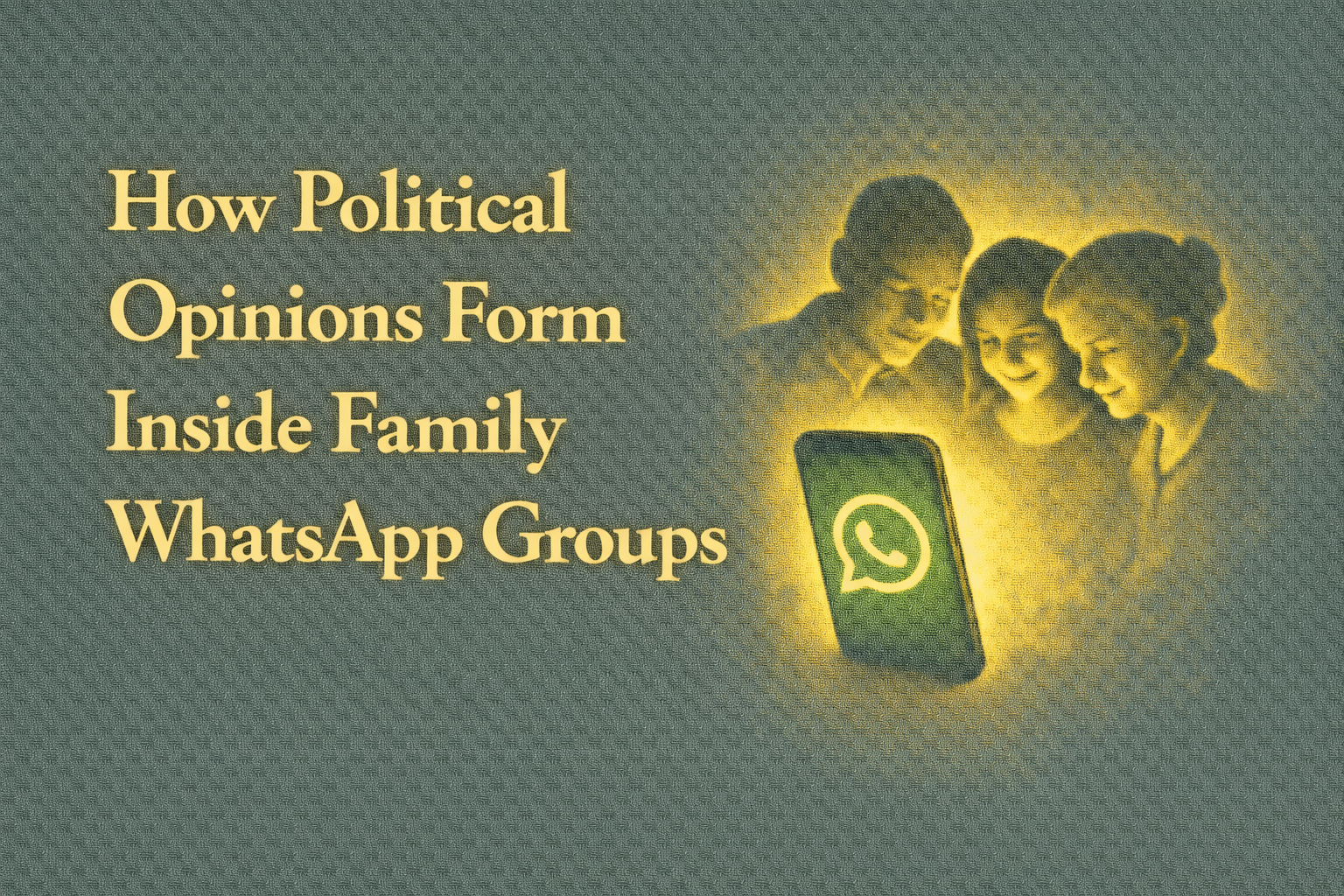
How Political Opinions Form Inside Family WhatsApp Groups
The Group Doesn’t Ask You What You Think. It Tells You.
The mechanism runs the same way every time. A message arrives in a group of 47 people. Someone reacts before others have opened it. By the time the fifth person responds, the frame is already fixed. What follows usually isn’t evaluation. It is alignment.
The political opinion that forms inside a family WhatsApp group is not built on information.
It is built from social weight:
- who sent it
- who agreed first
- how many people reacted before you arrived
How the Group Actually Works
The family group is not a news channel.
It does not function like one, even when it carries news.
Every message arrives wearing the identity of the sender.
When Dhruv’s chacha in Lucknow forwards a political video, the video does not land as a claim to be evaluated.
It lands as a signal from someone Dhruv already trusts.
That trust was built over years:
- weddings
- family calls
- funerals
- festivals
The message inherits the relationship.
The viewer is not reading only the content.
They are also reading the sender.
This is the first mechanism:
Source substitution.
The credibility of the person replaces the credibility of the content.
A forwarded message from a trusted uncle often feels more believable than a headline from a news channel watched for years.
The channel speaks to the family.
The uncle speaks with them.
What Forwarding Actually Does
Deepa opens the group.
Five people have already reacted.
She reads the reactions before watching the video.
That changes the meaning of the video before it even begins.
The reactions are not evaluations of the content.
They are social coordinates.
They tell her where the group already stands.
By the time she presses play, she is no longer deciding:
“Is this true?”
She is deciding:
“Do I align with this group position or separate from it?”
Forwarding intensifies this effect.
A message forwarded across multiple groups by multiple relatives does not become more credible because it repeats.
But from inside the system, it feels that way.
The fourth encounter with the same claim does not feel like repetition.
It feels like convergence.
The brain treats volume as verification.
It is not.
It is one message travelling through many trusted people.
The “Forwarded many times” label is actually the most honest signal in the entire system.
Most people do not read it as a warning.
They read it as importance.
The Social Cost of Private Doubt
Navya had a question forming.
Something in the numbers felt wrong.
She placed the phone face down.
The family group is not a place where doubt travels easily.
A correction inside the group does not land as a factual correction.
It lands as a challenge to the person who shared the message.
And through that person, to everyone who agreed with it.
The social cost is specific:
- the next wedding
- the next family gathering
- the next phone call
- the next conversation involving her parents
These are not abstract consequences.
They are the infrastructure of her social life.
So the doubt stays private.
The agreement stays public.
And slowly, the group builds a consensus that many people inside it do not fully hold.
But they continue performing it because the performance preserves belonging.
Agreement inside the group does not just protect relationships.
It reduces the psychological cost of standing alone against people whose approval structures everyday life.
This produces what looks like total agreement.
But often, it is only the absence of visible disagreement.
Why Repetition Turns Into Belief
The same political claim reaches Dhruv six times across three weeks.
From:
- his chacha
- a cousin
- his father over chai
- two different family groups
- a neighbour sharing the same clip
After the sixth encounter, Dhruv is no longer asking:
“Is this true?”
He is asking:
“How did I not know this earlier?”
That shift matters.
The movement from evaluation to acceptance does not require a dramatic moment of persuasion.
It requires repetition across trusted people over enough time.
The brain is not designed for a system where one message can appear independently through dozens of familiar faces within hours.
Volume starts feeling like proof.
Familiarity starts feeling like truth.
This mechanism does not belong to one ideology.
It works in every political direction.
The group’s existing lean determines the direction.
The forwarding mechanism deepens it.
What the Opinion Feels Like From Inside
By the end of the month, Dhruv holds a stronger political opinion than he did earlier.
He has not read major new analysis.
He has not deeply researched policy.
He has mostly read the family group.
The opinion still feels self-generated.
That detail matters.
Nobody directly instructed him what to think.
There was no visible moment of persuasion.
Only dozens of small moments:
- reactions
- forwards
- agreement
- shared emotional tone
- silence around doubt
And slowly, the group position became psychologically comfortable enough to feel personal.
Navya still carries her private doubt.
She still does not post it.
She watches the group the way someone watches a strong current from the bank:
- aware of its direction
- uncertain about entering it
- aware that everyone else already has
The newspaper in the corner has not been touched in three days.
The television remote remains where it always is.
The Android phone vibrates again.
Someone forwarded something new.
Five people have already reacted.
How This System Produces Political Opinion
- Source substitution: the sender’s credibility replaces the content’s credibility
- Reaction framing: people read the group’s position before evaluating the content itself
- Volume as verification: repeated exposure across trusted people feels like independent confirmation
- False consensus: private doubt stays hidden while public agreement accumulates
- Directionless amplification: the mechanism works across every ideology and strengthens whatever lean already exists
Frequently Asked Questions
How do family WhatsApp groups shape political opinions differently from news channels?
News channels speak to viewers.
Family groups speak through people viewers already trust.
A forwarded message from a relative carries years of emotional credibility automatically.
That makes belief transfer faster and deeper than traditional media.
Why doesn’t disagreement correct misinformation inside family groups?
Because correction feels personal.
The disagreement is experienced not as:
“You corrected a fact.”
But as:
“You challenged a family member publicly.”
The social cost becomes larger than the informational correction.
Does this mechanism work across all political beliefs?
Yes.
The mechanism itself is politically neutral.
It strengthens whatever direction the group already leans toward.
Why does repetition feel like proof?
Because repeated exposure across trusted people feels like multiple independent confirmations.
The brain often interprets familiarity as reliability.
The message feels established before it is verified.
When do people realise the group shaped their opinion?
Rarely while still inside the process.
Recognition usually requires distance:
- social distance
- physical distance
- time away from the group
From inside the mechanism, the opinion feels self-generated.
Final Thought
The political opinion formed inside a family WhatsApp group is not automatically false.
But it is usually not formed through the process people believe they are using.
Most people think they arrived at the opinion independently.
The group arrived there first.