Why the Promotion Didn’t Come This Year (And Why It Won’t Come Next Year Either)
Hard work fills the chair. Direction moves you out of it. Most people spend years confusing the two.
The promotion did not come this year either. You know the reason, and the reason is not your performance. You showed up. You delivered. You covered for people who left and absorbed their work without the title that would have followed. The reason is something you have not fully named yet, because naming it would require doing something with it.
The year passed the way the last one did. Busy. Tired. Technically moving. Net distance: the same chair.
There is a belief that holds all of this in place, and it is not a weak belief. It is the kind that has evidence behind it.
The belief: you cannot redirect until you have enough built to redirect from. Jumping toward a new direction before you are ready wastes what you already have and starts the clock over in an unfamiliar place. The people who pivot carelessly lose years recovering. You are not being passive. You are being strategic. Building the foundation before making the move.
This is a real argument. It is also the argument that is now in its second or third year of running, and the foundation it was supposed to produce has not produced a different move.
Here is what the belief is protecting: the identity of someone who finishes what they start. Who does not abandon things? Who does not confuse impatience for insight? You have watched people leave roles impulsively, burn bridges, take a step sideways, and call it growth. You are not that. You see the full picture. You wait for the right moment.
The right moment is the thing that has not arrived.
Hard work filled the chair. Direction would have moved him out of it. The two things are not the same currency, and the job took only one of them and called it enough.
Eight years at the same security desk. Same shift. Same spot. The cushion shaped itself to the body that sat there. The armrests wore smooth. The company got exactly what it needed. The person who sat there got exactly what the company required them to have — enough to stay, not enough to leave.
That is not a story about someone who did not work hard. That is a story about a direction.
What he had — the discipline, the reliability, the consistency — those are real qualities. In a different direction, they compound. In that chair, they held the shape of the cushion.
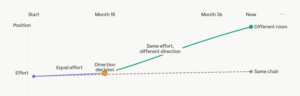
Think about what the last twelve months actually built. Not the hours. Not the deliverables. Not the performance rating. What compoundable thing exists now that did not exist at the start of the year? Not a task completed. A capability that someone else will pay more for. A piece of work that exists somewhere and can be shown. A relationship with a person who operates in the space you are trying to reach.
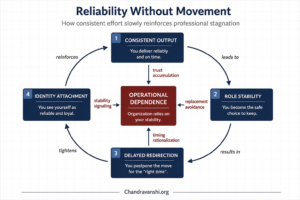
The honest answer for most people running this pattern is: not much that is new. A lot of that is more of the same. More competence in the thing already being done. More reliability inside a role that rewards reliability without rewarding growth. The hours were real. What they built is the question.

There is a specific moment this pattern becomes visible, and it usually happens by accident. Someone you started with — not someone exceptional, someone roughly equivalent — appears in a different role. One level up, different company, different title, salary that is meaningfully higher. You look at their profile for longer than you intend to. You review their trajectory. You try to find the thing they had that you did not.
You do not find it.
What you find, if you look closely enough, is a decision they made roughly eighteen months to two years ago that pointed them in a direction. Not a genius decision. Not a perfectly timed one. A decision with a direction attached to it — which meant the next eighteen months of effort went somewhere different from the eighteen months of effort before it.
The hardest part of this is not the redirecting. The hardest part is what the redirecting asks you to admit: that a significant portion of the time and energy already spent was going somewhere that was not going to produce what you told yourself it was going to produce. Not because the effort was wrong. Because the direction was.
Sunk effort is the most effective anchor there is. Not because people are irrational, but because they are honest. The cost was real. The time was real. Walking away from it means accounting for it, not deferring it further.
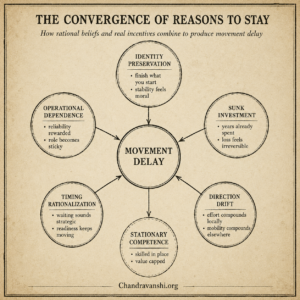
But here is what the accounting actually shows: the cost of the misdirected years is already paid. It is not recoverable. The question is only whether the next year gets added to that ledger or starts a different one. The answer to that question is a direction, not an amount of effort.
The internal argument has two sides that both sound correct. You have already invested too much in this direction to abandon it without something to show — leaving now means starting over, and starting over at this point costs more than it gains. But every month in the same direction is another month the gap between this position and the position you want grows wider. Waiting for the right moment is the same as choosing to wait.
Neither side is wrong. The argument is real.
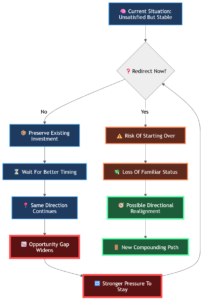
What is also real: the argument has been running for a while now. The chair is taking the shape of whoever sits in it long enough. The company will always need the role filled.
You already know what changes this. You have known for longer than the argument has been running. The question is not what to do.
The question is what you are calling the delay.