
The Marksheet Said One Thing. The Work Said Something Else.
What actually happens to people who scored 45 percent and started building anyway?
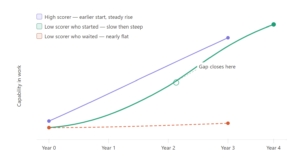
I scored between 40 and 55 percent throughout most of school. I am now in the same rooms, on the same deadlines, doing the same work as people who scored above 90. One afternoon — content work, client deadline, deliverables being reviewed — I looked around and realized nobody in that room knew what anyone had scored in tenth standard. Nobody had asked.
Nobody had remembered. The gap everyone had treated as permanent had closed quietly, without announcement, sometime in the years between the marksheet and that meeting.
The way it closed is the only part worth examining.
It did not close because the disadvantage disappeared. It did not close because circumstances got better before the building began. It closed because the building started before the circumstances improved — slowly, without a clear path, without the obvious tools, without any guarantee that the direction was right. The marksheet said one thing. The work said something else, over time, loudly enough that the marksheet stopped being relevant.
Most people are waiting for the sequence to reverse. For the gap to close first, then the building to begin. That sequence does not exist.

High marks give a faster start. That part is true and worth saying clearly — toppers get better college options, cleaner entry points, and more doors open early.
At the first gate — application filters, percentage cutoffs, initial shortlists — the number on the marksheet is still doing real work. Many large companies and government roles cut below a threshold before a human reads the name. That wall is real.
The first gate is not the whole race.
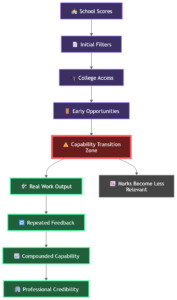
School measures a specific, narrow kind of readiness: how well you absorbed and reproduced information under controlled conditions.
Work measures almost none of that. Work measures whether you handle ambiguity without freezing. Whether you keep moving when the instructions stop. Whether you figure things out when nobody is watching, and there is no rubric for what correct looks like.
The skills that close the gap are not the skills the marksheet tests. They are built through a different process entirely — through the daily pressure of moving forward without full information, without a guaranteed outcome, without someone ahead of you on the same path showing that it leads somewhere real.
A faster start and the final destination are two separate things. Most people treat them as the same. The student with 90 percent has a faster start. What happens between the start and the destination is a different competition, running on different measurements, where the marksheet has already stopped doing work.
There is something that grows in the absence of obvious support that does not grow as easily when everything is provided.
When the fast lane is not available, you learn to read situations more carefully. You get used to moving without full certainty. You develop a tolerance for the space between knowing what to do and figuring it out mid-motion. That tolerance is not given by the situation as a gift. It is required by the situation, and you meet it, and over time it becomes the thing you bring to every room.
Nobody in that work meeting knew what anyone had scored. Not because everyone was being polite. Because past a certain point in any career, what the work demands has so little to do with what the exam was testing that the connection stops being visible.
The person working beside you on the same deadline, from the top college, with the marks you could not have matched — they are not in the room because of the marks. They are in the room because of what they built after the marks. So are you. The room is evidence that the gap has closed.
There is a version of this story that becomes an excuse — that marks do not matter, that the system was unfair, that you owe nothing to the situation because the situation was not fair to you.
That version is wrong.
Your parents used their time, their energy, and their money to get you to where you are standing. That part is done. What they could do, they did. The next part belongs to you — not because the situation is fair, but because waiting for fairness before building is a method for guaranteeing nothing gets built. Fairness does not arrive first, and then the work begins. The work begins, and what you build with it eventually creates the stability that fairness was supposed to provide.
Nobody is coming to fix the gap. Not a better score, you no longer have. Not a college you did not attend. Not a mentor who never appeared. The gap is real. The only productive response to a real gap is to start building across it, with whatever is available, from wherever you are standing right now.
The internal argument that does not resolve cleanly: starting without the right foundation means building on unstable ground — better to close the gaps properly first, then build something that holds.
The person who started two years ago without closing the gaps first is two years ahead. Not two years ahead in credentials. Two years ahead in the work itself — in what they can produce, what they can handle, what rooms they are already sitting in.
Both of these are true. The argument does not resolve. It just runs.
What does not run indefinitely is the window in which starting now and starting two years from now produce the same outcome. The 45 percent that felt like a verdict in a classroom was not a verdict. It was a number measuring one specific thing on one specific day. The work you do after that — for years, without applause, without a clear map, without the early advantages that make the beginning easier — that is what actually decides it.