Why Good Employees Keep Leaving (And Why Companies Keep Being Surprised)
Why Companies Lose Experienced Employees Even When Managers Are Good
Companies do not usually lose experienced employees because of one dramatic event.
Not the angry meeting. Not the toxic manager. Not the resignation email sent at midnight.
Those are visible endings.
The real mechanism begins much earlier, inside the systems companies use to measure success.
Hiring is visible. Retention is invisible.
And organisations optimise for what they can measure.
She Trained Her Replacement Without Realising It
She had been at the company for six years.
She knew:
- Which vendor responded faster to calls than emails
- Which client escalated issues after four hours of silence
- Which report looked automated but actually broke every month
- Why certain files existed in places that made no procedural sense
That knowledge was never formally documented.
It lived in judgment, memory, and repetition.
One Tuesday, she sat in an onboarding room introducing a new hire to systems she had quietly built over years.
Three months later, he held the same designation.
Six months later, he became her manager.
Nobody technically violated policy.
Nobody consciously decided to punish loyalty.
And yet the system produced exactly that outcome.
The Retention Problem Is Not Primarily a People Problem
Most explanations for employee turnover focus on direct causes:
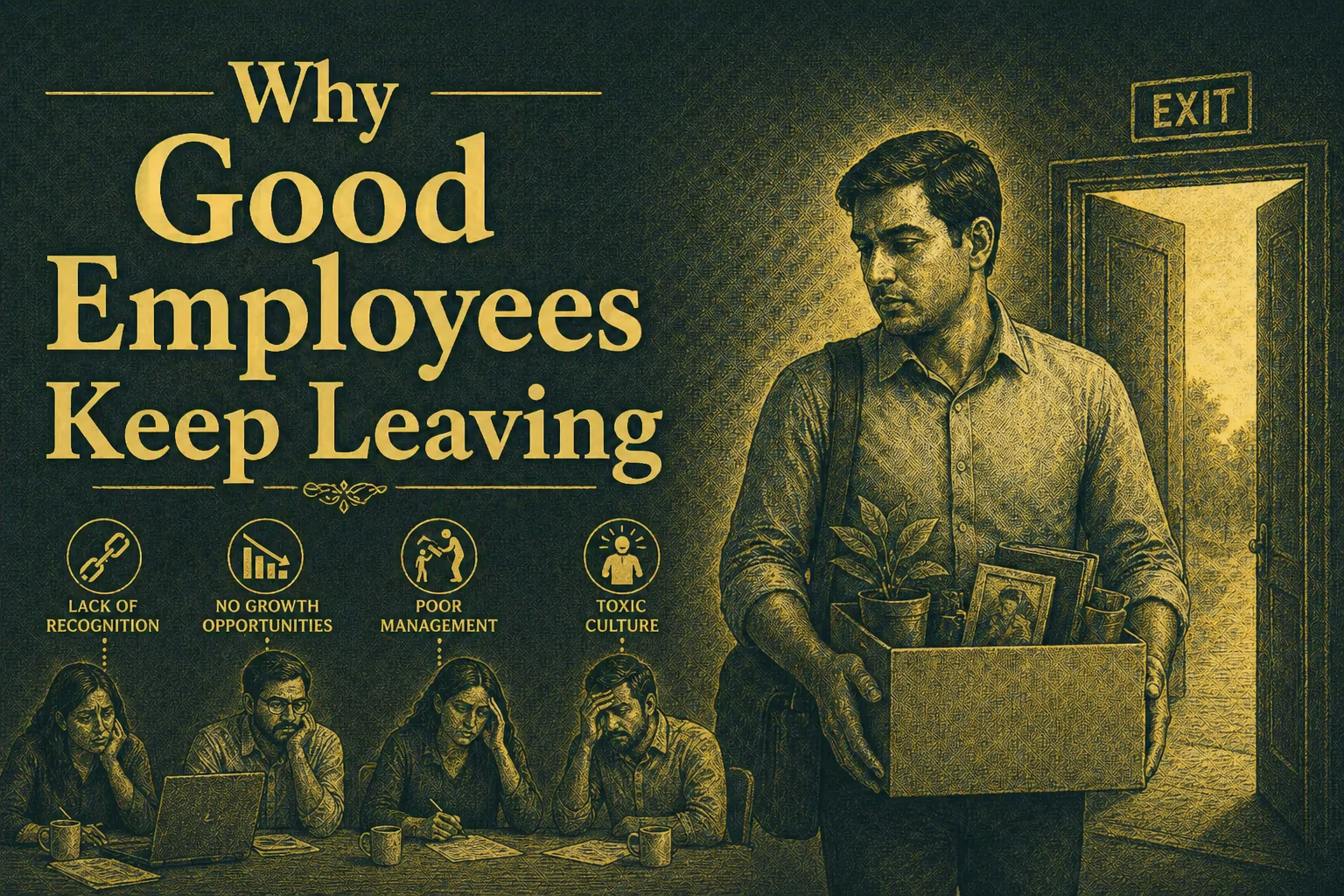
- Bad management
- Weak culture
- Poor compensation
- Limited promotions
These factors matter.
But they are often symptoms of something underneath them:
An incentive structure that makes replacing employees measurable and retaining them largely invisible.
Organisations naturally optimise around visible metrics.
Hiring produces visible movement:
- Headcount increases
- Job openings close
- Recruitment targets are achieved
- Announcements are made
- Dashboards update
Retention produces almost no visible event at all.
An experienced employee staying for a seventh year creates no celebratory metric.
No graph spikes upward because a client relationship survived quietly through institutional trust.
No dashboard records the disaster that never happened because someone already knew how to prevent it.
Invisible outcomes rarely receive budgets.
Why Hiring Gets Rewarded More Than Retention
Hiring Has Clear Metrics
Hiring managers are typically evaluated on:
- Roles filled
- Time-to-hire
- Recruitment velocity
- Headcount growth
What is rarely measured:
- Whether departures could have been prevented
- The productivity loss caused by turnover
- The institutional knowledge destroyed during exits
- The hidden cost of rebuilding expertise
The metric is role closure.
The departure itself becomes background noise.
Recruitment Is Treated as Investment
Training and retention budgets are frequently treated as operational costs.
Recruitment spending is often framed as investment in growth.
This distinction sounds technical, but it changes behaviour dramatically.
Executives protect investment budgets during uncertainty.
Cost centres are scrutinised and reduced.
The result:
- Training programs shrink
- Recognition systems weaken
- Internal raises lag behind market rates
- External recruitment remains aggressive
None of this requires malicious intent.
It is the logical outcome of the accounting structure itself.
Salary Compression Quietly Punishes Loyalty
One of the clearest structural problems is salary compression.
This happens when newer employees are hired near or above the compensation of experienced employees already inside the organisation.
Why does it happen?
Because external candidates negotiate against live market rates.
Internal employees negotiate against historical compensation bands adjusted gradually through annual reviews.
Over time, market wages rise faster than internal adjustments.
The employee who stayed becomes relatively underpaid compared to the employee who arrived yesterday.
This is how loyalty quietly turns into a financial disadvantage.
Employees rarely discover this through official channels.
They discover it through:
- Recruiter outreach
- Job postings
- Private salary conversations
- Accidental disclosures
The calculation that follows is rarely emotional.
It is practical.
A quiet realization forms:
The market values my experience more than my employer does.
The Most Expensive Stage Happens Before Resignation
By the time an employee resigns, the organisation has usually already absorbed months of hidden loss.
This is the stage almost no dashboard measures:
The withdrawal of discretionary effort.
Discretionary effort is the work people do beyond formal obligation:
- Fixing problems outside their role
- Preventing issues before escalation
- Mentoring informally
- Sharing institutional shortcuts
- Protecting clients through personal investment
This behaviour is rarely contractual.
Which means it is rarely measured.
When experienced employees feel structurally undervalued, they often do not resign immediately.
They reduce emotional ownership first.
The employee remains physically present while mentally disengaging from the organisation’s long-term wellbeing.
That transition is extraordinarily expensive because organisations depend heavily on invisible discretionary behaviour to function smoothly.
Why Tacit Knowledge Cannot Be Fully Replaced
Companies often assume knowledge can simply be documented before someone leaves.
That assumption is partly true and partly dangerously incomplete.
Some knowledge is explicit:
- Procedures
- Instructions
- Technical workflows
- Templates
But experienced employees also carry tacit knowledge:
- Judgment developed over years
- Pattern recognition
- Political awareness
- Client sensitivities
- Failure scenarios nobody documented
Tacit knowledge does not transfer cleanly through onboarding documents or exit interviews.
It transfers slowly through observation, repetition, and shared experience.
When experienced employees leave, part of that knowledge disappears permanently.
The organisation often notices the effects indirectly:
- Recurring operational mistakes
- Client frustration without obvious cause
- Technical instability
- Repeated reinvention of old solutions
- Slower decision-making
The company appears to be growing because headcount rises.
But underneath, institutional memory becomes thinner every year.
Why Exit Interviews Rarely Solve the Real Problem
Exit interviews happen after the important decision has already been made.
By that stage:
- The employee has already disengaged emotionally
- The market comparison has already happened
- The trust calculation is already complete
Exit interviews collect explanations after departure.
They rarely measure the earlier stage where retention was actually lost.
Trying to fix turnover through exit interviews is similar to studying customer churn after cancellation instead of tracking satisfaction while customers still remain.
Useful information arrives too late to change the outcome.
What Companies With Strong Retention Do Differently
Organisations that retain experienced employees effectively are not simply more compassionate.
They make retention measurable.
They Calculate the Real Cost of Departure
Strong organisations calculate:
- Recruitment expenses
- Onboarding costs
- Productivity ramp time
- Client disruption risk
- Tacit knowledge loss
- Team instability effects
Once these costs become visible, retention investments look financially rational instead of emotionally generous.
They Track Market Compensation Continuously
Instead of waiting for annual review cycles, they monitor market positioning regularly.
The goal is not necessarily to pay the highest salaries.
The goal is preventing loyalty from becoming economically irrational.
They Measure Retention at the Management Level
Managers are evaluated not only on hiring outcomes but also on:
- Voluntary turnover
- Internal mobility
- Team tenure stability
- Retention of high performers
Once retention affects managerial evaluation, behaviour changes quickly.
Where This Framework Applies Most Strongly
This retention problem becomes most severe in knowledge-intensive work:
- Engineering
- Specialist operations
- Client management
- Senior project leadership
- Complex technical systems
In these roles:
- Ramp times are long
- Tacit knowledge matters heavily
- Relationships carry economic value
- Judgment matters more than procedure alone
The cost of losing experienced employees is therefore much larger than replacing headcount numerically.
Frequently Asked Questions
What is salary compression?
Salary compression occurs when long-term employees earn salaries close to or below newly hired employees in similar roles. It happens because external market rates often rise faster than internal salary adjustment systems.
Why do experienced employees disengage before leaving?
Because most people avoid sudden financial disruption. Instead of resigning immediately, they first reduce discretionary effort and emotional investment while evaluating alternatives.
Can tacit knowledge really not be documented?
Only partially. Procedures can be documented, but judgment developed through years of experience is much harder to transfer quickly or fully.
Is hiring itself the problem?
No. Organisations need external hiring for growth and fresh perspectives. The problem appears when hiring receives structural measurement while retention remains largely invisible.
Does this only affect large corporations?
No. Any organisation where hiring and retention are evaluated separately can develop this incentive imbalance. Larger organisations simply experience it more intensely because decision-making becomes more distributed.
The Structural Reality
Most companies are not intentionally driving experienced employees away.
They are producing that outcome through systems that reward visible expansion while ignoring invisible erosion.
Hiring creates measurable growth.
Retention protects unmeasured stability.
And over time, organisations become extremely good at tracking the first while slowly destroying the second.
The solution is not motivational workshops or culture slogans.
It is structural visibility.
The moment retention becomes measurable, attributable, and tied to incentives, organisations begin treating experienced employees differently.
Not because they suddenly became kinder.
Because the accounting system finally started seeing what was already economically true.