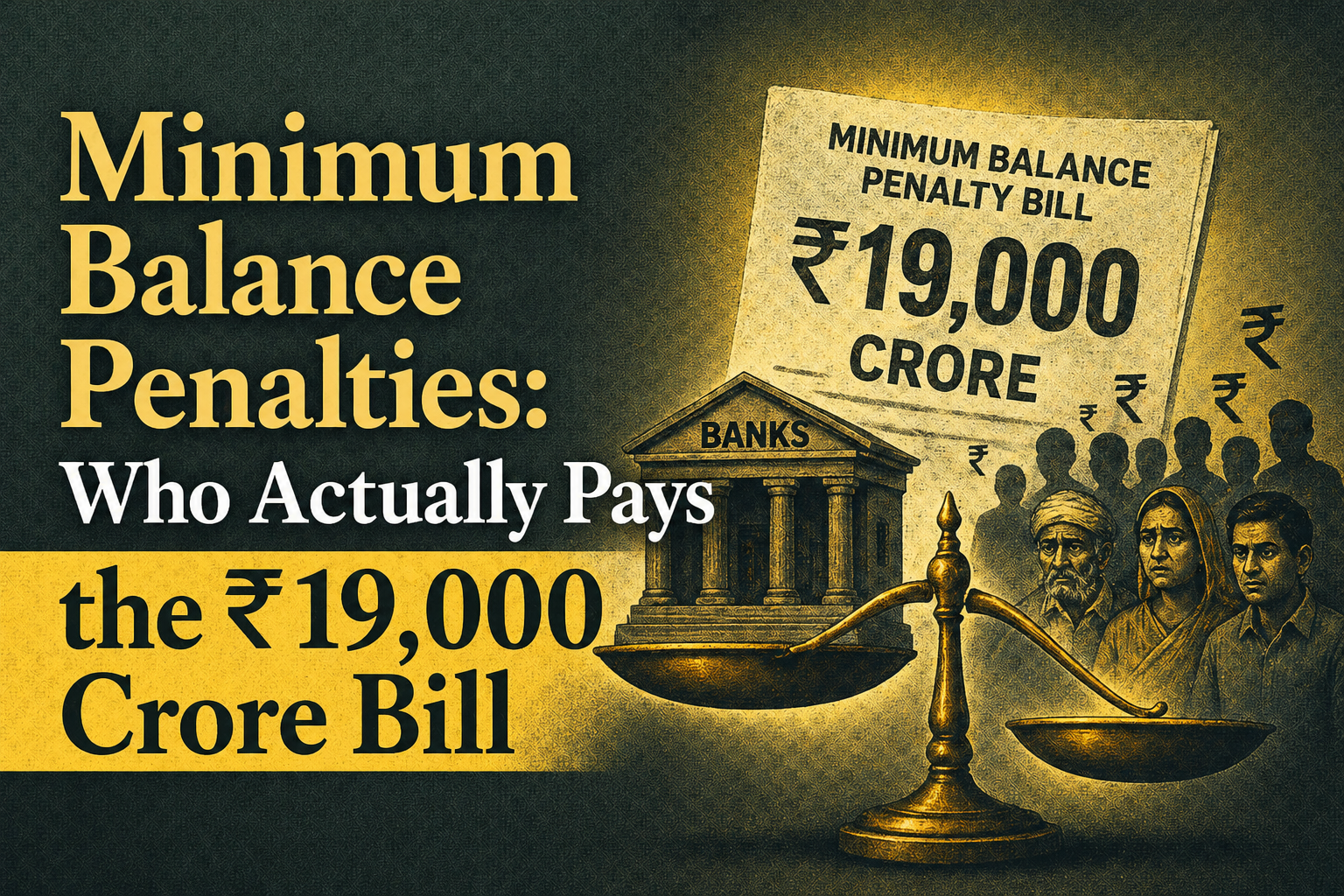
Minimum Balance Penalties: Who Actually Pays the ₹19,000 Crore Bill
Why Minimum Balance Penalties Hit Irregular Earners Hardest in India
Minimum balance penalties in India are charged to account holders when their savings account balance drops below a bank-defined threshold — typically ₹1,000 to ₹10,000 depending on the bank and account type.
Banks collected roughly ₹19,000 crore in such penalties over recent years.
The fee appears small per account, often ₹100–₹600 per year.
The damage concentrates on irregular earners — the majority of Indian workers — who cannot guarantee a stable monthly balance.
A minimum balance penalty is a fee banks charge when your savings account balance falls below a required threshold. Most people understand this. What most people don’t understand is who absorbs those fees at scale — and why the architecture of the penalty system makes that distribution nearly impossible to avoid for workers with irregular income.
This article explains how the penalty mechanism works, which income groups carry the burden, where zero-balance accounts do and don’t solve the problem, and what the honest limits of both the banking system’s defence and the reform argument actually are.
How Does the Minimum Balance Penalty Actually Work?
Every standard savings account in India carries an Average Monthly Balance (AMB) requirement. The bank doesn’t look at your balance on one day — it calculates the arithmetic mean of your end-of-day balances across the entire month.
If that average falls below the required threshold, a penalty applies. The penalty is not a flat charge for being below on one day. It’s assessed on the shortfall percentage. The larger the gap between your average balance and the required minimum, the higher the penalty — up to a stated cap.
Banks in India collected roughly ₹19,000 crore in minimum balance penalties over recent years. The typical AMB requirement ranges from ₹1,000 to ₹10,000 depending on bank, account type, and geography. The annual penalty per account, in common cases, runs ₹100–₹600 before GST.
The mechanism includes GST on top of the penalty amount. A ₹100 penalty becomes approximately ₹118 after 18% GST. This compounding detail rarely appears in account-opening disclosures in simple language.
Here is a sequence the mechanism produces in practice. A worker accumulates ₹6,000 over time. An emergency — medical, household, travel — requires a ₹2,000 withdrawal. The balance drops to ₹4,000. The AMB for that month falls below the ₹5,000 requirement. The penalty applies. The following month, if the balance stays low, it applies again. Six months of ₹100 penalties plus GST removes approximately ₹708 from the account — money the depositor never consciously spent.
“The system worked exactly as designed. That is the real point.”
The design is coherent. Banks set minimum balance requirements to maintain the operational cost structure of serving accounts. An account with near-zero activity and near-zero balance still consumes branch infrastructure, digital servicing costs, and regulatory reporting. The minimum balance requirement offsets that cost. When the balance falls short, the penalty recovers the estimated cost differential.
The mechanism is rational. The question is whether a rational mechanism applied uniformly across a non-uniform income distribution produces equitable outcomes.
Why Does the Cost Land on Irregular Earners?
India’s formal employment rate — people with stable, predictable monthly salaries — accounts for roughly 10–15% of the working population. The remaining 85–90% earn through daily wages, seasonal agricultural income, small trade, informal services, or contract work. Their income arrives irregularly, in variable amounts, with gaps.
A minimum balance requirement assumes a baseline behavioural pattern: money arrives at a predictable interval, stays in the account long enough to sustain an average, and only leaves in planned amounts. That assumption matches the income pattern of approximately one in seven Indian workers.
For the remaining six, the mechanics produce a specific trap. Income arrives in a lump. It’s used quickly — food, rent, repayment of informal debts that carry a higher interest than the penalty itself. The account balance oscillates between funded and depleted. The average monthly balance ends up below the threshold, not because the depositor is irresponsible, but because their income structure makes a stable average mathematically difficult to achieve.
I should be precise about what I can and cannot claim here. Aggregate data on who specifically pays minimum balance penalties is not publicly disclosed by Indian banks at the account-holder income-segment level. The ₹19,000 crore figure represents publicly reported or estimated totals from media and RBI references. The distribution of that cost across income groups is inferred from income data, not directly measured from bank penalty records. The inference is reasonable. It is not direct evidence.
This is not simply a financial literacy problem. A depositor who fully understands the AMB requirement still cannot easily maintain it if their income arrives in lumps and their expenses are immediate. Understanding the rule doesn’t change the income pattern the rule conflicts with.
When Does the Penalty System Stop Working as Intended?
The penalty mechanism breaks — or rather, produces outcomes that deviate from its stated purpose — in three specific conditions.
When the Penalty Exceeds the Bank’s Actual Cost of Servicing the Account
The stated rationale is cost recovery. If a bank charges ₹500 annually in penalties on an account that costs ₹200 to service, the excess is revenue extraction, not cost recovery. There is no public disclosure mechanism that allows a depositor to verify which situation applies to their account.
When the Penalty Depletes a Balance That Was Already Near the Threshold
An account with ₹5,100 — marginally above requirement — receives a penalty for falling below average if withdrawals occur mid-month. The penalty then pushes the account further below minimum, creating a compounding sequence where the penalty itself makes the following month’s compliance harder. The mechanism self-amplifies in the very accounts it most pressures.
When the Depositor Is Unaware of the Average Balance Calculation Method
Many depositors monitor their point-in-time balance, not their running average. An account that shows ₹6,000 on the 28th of the month may still have failed the AMB requirement if it was below ₹2,000 for the first twenty days. The disclosure of this calculation method varies significantly by bank and account-opening channel.
Do Zero-Balance Accounts Actually Solve This?
Zero-balance accounts — primarily Jan Dhan accounts under the Pradhan Mantri Jan Dhan Yojana — do eliminate the minimum balance penalty for account holders who qualify. Over 50 crore Jan Dhan accounts have been opened in India. The scheme is the largest financial inclusion drive in the country’s history.
But the zero-balance account solution has three structural limits that prevent it from fully resolving the penalty problem.
First: Multiple Account Reality
A large number of Indian adults hold both a Jan Dhan account and a regular savings account — often because their employer, cooperative, or chit fund requires a regular account for transactions. The Jan Dhan account sits unused or minimally used. The regular savings account accumulates penalties.
Second: Feature Restrictions
Jan Dhan accounts carry feature restrictions — limited overdraft facilities, restricted debit card usage, and lower transaction limits — that make them inadequate for depositors whose financial complexity has grown. Workers who shift into slightly higher income brackets often open regular accounts and exit the zero-balance system, re-entering penalty territory.
Third: BSBD Accounts Are Rarely Offered Proactively
Basic Savings Bank Deposit (BSBD) accounts — another zero-balance option available through regular banks — are not actively marketed by banks. The revenue incentive structure doesn’t favour offering them. A depositor must know how to ask.
| Account Type | Minimum Balance | Penalty Risk | Key Limitation |
|---|---|---|---|
| Regular Savings | ₹1,000–₹10,000 | Yes | Full features, penalty exposure for irregular earners |
| Jan Dhan (PMJDY) | None | No | Transaction limits; employers may require a regular account |
| BSBD Account | None | No | 4 withdrawals/month limit, rarely offered proactively |
| Small Savings | None | No | Annual credit cap, KYC restrictions |
The zero-balance solution works for its designed population. It doesn’t reach the population that has migrated into regular accounts without understanding the penalty exposure those accounts carry.
Where This Breaks
- The penalty mechanism assumes a stable monthly income pattern that only 10–15% of Indian workers actually have. For the remaining majority, compliance requires a behavioural change that the income structure makes genuinely difficult.
- The self-amplifying sequence — where a penalty pushes a near-threshold account further below minimum — means the most financially fragile accounts receive the most compounding pressure.
- Zero-balance accounts solve the penalty problem for eligible depositors but fail the population that holds regular accounts alongside Jan Dhan accounts, or that has graduated out of PMJDY eligibility without understanding the penalty system they re-entered.
- The revenue incentive for banks runs against active disclosure of BSBD accounts, which would eliminate penalty income for the accounts most likely to generate it.
Is the Minimum Balance Penalty Unfair — Or Just Poorly Matched?
Two defensible arguments exist here, and they don’t resolve cleanly into one answer.
The cost-recovery argument holds that no financial system can sustain accounts it cannot recover the cost of servicing. Minimum balance requirements are a reasonable pricing mechanism for a service that requires infrastructure. A depositor who chooses a regular savings account over a Jan Dhan account has access to a zero-balance option and has selected a product that carries a balance condition. The penalty is the disclosed cost of that choice.
The structural mismatch argument holds that a system designed for monthly salary earners cannot be applied neutrally to an economy where the majority of workers earn irregularly. A “choice” between a Jan Dhan account with feature restrictions and a regular account with penalty exposure is not a free choice when the depositor’s financial needs require regular account features, but their income structure makes compliance with regular account requirements structurally difficult.
Both arguments are accurate. The system is not predatory by design. It is mismatched by design — built for one income pattern, applied to another, and not corrected when the mismatch became clear at scale.
“The cost is not shared equally. The more important question is whether it was ever designed to be.”
Frequently Asked Questions
What is the minimum balance requirement in Indian savings accounts?
It varies by bank, account type, and location. Public sector banks typically require ₹500–₹2,000 for urban accounts and less for rural accounts. Private sector banks often require ₹5,000–₹10,000 for standard savings accounts. The requirement is measured as an Average Monthly Balance — the arithmetic mean of your end-of-day balances across the month — not your balance on any single day.
How does the AMB calculation actually work, and why does it catch people off guard?
Your bank adds up your closing balance for every day in the month and divides by the number of days. If you had ₹10,000 for the first 10 days, then withdrew most of it and held ₹500 for the remaining 20 days, your AMB would be roughly ₹3,700 — likely below most urban account thresholds. A point-in-time check of your balance on day 28 showing ₹500 wouldn’t reveal the problem until the penalty is already assessed.
What’s the difference between a Jan Dhan account and a BSBD account?
Both are zero-balance accounts. Jan Dhan (PMJDY) accounts are targeted at unbanked populations and come with government scheme access, including direct benefit transfers and ₹2 lakh accident insurance. BSBD accounts are offered by regular banks under RBI guidelines — no minimum balance, but limited to 4 withdrawals per month. Jan Dhan accounts are more widely available and actively promoted. BSBD accounts exist in the regular banking system but are rarely offered proactively.
Can a bank charge more than the actual cost of servicing my account?
RBI guidelines state that penalties should be reasonable and not exceed the shortfall amount. However, there is no publicly available framework that ties the penalty to the verified actual cost of servicing a specific account type. Banks set penalties within RBI’s stated parameters, but the link between penalty amount and actual cost recovery is not disclosed at an account level.
Has the RBI taken any action on minimum balance penalties?
The RBI has issued periodic guidelines requiring banks to notify customers before levying penalties and not to charge penalties on zero-balance accounts. Several public sector banks have periodically waived or reduced minimum balance requirements during economic stress periods. No comprehensive regulation eliminates the penalty for regular savings accounts, and enforcement of disclosure norms has been inconsistent across institutions.
If I already have a Jan Dhan account, why would I need a regular savings account?
Several practical reasons push depositors toward regular accounts. Employers often require a specific bank account for salary credits. Loan processing, investment accounts, and some insurance products require a regular savings account. Jan Dhan accounts also carry monthly transaction limits that can be inadequate for someone whose financial needs have grown. Holding both types simultaneously is common — and the regular account carries penalty exposure, the Jan Dhan account doesn’t.
What should someone with an irregular income actually do to avoid penalties?
Three steps matter most.
- Ask your bank explicitly about BSBD account conversion — it’s your right under RBI guidelines, though you’ll accept the 4-withdrawal monthly limit.
- If your Jan Dhan account covers your basic transaction needs, consider minimising use of the regular savings account or closing it.
- If you need a regular account, set a calendar reminder to check your month-to-date average balance in the third week of each month — not your current balance.
Conclusion
The minimum balance penalty works exactly as designed. Banks built accounts for monthly salary earners. The AMB requirement maintains cost recovery when balances are stable. When balances are unstable — because income is unstable — the penalty fires. It fires most on accounts of workers whose income structure makes compliance structurally difficult, not behaviorally irresponsible.
Zero-balance accounts exist, and they work for the population that uses them. The gap is the population that has migrated into regular accounts — for legitimate reasons — without understanding that the account they chose was designed for an income pattern they don’t have.
The ₹19,000 crore aggregate makes the structural effect visible. The system isn’t broken. It’s doing what it was designed to do. The question worth holding is whether a design built for 10–15% of the working population should apply uniformly to the other 85%.